
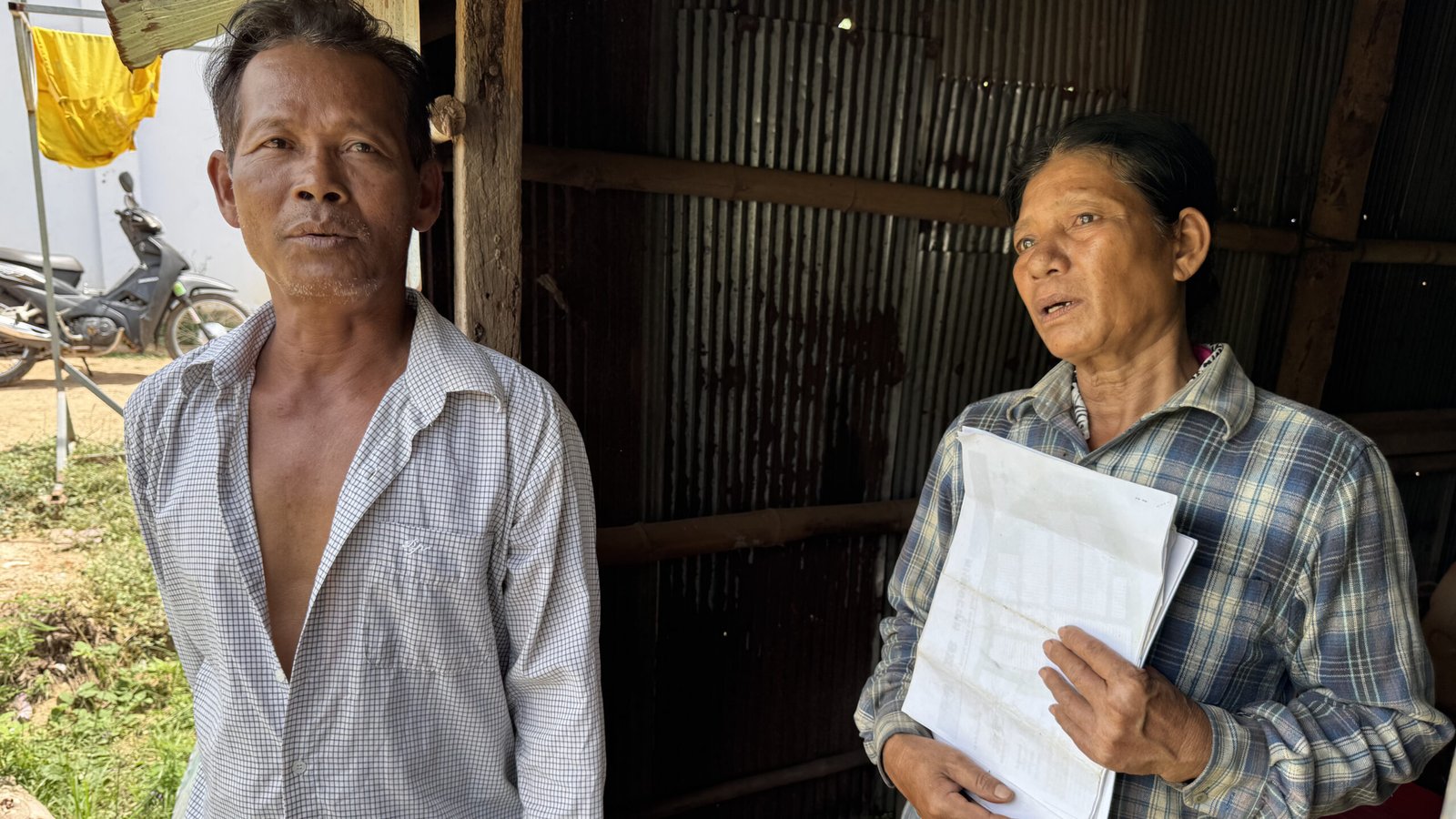
Nguon Sothy’s family is among thousands caught in a massive land fraud scheme orchestrated by Piphup Deimeas Investment, which enticed rural land buyers with promises of high returns.
To finance their investment, the 53-year-old construction worker took out microfinance loans, leaving his family saddled with overwhelming debt.
“My wife has been sick, but we don’t have money for her treatment after she worked hard for a year to repay the loan that we took,” he said.
Due to severe financial constraints, his wife has had to resort to traditional medicine to treat her worsening spondylosis — a condition aggravated by a year of manual labor alongside her husband on construction sites.
The couple now lives in a modest hut on their eldest daughter’s land. In 2024, escalating monthly loan payments forced them to liquidate all their assets: their house, land, tractor, and livestock.
The family’s story reflects a broader crisis, as victims of Piphup Deimeas have fallen into debt and desperation across Cambodia. At least two families have spoken of deaths by suicide.
The company’s owner, Hy Kimhong, was arrested in August 2023 for fraud, but released on bail in November of the same year.
On August 17, three years after his arrest, the Phnom Penh Municipal Court sentenced Hy Kimhong and two associates to 15 years in prison each for fraud. The court also ordered the tycoon to repay $33.5 million to 1,115 victimized families.
But some families remain skeptical about how soon they can receive relief. Hy Kimhong remains free on bail pending appeals, according to a representative of the families.
Promises
Piphup Deimeas Investment Co., Ltd. was registered with the Ministry of Commerce in 2018 by Hy Kimhong, a former “oknha” whose title was revoked by royal decree in April 2024. Oknha titles are given to businesspeople who donate at least $500,000 to the Cambodian state.
Between 2021 and 2023, the company aggressively promoted schemes offering 3% monthly interest on $16,000 land plots for 24 months, promising buybacks and giving the land titles as collateral to encourage victims to borrow heavily from microfinance institutions.
Nguon Sothy’s financial ordeal began in 2023 when he and his wife were targeted by local marketers representing Piphup Deimeas.
“You’re old; why keep your land title at home? Invest in it to make money. Your old age can generate income from interest rates,” Sothy recalled. A neighbor spent two years encouraging them to join, displaying a new car that Sothy later discovered was merely a company-owned vehicle provided for show.
He bought two plots of land for $40,000, anticipating a monthly 3% return ($1,200), according to a receipt dated January 13, 2023. Then his wife added $5,000 more.
Although taken to a development site, he was never shown the exact boundaries of his plots. To secure the funds, he took out a $45,600 microfinance loan, splitting it into two accounts and putting one under his eldest daughter’s name.
After making the initial investment, Nguon Sothy received $2,600 in interest over two months. Then, the payments stopped, and the company went silent.
Compensation
Taing Sinhong, a lawyer representing the plaintiffs, said there was a one-month period for either party to appeal.
If the defendants appealed, she would file a request for the court to expedite the compensation process.
“People face challenges with loans,” she said. They seek expedited legal procedures “because the court has sentenced them.”
Concerns about how long the process will take come not only from the three years the victims have already waited for progress in court, but a history of delays in compensation in other incidents of fraud.
In 2021, the Supreme Court heard that years after a lower court verdict, $900,000 in compensation had yet to be paid out to Kampong Cham families defrauded by an NGO that had promised high returns on investments.
The Cambodia Happiness Development Organization had presented a document that appeared to be signed by the National Bank governor as it enticed people to sell their land and take out loans, the court heard at the time.
A similar scam by an NGO called WBO also allegedly defrauded about 200 families of $1 million, with no compensation years later.
It is typical for politicians to get involved in negotiations for compensation, pushing victims to make public appeals and hold protests.
A prime ministerial assistant initially mediated talks over compensation for hundreds of people who lost money in politically-connected investment firm GoldFX in 2022.
In a case similar to Piphup Deimeas, about 300 people protested outside the Justice Ministry in January asking to speed up their trial over alleged fraud in the Brilliant City investment scheme. The scheme’s owner, Leng Channa, was arrested in March 2024.
There was still no result, one of the victims told Mekong Independent in late August. “It’s still quiet. I’m unsure who else I can ask for help.”
Another alleged land-fraud case, for which real estate tycoon Chea Saron was arrested in 2023, has also yet to lead to compensation, one of the plaintiffs said.
The Brilliant City case reportedly involves $200 million in funds, while Chea Saron allegedly defrauded thousands of victims of $40 million.
Sek Socheat, a researcher and commentator on social and political issues, urged the courts to implement the Piphup Deimeas verdict in a timely manner.
In the past, even when victims appeared to receive justice through a court verdict, enforcement had failed to deliver true justice to the victims, he said.
“Authorities must respect the rule of law as a core value, which makes our society equal under the law,” he said, cautioning that cases involving powerful people can lead to injustices.
Seng Han, 40, has acted as a representative of Piphup Deimeas victims.
He borrowed $80,000 from ACLEDA Bank in 2021 to invest in the scheme, and has since been forced to sell his gold jewelry and car to pay off part of the debt. He still has an outstanding balance of about $40,000.
He did not know when the compensation process would begin, as it depended on the court proceedings. If there was no further court action after a month, he would lodge a court petition. Compensation was to be based on the amount families invested in the company, he said.
Hy Kimhong remained on bail pending appeals, Seng Han said, and he urged the court to expedite the process as people were struggling, falling ill and even dying due to debt.
On August 24, a separate group of Piphup Deimeas victims protested outside the court, believing they had a better chance of receiving their money back if company officers were not jailed.
Mekong Independent could not reach the company for comment.
Pressure
Unable to service the debt on income that barely covers daily survival, Nguon Sothy has missed five months of payments. Amret’s loan officers visit three to four times a month, remaining indifferent to the family’s hardship. He was summoned by the local authority to repay a late loan, as the loan officer had filed a complaint.
“I told them to jail me,” he said. He told them he wasn’t evading repayment, but they didn’t believe him.
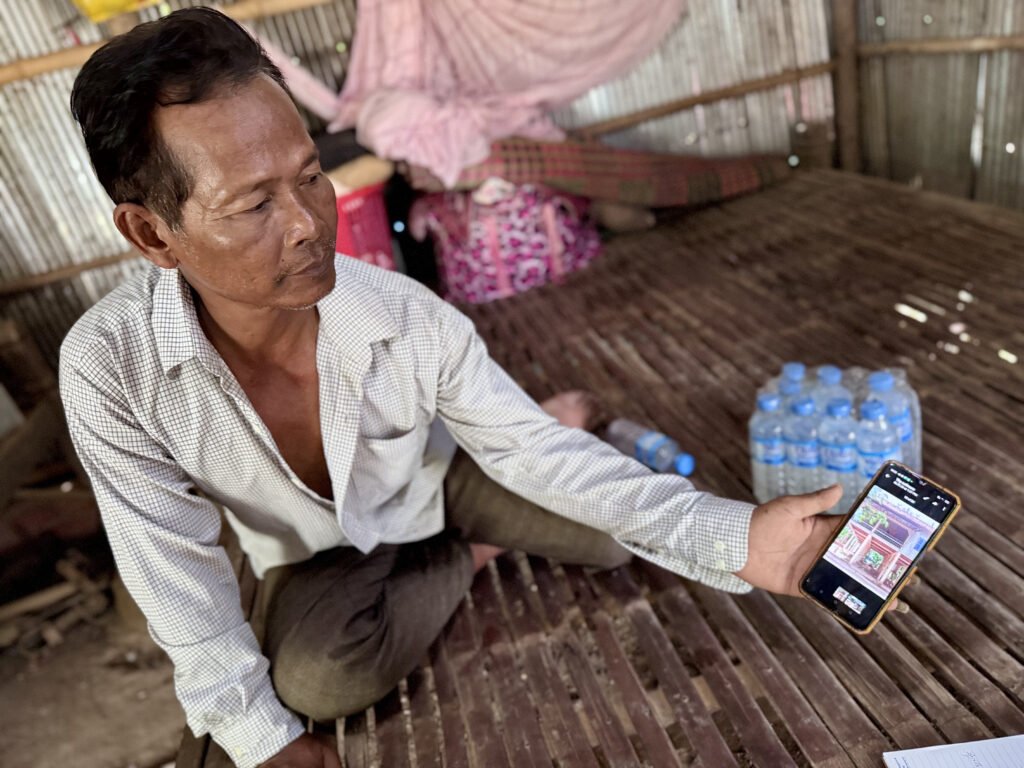
He claimed a loan officer had told him that the institution did not care about his failed real estate investment — they simply expected full repayment of the loan. He has to repay both accounts, up to about $800 per month in total, while he earns $350 a month.
“I try to repay the loan under my daughter’s name because I don’t want to cause trouble for her and her family,” he said. “Since I took the loan, I always repay them, never missing it, but lately I’m unable to repay in full; I ask them to pay only the interest rate, and then I ask them to delay.”
Victims have petitioned the National Bank for loan deferments or relief, but to no avail.
Nguon Sothy continues construction work to support his family and pay for his daughter’s university fees.
“I’m worried I won’t be able to repay the loan,” he said, noting that his current site was winding down. “The construction project ends soon, and they plan to cut workers.”
Having spent the past few years campaigning for accountability, Nguon Sothy hoped for swift enforcement of the court ruling.
“My last wish is for the court and authorities to deliver justice for my family and the other victims,” he said. “We just need our money back so we can pay off these loans to at last live a peaceful life.”
This article is published as Creative Commons.