
This article was originally published on Dialogue Earth as Creative Commons.
For the past seven months, Analiza Balliao, 39, has started the day by preparing her two children for school, then tending to the garden where she and her husband Alfredo grow chillies to sell in the provincial market. Once her morning chores are done, she walks to a makeshift camp to join a human barricade.
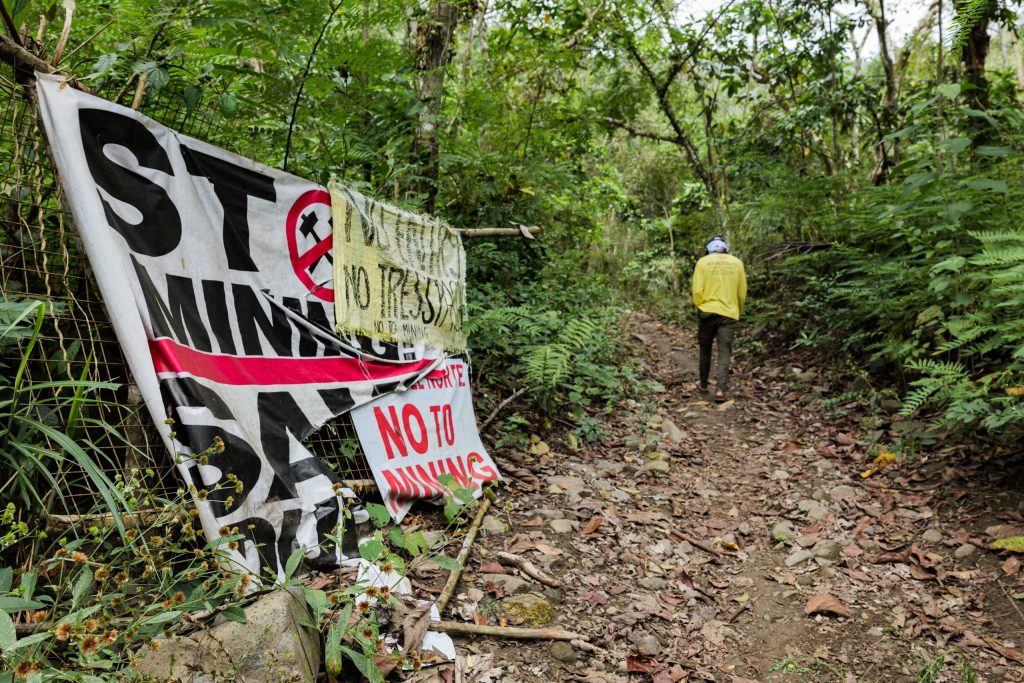
The obstacle is set up at the entrance of Bitnong village, in the mountain town of Dupax del Norte, Nueva Vizcaya, northern Philippines.


When Analiza arrives, more than a dozen residents from surrounding barangays (villages) are already there. The women wash dishes, sort out donated vegetables, set a fire on the stove. The men axe wood. Some people sip coffee. Others huddle around a laptop watching their barricade on the news. They are talking, laughing, trading jokes in the easy rhythm of people who have been spending their mornings together for months. Others keep an eye on the road, checking the IDs of every motorist they do not recognise.
The community set the barricade up as a response to a mining exploration permit they say was granted without their knowledge or consent. The permit went to Woggle Corporation, which is owned by Metals Exploration PLC, a UK-listed company. Woggle planned to expand its existing open-pit mining operation in Runruno, also in Nueva Vizcaya, by exploring more than 3,000 hectares of forest and agricultural land for gold, copper, lead and zinc in neighbouring Dupax del Norte.
A permit kept secret
The application for the permit was filed with the Philippine Mines and Geosciences Bureau in July 2022 and approved in August 2025. Residents of Dupax del Norte claim that in that time, community members in the five affected villages of Bitnong, Inaban, Munguia, Parai and Oyao didn’t even know an application was being processed.
Congressman Timothy Cayton, then Dupax del Norte mayor, said at a 23 February Senate hearing that they had made the application public by posting it on a bulletin board and in newspapers. Lawyer Ryan Roset, of the Legal Rights and Natural Resources Center, argued that this is not the same as a public consultation.
“There was no genuine consultation conducted with the different barangays or local government units,” Florentino Daynos, president of Dupax del Norte Environmental Defenders, told Dialogue Earth.
Dialogue Earth reached out to Woggle Corporation by phone and email, but did not get a response.

Analiza first noticed something was amiss when she returned from selling vegetables one morning to find red markers and wires laid across her garden, some of them going through her crops – without warning, without permission. The wires, she was later told, were used to detect mineral deposits beneath the soil.
“We just saw them there, men trespassing on our property along with their equipment,” she recalled, adding that some areas of her property were cleared for this.
Dialogue Earth contacted Metals Exploration by email regarding their permit application and the ingress of exploration equipment into Dupax del Norte. They did not respond.
On 17 September 2025, the community set up the first barricade in their village to block incoming equipment from the mining company. A more substantial barrier on the road entering the village followed the next month. Analiza and Alfredo did not hesitate to join. They continue to take turns guarding it, bringing their children along when school is out to solve the childcare issue.
The resistance has come at a cost. Their income from the garden was already precarious, rising and falling with market prices. Spending time at the barricade has made it even more so. “The important thing is you have something for each day, something for the children’s needs,” Analiza said.


For a time, the barrier was able to prevent Woggle from bringing their equipment into the area, but on 17 October 2025, they faced the first of several dispersals by the police.
In January 2026, the cost of resistance became even higher for Analiza, when she was arrested along with six others by police enforcing a local court order to dismantle the barricade and allow mining exploration equipment to enter.
The day after her arrest, her 10-year-old daughter was rushed to hospital by her father after fainting. Analiza pleaded with the police and was eventually allowed to visit, but officers did not leave her side. She sat with her child under guard, not knowing whether she would be allowed to stay.
“I couldn’t eat, I couldn’t sleep, my blood pressure shot up because of what happened to my daughter, and I couldn’t go to her immediately,” Analiza told Dialogue Earth in Filipino.
After three days in detention, Analiza was released, heading straight back to the hospital where her daughter was being treated for what turned out to be meningitis. Mother and daughter stayed together in the hospital for two weeks.

A law built for extraction
The legal framework enabling Woggle’s entry is the Philippine Mining Act of 1995, which opened the country to large-scale foreign mining investment and remains the basis for permit approvals today.
Joice Leray, advocacy officer for the Center for Environmental Concerns, a Philippine non-profit, says the law prioritises extraction over community rights and environmental protection, giving agencies like the Mines and Geosciences Bureau broad discretion to approve permits with minimal public disclosure.
She says the mining act “was made to open up, to tear through our country, for foreign mining companies”. Leray added: “In 31 years of this law, we have seen that it does not serve the people”.

The threat to Dupax del Norte is not abstract. Tin Araneta, a geologist with Agham (Advocates of Science and Technology for the People), another non-profit, said open-pit mining in a forested area strips vegetation, destabilises the terrain and can contaminate groundwater and surface water almost immediately once mineralised rock is exposed. The effects can persist for years. Stripped farmland is rarely rehabilitated in time to prevent lasting damage, she added.
“The intensity of the extraction process is too fast compared to how the environment recovers,” Araneta told Dialogue Earth.
Dupax del Norte lies within the Magat watershed – a critical water system spanning four provinces in Northern Luzon that supplies one of the Philippines’ largest hydroelectric dams and supports irrigated agriculture downstream. Residents think that mining in their town will affect the watershed, as all their waterways lead to the Magat River.
The Mines and Geosciences Bureau declined to be interviewed for this story. At the Senate hearing in February, however, Ismael Manaligod, head of the regional environmental department covering Dupax del Norte, presented the agency’s findings for approving the exploration permit.
“The entire area covered by the exploration permit has a minimal impact on the Magat River. This is because it is only 0.8% of the total area of the Magat River forest reserve,” he said. He also said that given the area’s distance to the Magat dam, it has no adverse effects on the river, and that the area covered in the permit does not directly drain into it.
“Lastly, Woggle Corporation shall include mitigating measures in its environmental work programme,” he added.


At a separate Senate hearing on 3 March, Woggle’s president, Tommy Alfonso, described the conflict as “a big misunderstanding” and said the company remained open to dialogue. He said Woggle had followed proper procedure throughout, had “undergone a strict 40-month process from 2022 to 2025”, and complied with all government requirements. As evidence of responsible operations, he pointed to FCF Minerals’ track record in the region. FCF Minerals, a Philippines-based subsidiary of the UK-listed Metals Exploration, owns a 60% stake in Woggle Corporation.
“We have contributed more than PHP 5 billion (USD 83 million) to national and local government for the last five years alone, with PHP 1.5 billion of this amount going directly to the local government,” Alfonso said at the hearing.
Leray said the mining industry’s contribution to the Philippine economy remains marginal, making up just 0.68% of the GDP and 0.58% of total employment nationally in 2024, according to Mines and Geosciences Bureau data.
“Their contribution to GDP and employment doesn’t even come close to the agricultural benefits of the land itself,” she said.
For Analiza, the economic argument is a hollow narrative.
“We feel frustrated because they keep insisting on going ahead with mining,” she said.


A victory, not yet an end
The arrests in January did not end the resistance. Instead, they sparked massive public outcry from various groups – from environmentalists to the Catholic church, even a beauty queen. Due to the growing opposition against the project, the Mines and Geosciences Bureau suspended Woggle’s permit, as senators called for an inquiry into its issuance.
At the 3 March hearing, the Senate ordered the local government to facilitate Woggle’s pullout from Dupax del Norte.
The suspension of the Dupax project has had a knock-on effect on other mining operations. On 18 February, FCF Minerals announced that by the end of 2026, they will cease operations at their existing gold mining project in nearby Runruno. The project would need new ore coming in from Dupax to remain feasible, it explained.


Daynos said: “This success in Dupax del Norte is a success against mining all over the Philippines.” He called it “a victory for all of us”, but added that the community ultimately needs the permanent cancellation of Woggle’s permit.
Metals Exploration chief executive Darren Bowden said they were putting the Dupax del Norte project on hold “for a little while”, but did not announce a permanent stop to mining operations. “Dupax at this stage is not a mining-friendly environment, not somewhere where we can move quickly,” Bowden said in a 6 February video published on their website.
“If things turn around in the future, sure, I think there’s still something there, I think there’s still something that could be great,” he said.
Without concrete confirmation that Woggle will not return, Bitnong’s barricade will continue to stand, and Analiza will continue to guard it.
Chantal Eco is a Filipina visual storyteller producing investigative reports and films on environment, human rights and climate justice. Her other works can be found at Deutsche Welle, LiCAS News and Bulatlat. She is chairperson of the Filipino Freelance Journalists’ Guild.