
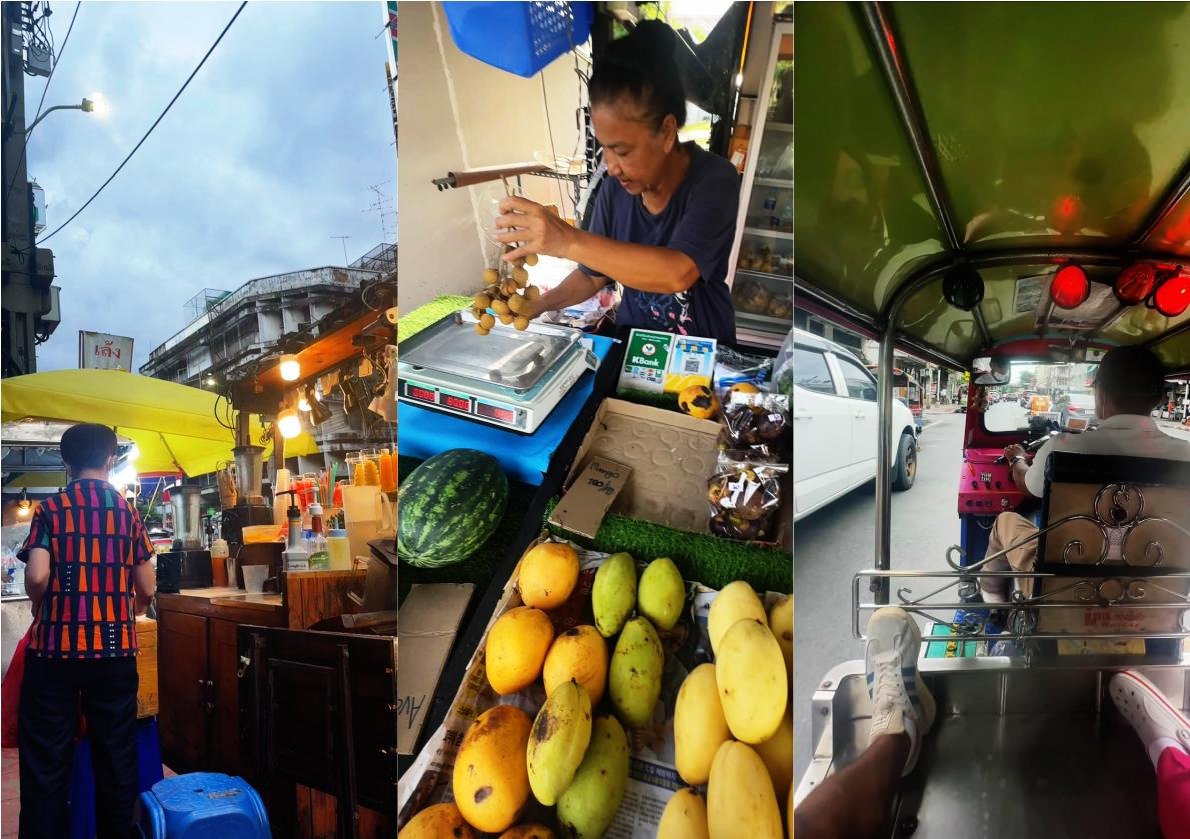
Phuket, Thailand — The only thing about money in Phuket that bothered me was the ATM. Every withdrawal cost me a 250 baht fee, or about $7.50. My currency is strong, and most things on the island feel cheap to me, so that fee had become my one real complaint. I said as much to Kittisak Boonmee, a tour guide who goes by Kit, just after he’d finished telling me how hard the island has become to afford.
He laughed.
“For you, 250 baht is a fee,” he said. “For many people here, that’s more than half a day of work.”
He’s right. Phuket’s legal minimum wage has been 400 baht a day, or about $12, since January 2025, and it is still 400 this year. My withdrawal fee is worth more than half a shift at the legal floor, and I haven’t bought anything yet.
My wife and I are spending several weeks on the island. I wanted to find out how much of the money visitors like us spend here reaches the people who serve us. Kit’s laugh was the first answer.
Our visit came as questions are being asked about tourism: a national debate around foreign visitors’ respect for local society as the government floats fees and restrictions. The industry is meanwhile seeing an unsteady mix of stagnant arrival numbers, persistent labor shortages and rising living costs.
Two jobs, one island
Kit is 34, born and raised in Phuket, in a family that has been here a long time. In the mornings he guides tours. In the afternoons he works as crew on the island hopping boats.
“One job is not enough anymore,” he told me.
I asked whether that held even for someone born here. “Yes,” he said. “Phuket is one of the most expensive places in Thailand now. Everything goes up so much. Not only me. Everybody I know is struggling.”
I’d caught a small version of this from the visitor’s side. When we arrived from Bangkok on the overnight bus, food and transport felt more expensive here than in the capital, at least in the places we used. For us, that was a line in a travel budget. For Kit, it’s the price of staying where he grew up.
I’d also done some bargaining of my own in those first days. On a very windy day, with nobody else on the beach, I talked an umbrella and two beach beds down from 400 baht to 100, or about $3, for the two of us, using the wind and the empty sand as my argument. Measured Kit’s way, the 300 baht I saved was three quarters of a day’s minimum wage.
I asked him about something ordinary: phones. “iPhone here is like driving a Mercedes-Benz,” he said. Most people can’t pay cash, so they buy in installments over many months. Drop to a midrange Samsung or a Huawei and the price falls a long way; an Oppo is cheaper again. An intern, by his reckoning, can buy an Oppo outright with one month’s salary.
Then we got onto cafés. Tourists from London had told him that some popular cafés in Bangkok charge close to London prices, though Thailand’s minimum wage, as he put it, is “maybe 10 times lower.” He’d seen those prices himself. When his family visited his sister in Bangkok, they went to an upscale café, and coffee with some dessert came to between 1,500 and 2,000 baht, around $45-$60.
“That’s three, four days of minimum wage for a Thai worker,” he said. “For one afternoon.”
At 400 baht a day it’s nearer four or five. One café says little about a whole city, let alone an island. It does show the gap Kit was describing.
Same industry, very different pay
The best breakfast my wife and I have found on the island came from a café near Karon Beach. A big English breakfast, a croissant with salad, eggs and chicken, mango sticky rice, a watermelon juice and a mango juice: 900 baht for the two of us, roughly US$27, and the quality was extraordinary.
Rif works the front desk at a four star hotel on the island. He told me he earns 10,000 baht a month, about $300. Our breakfast came to nearly a tenth of that.
When I followed up with him on WhatsApp, he filled in the hours behind the number. His shifts run nine to 10 hours. In high season he gets four days off a month; in the quieter months, about one a week.
Then there is his girlfriend. She works at a large hotel and, according to Rif, receives 15,000 to 35,000 baht a month in service charges alone, about $450-$1,050 on top of her regular salary. At the low end, that is one and a half times his monthly pay. At the high end, three and a half.
The money comes with its own conditions, as Rif described them. She works five days a week, nine hours a day including a break, with two days off that rotate. Getting time off around Songkran, New Year or a busy high season weekend is close to impossible. If she works a public holiday, she is usually credited with a day off to bank and take later, in the low season.
Put side by side, on Rif’s account, he works about six days a week for his 10,000 baht. She works five, and her service charge alone can come to more than three times his pay.
Many hotels and restaurants in Thailand add a 10% service charge to the bill, and how much of it reaches staff depends on the employer. When BK Magazine asked around Bangkok restaurants in 2015, the answers ran from nothing at one dessert café chain to the full 10% at a couple of independent places. Most of the waiters and owners it spoke to put the staff share at about four of the 10 points. That was restaurants in another city a decade ago, not Phuket’s hotels today. It still shows how wide the spread can be.
The workers Phuket still needs
Rif’s experience is particularly striking given Phuket’s continuing demand for workers. A 2024 study by Srinakharinwirot University identified two problems facing the island’s hotels: finding enough employees and recruiting people with the skills employers needed.
The demand was still visible in August 2026, when a Phuket hotel job fair advertised more than 2,500 positions ahead of high season. Yet visitor numbers are not rising in lockstep with the industry. According to Tourism Authority of Thailand figures reported on October 21, Phuket generated almost 400 billion baht in tourism revenue in the first nine months of 2026, even as arrivals fell slightly from a year earlier.
Research also complicates the idea that tourism work is uniformly exploitative. A 2021 study based on interviews with 150 tourism workers in Bangkok and northern Thailand found generally high job satisfaction, with higher levels reported among employees of foreign-owned businesses.
But a June 2026 study of migrant hotel workers in Phuket identified a different set of pressures. Workers from Myanmar, Laos and Cambodia described long hours, limited opportunities to move up and difficulties navigating employment regulations. The research also identified lower labor costs as one reason hotels recruited migrant workers.
Some tourism leaders see the divides, too. At the Phuket Tourism Forum in September, Rangsiman Kingkaew, president of the Phuket Tourism Industry Council and vice president of the Phuket Tourist Association, described the industry’s post-pandemic recovery as “K-shaped.” Well-funded four- and five-star hotels had recovered strongly, he said, while smaller two- and three-star operators faced greater difficulties. He also pointed to rising land and rental costs that were pushing some long-time residents out of parts of Phuket Old Town, as reported by The Phuket News.
Rangsiman was talking about businesses and housing, not individual pay. His remarks do not explain Rif’s salary, or tell me why his girlfriend receives so much more in service charges. Nor do the studies show how representative their experiences are. But the stories and the wider reporting point to a similar contradiction: Tourism can create work and considerable wealth without spreading its rewards evenly.
Good and bad at the same time
Nurding drives for Bolt, the ride hailing app. His English is limited, so our first conversation went through a translation app. He was very friendly, and he told me he likes Phuket.
Most of his passengers are tourists, and many of his friends work in hotels and restaurants. When I asked about his relationship with tourists, he laughed. Good and bad, the translation said, at the same time.
The good part is simple: tourists are his customers. The bad part came out as a list. Drunk tourists who fight. Tourists who cause accidents. Homeless foreigners he’d seen on the TV news, who came to Thailand thinking it would be cheap. In his view, the country attracts a lot of what his app rendered as “low value” tourists, people who want to live here for free and then get a surprise.
The money came up later, when we picked the conversation back up on WhatsApp. Nurding doesn’t own the car he drives. It belongs to a company and is registered as a public transport vehicle. As he described the deal, he gets 18,000 baht a month ($540) plus 40% of his fares, counted after fuel and the app’s fee come off.
He also passed on the figures drivers tend to quote. Full time drivers, he said, can take 3,000 to 5,000 baht a day in high season ($90-$150), roughly November to April. In the rainy months, May to October, that drops to around 1,500 to 2,500 ($45-$75), with longer waits between bookings and more reliance on long runs to and from the airport. Those are takings for drivers in general, before costs. They are not Nurding’s pay.
The takings look incredible, he said, until you count what comes out of them: fuel, which he says costs more on the island than on the mainland; tires worn down on Phuket’s steep hill roads; and the commission Bolt deducts from fares.
He told me to watch out for the checkpoints, too. Drivers who carry passengers in cars that aren’t registered for public transport, he said, risk a fine of about 2,000 baht ($60) on the spot if they’re caught in sweeps around the airport or the hotels. His car is registered, so this was a warning about the trade rather than a story about himself. The figure fits the maximum fine the government announced in February for anyone still carrying passengers in a private car, and the Transport Ministry promised tougher enforcement from October 1.
Back in our first conversation, he’d told me he was glad Thailand had tightened its visa rules. He hopes they will bring better quality tourists.
The rules had changed on September 15. A 60-day visa exemption previously covering 93 countries and territories was replaced by new arrangements, including a 30-day tourist exemption for 60 countries and territories. The government cited security, tourism and economic interests, and diplomatic reciprocity in explaining the shift.
Another debate concerns a proposed 450-baht fee for foreign tourists. The government says the money would help pay for visitor insurance and tourism development. The Thai Hotels Association has questioned the health care figures used to justify the insurance component, while tourism businesses have also sought greater transparency over how the revenue would be spent. As of October, the charge was still a proposal, not a fee being collected.
Neither that proposal nor the new visa arrangements is known to prevent the kind of disruptive behaviour Nurding described. And he did not identify which rule change he had in mind.
The phrase “quality tourists” has a meaning beyond the driver’s seat. At the same September forum, Rangsiman argued that visitors should be judged not only by how much they spend, but also by how long they stay and whether they respect local society and the environment. Nurding had no such formula. His concern was the trouble some visitors cause. Still, he and the industry leader put respect at the center of what makes tourism worth having.
But the debate raises a wider question for an island whose economy depends so heavily on visitors: How should tourism be managed, and who should benefit from the money it brings?
He was clear that he’s happy with tourists. Come here to have fun and show respect, he said, and that’s good. Make trouble, and you’re not welcome.
He needs the tourists. He also has terms.
Same country, same city
Three conversations are not a survey. Kit, Rif and Nurding can’t speak for everyone who works in Phuket’s tourist trade, and they didn’t speak with one voice to me either.
Kit has two jobs and says one isn’t enough anymore. Rif’s pay and his girlfriend’s come out of the same industry and land a long way apart. Nurding depends on visitors, says he’s happy with them, and keeps a list of the ones he could do without.
Near the end of our conversation, Kit put it more plainly than I can. “Thailand has incredible range between poor and rich,” he said. “Same country, same city. Some people pay 2,000 baht for coffee, some people work two jobs just to survive.”
When I thanked him for being so open, he said, “No problem, krub.”
This article is published as Creative Commons.