
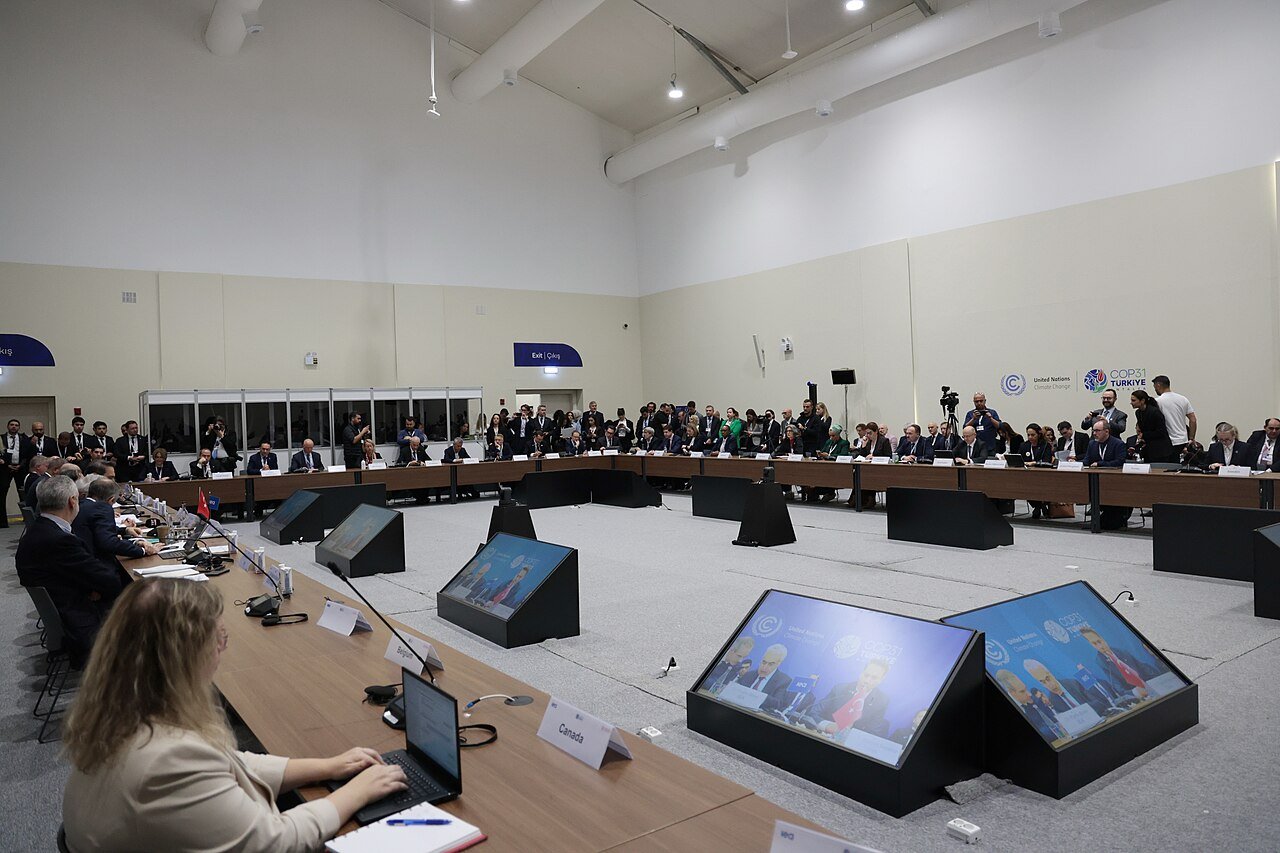
Phnom Penh, Cambodia — Cambodian delegates at COP31 have made it clear that the country remains committed to implementing its national climate plan, but they are calling on world leaders to turn adaptation pledges into concrete, accessible finance for communities living with drought, floods, declining fish catches and coastal risks.
Cambodia’s message comes as COP31 negotiations in Antalya focus on whether climate finance will reach developing countries. For a country where agriculture, fisheries, and coastal livelihoods are highly exposed to climate shocks, the outcome could determine whether national plans become real protection for farmers, fishers and coastal households.
A commitment that needs clear actions
Cambodia’s Third Nationally Determined Contribution (NDC 3.0) was submitted to the UNFCCC in 2025. It raises the country’s climate ambition, including a target to reduce greenhouse gas emissions by 55% by 2035 while strengthening adaptation and implementation planning.
While at COP31, Environment Minister Eang Sophalleth attended a discussion on expanding and modernizing the electricity grid to support clean energy goals, but officials say they require additional climate finance resources to do so.
Sum Thy, director general of the General Directorate of Policy and Strategy at the Ministry of Environment told Mekong Independent via Telegram that the country’s commitment is clear. What is missing, he added, is predictable adaptation funding that can reach the communities and sectors most exposed to climate impacts.
“COP31 must reaffirm that the 1.5°C temperature limit remains the benchmark for global climate action,” he said. “The New Collective Quantified Goal (NCQG) on climate finance must move quickly from commitment to practical implementation.”
The New Collective Quantified Goal (NCQG) on climate finance, adopted at COP29 in Azerbaijan in 2024, triples the previous annual global climate finance contribution goal to $300 billion, which will be primarily funded by developed countries to aid climate change vulnerable nations.
Sum Thy stressed that climate finance must be predictable, easily accessible, and responsive to national priorities.
“Climate adaptation remains an urgent national priority for Cambodia,” he wrote. “COP31 must move beyond defining indicators and deliver practical, on-the-ground implementation.”
Cambodia says it needs an estimated $32.2 billion to fulfill its climate commitments, highlighting the scale of investment required to reduce emissions, strengthen resilience and support the transition towards a more climate-resilient economy.
Adaptation finance at COP31
COP31 has placed adaptation finance at the center of its agenda. Developing countries are pressing for faster and more direct access to climate finance, particularly for adaptation, resilience and loss and damage. A most recent example of loss and damage needs include Nepal’s glacier disaster that has claimed 1,500 lives and left another 5,600 still missing.
The pressure follows COP30 in Belém, where governments called for efforts to at least triple adaptation finance for developing countries by 2035. The commitment was seen as an important political signal, but it left some major questions unresolved.
Officials say Cambodia needs finance that can support local adaptation projects, strengthen early-warning systems, restore ecosystems and help farmers and fishers diversify their incomes.
COP31 President Murat Kurum made it clear that COP31 must bring action, not promises.
“This is Antalya’s call: let dialogue grow as divisions deepen. Restore trust where it is under strain. Put resources to work as needs grow. Close the gap between our promises and people’s lives,” he said.
The advocacy group Coalition for High Ambition Multilevel Partnerships for Climate Action (CHAMP) called for stronger collaboration across all levels of government to turn climate ambition into delivery. The statement points to predictable access to climate finance and ensuring that Nationally Determined Contributions (NDCs), National Adaptation Plans (NAPs), and any sectoral targets and delivery plans agreed at COP31.
“The next phase of climate action is not about setting goals alone, but about delivering them,” said Ulf Jaeckel, CHAMP Co-chair and Head of the International Adaptation to Climate Change Division.
Globally, developing countries are estimated to need around $310 billion a year for adaptation by 2035, while international public adaptation finance reached only one-tenth of this level in 2024, according to a report from the UN Environment Program.
Cambodia’s National Adaptation Plan already identifies the need for systematic financial support and resource mobilization. It also calls for stronger data systems, vulnerability assessments, capacity development, and better links between national and local planning.
Agriculture under El Niño shifts
Cambodia has faced two major weather events in 2026, both linked to the Pacific Ocean weather phenomenon El Niño: a drought that intensified in July and severe flooding in September. The back-to-back disasters damaged crops, homes and infrastructure, leaving thousands of farming families struggling.
In July, the drought affected nearly 290,000 hectares of rice fields across eight provinces, according to the National Committee for Disaster Management (NCDM).
In September, heavy rainfall caused flooding in 10 provinces, affecting nearly 60,000 families and forcing the evacuation of about 5,000 families to safe areas. Some 150,000 hectares of rice fields were flooded at the time, accounting for around 5% of three million hectares of wet-season rice in the country.
But the weather effects could intensify. An unprecedented, record-shattering “Super El Niño” is active in the Pacific Ocean and could persist through February 2027, with a peak expected in late 2026.
In Cambodia, climate change is not an abstract future threat. It affects rice harvests, water availability, fish migration, coastal erosion, and the ability of families to earn a living.
The need is especially urgent in agriculture. The El Niño event brought drier conditions and drought to parts of Cambodia and the world, putting pressure on crops, livestock, and fisheries.
During a briefing organized by World Vision International, climate adaptation adviser Aaron Simon Tanner said COP31 would integrate food security, water security, and sustainable livelihood strategies to the climate action agenda.
“Climate action alone will not. We are aiming for this win-win solution of integrating food security, water security, and also livelihood, sustainable livelihood strategies, and we should integrate children’s perspectives. The implementation plan is still missing,” he said.
“At the moment, the finance mobilized is far too small. The amount pledged has been greater than the amount realized. The amount realized is relatively pitiful compared to the amount really needed.”
Fisheries and coastal livelihoods
Cambodia’s fisheries sector is equally exposed. The country’s NDC and National Adaptation Plan identify fisheries as a priority sector, with actions to promote climate-resilient fisheries, support climate-adaptive aquaculture, and strengthen the resilience of fishing communities.
El Niño and climate variability can worsen existing pressures on fisheries. Reduced river flows, changing water levels, heat extremes, habitat loss, and overfishing can combine to reduce catches and undermine food security.
In coastal areas, the risks are different but equally serious. Rising sea levels, coastal flooding, erosion, and saltwater intrusion threaten homes, farmland, fishing grounds, and marine habitats.
Cambodia’s adaptation framework includes building and maintaining sea dikes, promoting climate-resilient farming in coastal areas, and developing climate-adaptive aquaculture.
Bram De Boselier, a Belgium delegate at COP31, stated during the opening session of COP31 that developing countries need accessible, predictable, and fit-for-purpose finance, calling for a comprehensive approach that combined public grants, concessional finance, private finance, and blended finance tailored to national ocean priorities.
“That is why urgent action must be taken. The dialog underscored that finance remains both a key enabler and a major constraint to ocean-based climate action,” he said. “The challenge is not only the scale of finance, but also access to it.”
For coastal communities, mangroves and seagrass are part of the solution. Mangroves buffer waves and store carbon, while seagrass beds stabilize sediment, improve water quality, and provide habitat for fish. Protecting and restoring these ecosystems can support both climate mitigation and adaptation.
“Today, we gather around a shared priority: turning national adaptation plans into concrete action that protects people, strengthens communities, and builds resilient economies,” said Orhan Solak, Turkish deputy director of climate change during a high-level meeting. “It must become an integral part of development and investment decisions.”
This article was supported by Informed Earth.