
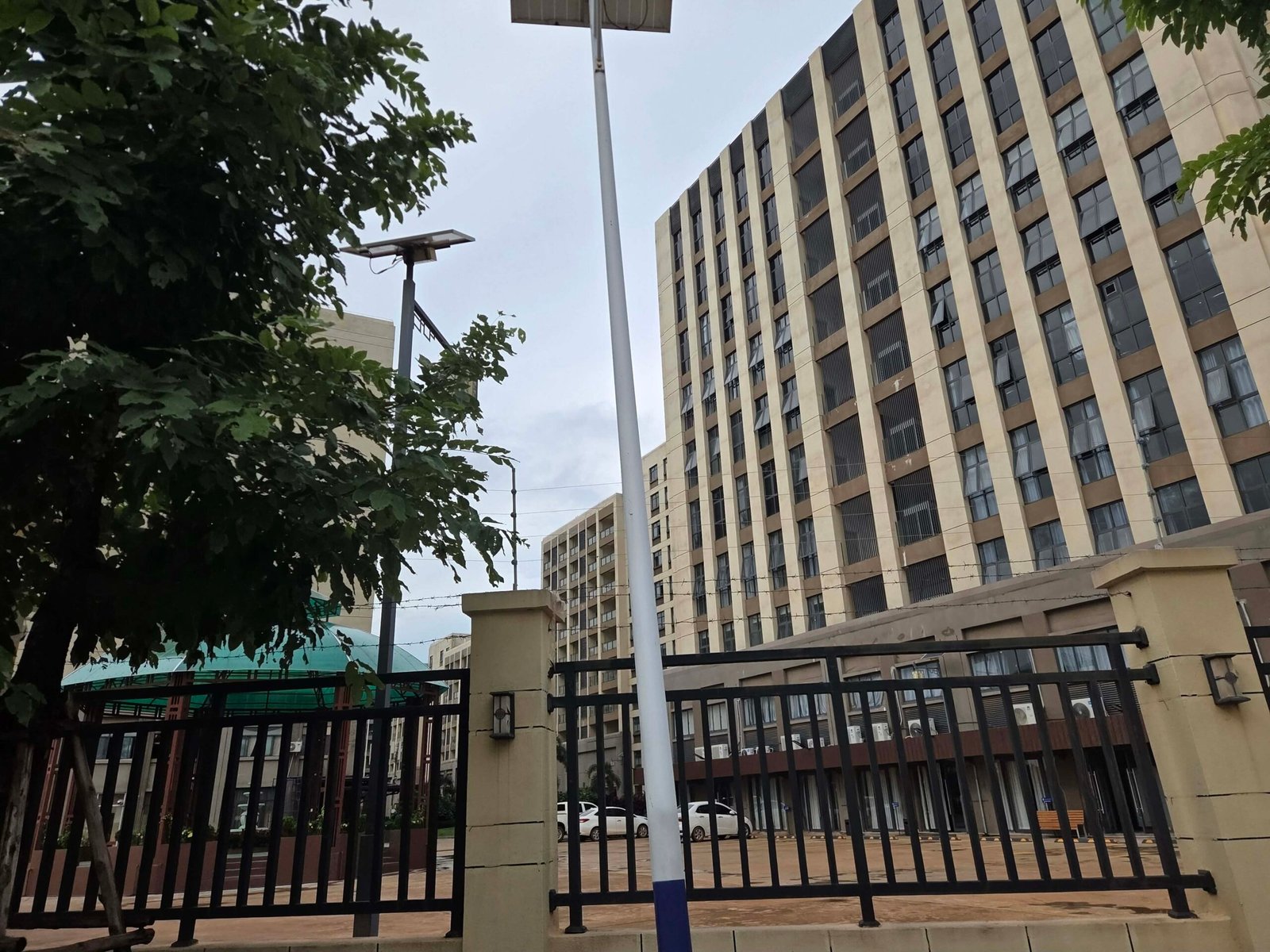
Vientiane — Between the rice fields of the northern outskirts of Laos’s capital, a narrow concrete side road leads away from the hum of traffic on Kaysone Phomvihane Avenue into a quiet but looming six-building complex, where a security guard sits at the front gate. Alienated by its surroundings of low-rise households, the 10-story buildings stand imposingly in the area, but they show no obvious signs of life inside.
When a reporter approached the gate on a motorbike, a group of men sitting opposite of the buildings saw and said “No. No. No.” One man crossed his arms to X gesture, in a warning against continuing further up the road. The reporter turned around and left.
The cybercrime industry has been known to take root in large special economic zones and border areas, but a surge of government arrests and a reporter’s conversations with residents show evidence that scam operations have nested amid everyday life in Laos’s capital city of Vientiane.
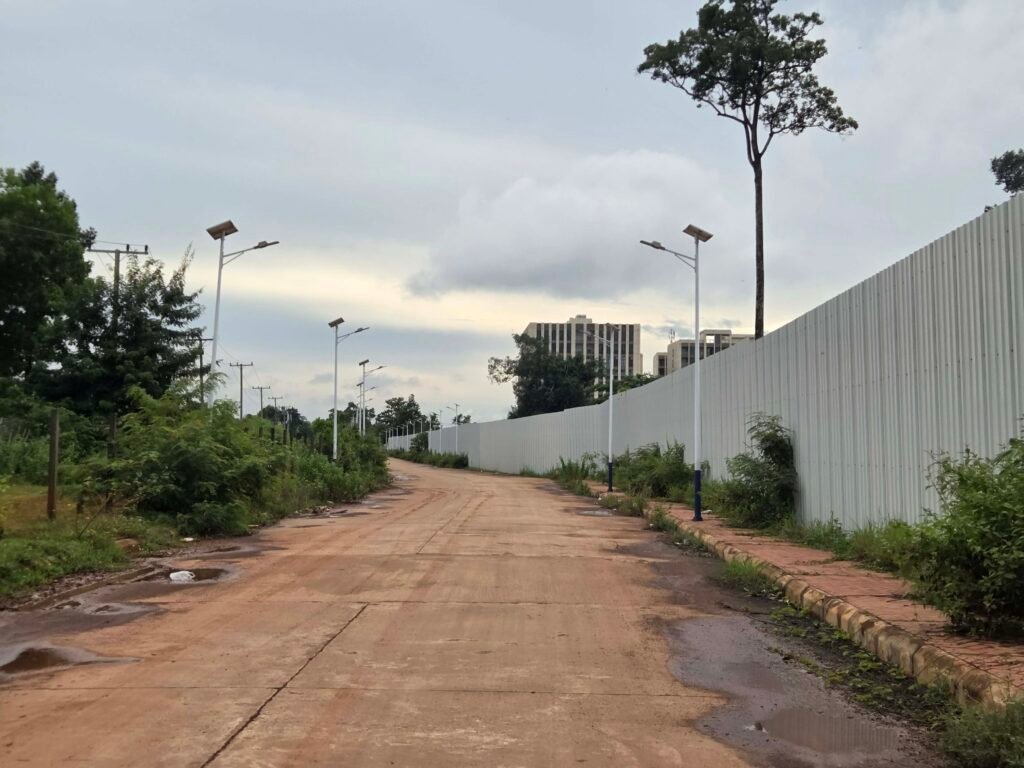
The cluster of buildings sit in an area that is largely sparse but on the verge of development, filled with corrugated metal fences reserving land or preparing it for new construction projects. The park, which has no clear names in Lao or other languages, sits near the western edge of an ambitious tourism park called the Lanxang Culture Village, an $80 million public-private investment that promised at its 2019 groundbreaking to create a botanic garden, zoo, play zone, hotels and residential properties. On the opposite side of the main road is the Laos National Stadium.
A fruit vendor near the compound said he had sold produce for a long time, but never ventured inside the gated area. But online this location has generated attention.
From late last year, at least one Laos influencer has posted photos of this park, naming it as a scam center. Radio Free Asia’s Lao Service said in a recent video they spoke to villagers near the stadium at “Kilometer 16” of the national road, who said they were aware of scammers trying to occupy the area.
Laos became known as a hub for cybercrime, scam compounds and human trafficking networks due to its Golden Triangle Special Economic Zone (GTSEZ), a 3,000-hectare entertainment and commercial hub in Bokeo province, owned by Hong Kong-registered Kings Romans Group and the Laos government. The zone is led by Zhao Wei, a Chinese businessman who was sanctioned in 2018 by the US Department of Treasury’s Office of Foreign Assets Control (OFAC) for the involvement in “drug trafficking, human trafficking, money laundering, bribery and wildlife trafficking” through Kings Romans Casino.
The country has suffered not only significant economic and financial losses but also profound social consequences as many civilians, particularly from remote and Indigenous communities, have been trafficked into scam operations, according to reports from RFA. Their destination was often GTSEZ.
As domestic fears and international pressure grew, the Laos government has taken action. In August 2024, RFA reported that the governor of Bokeo province, the Ministry of Public Security, and Zhao Wei collectively ordered all scam centers to shut down before the end of that month. In the wake of increased scrutiny in the GTSEZ, cybercrime operations reportedly moved to other parts of Laos, including Vientiane.
New cybercrime landscape
Laos has joined Cambodia and Myanmar as a known center of the cyberscam economy, and just like in those countries, fraud operations appear to shift both their methodology and locations as watchdogs and authorities take notice of the business.
As pressure surges and subsides on the GTSEZ, researchers note that scam operations appear to be moving, in part or in full, according to the Mekong Risk Monitor report by The Global Initiative Against Transnational Organized Crime (GI-TOC).
“When people think of scam centers in Laos, they immediately picture the massive compounds within the Golden Triangle Special Economic Zone. However, the landscape has changed significantly in recent months,” said Phetmany Khemmana, Laos Field Coordinator for GI-TOC in a video analysis.
Phetmany Khemmana said that most scam operations in Laos operate in a similar model regardless of their location: Locals and foreign nationals in these businesses chat and defraud people that share similar language or cultural background and eventually lead them into giving money to a deceptive account, posing perhaps as a lover, an investor with an opportunity or a government authority.
But he noted that businesses themselves take different shapes, manifesting either as hidden companies occupying empty space, or even registering as legal businesses like technology companies, digital marketing agencies or online gaming platforms. Phetmany Khemmana did not name any registered companies that allegedly operate scams, so Mekong Independent could not verify this claim.
Phetmany Khemmana said in that video that Laos’s Special Economic Zones are sometimes preferred as locations for scam operations because of their “relatively high degree of administrative autonomy” that make crackdowns harder. But he added that he believes Laos also emerged as a hub because it’s landlocked, with five countries on each side, making it a convenient place for criminal networks to move their entire operations, including equipment and people.
Endless crackdown
Laos authorities have joined regional peers in ramping up crackdowns on cybercrime within the last year, both announcing major campaigns and raiding different buildings throughout the country.
Prime Minister Sonexay Siphandone in April ordered relevant government agencies to strengthen the fight against online scam networks, citing a surge in cyber fraud cases that threaten public finance, social stability and confidence in Laos’s digital economy. He called this enforcement one of the country’s top priorities, leading to increased raids nationwide.
The Laotian Times reported that Laos authorities have arrested 4,482 people linked to cybercrime, online scams and illegal gambling operations between January and June 2026, according to the premier’s speech to the National Assembly on July 6. The suspects included individuals from 25 countries as well as 799 Laos nationals, with raids held in several provinces including Vientiane and Savannakhet.
Within about three weeks in June, Laos authorities arrested nearly 900 people linked to the scam businesses according to The Laotian Times. The raids and crackdowns were conducted almost every day from northern to southern Laos including Vientiane city, Vientiane province, Savannakhet, Khammounce and Champasak. Singular raids led to arrests of dozens, with up to 142 people arrested at one site on June 11, according to The Laotian Times. Among those arrested at the June raids were Chinese, Singaporean, Filipino, Malaysian, Indonesian, Japanese, Taiwanese, Burmese, Ethiopian and Ukrainian nationals.
Most Chinese nationals arrested in June were deported to China at the Boten International Border Checkpoint in Luang Namtha Province, and warned they would face prosecution for running telecommunications and online scam operations in Laos.
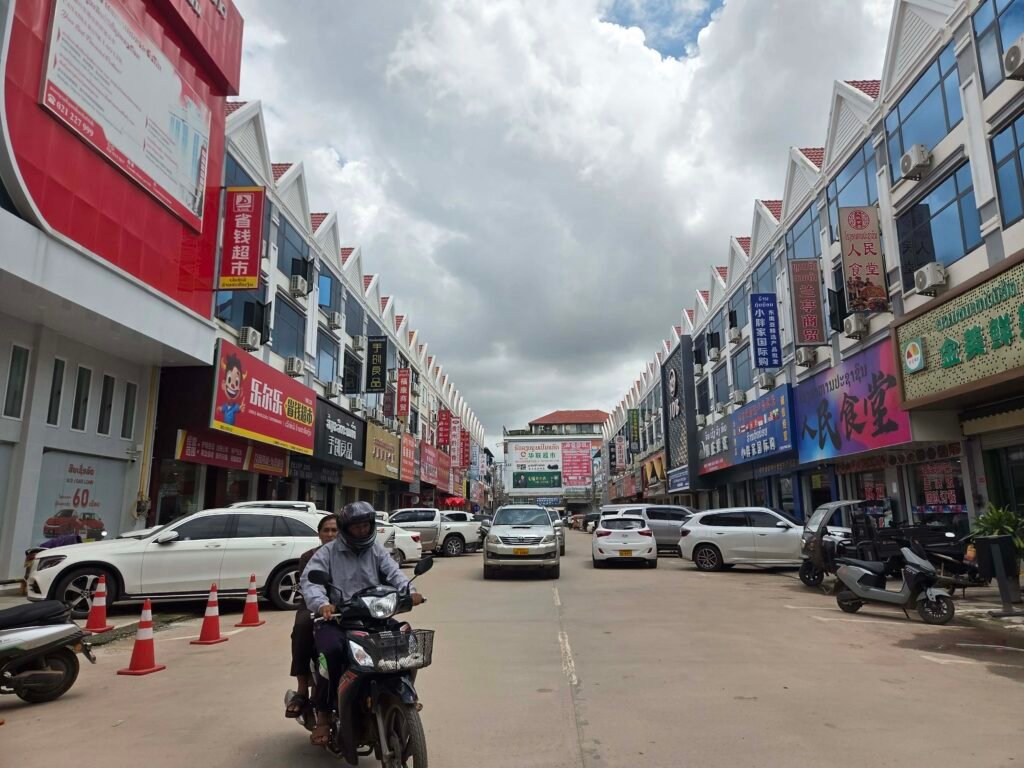
The crackdown continued into early July, when Vientiane police raided a hotel in Xang Jieng market, also known as the city’s Chinatown, in the capital’s Sikhottabong district, arresting 28 Chinese nationals. Later on July 6, in Sangthong district, authorities arrested 26 Chinese nationals over alleged involvement in a South Korean stock investment scam.
Authorities then found 35 Laos citizens and 80 foreign nationals, mostly Ugandans and Kenyans, in a wood-processing factory in Champasak province on July 8, arresting them for an alleged scam operation.
On July 11, The Laotian Times reported that Vientiane police raided seven rented houses in Sisattanak district to arrest 122 people including Chinese, Malaysian, Brazilian, Myanmar, Uruguay and Pakistani nationals. The properties located in Buengkhayong village reportedly belonged to CAMCE Investment (Laos), a company operated by Laos-based Krittaphong Group and China CAMC Engineering (CAMCE), a Beijing-based infrastructure development company. The company didn’t respond to an emailed request for comment.
Later on July 18, Laos police carried out another crackdown operation on scam networks at the ST Vegas Hotel and Casino in Vientiane’s Hatxayfong district in Vientiane, arresting a total 589 people consisting of 373 Thai nationals, 199 Laos nationals, 15 Vietnamese and two Cambodians in alleged online fraud and illegal gambling.
By the end of July, the Ministry of Public Security issued a notice calling all public and private sectors to be more alert against cybercrime gangs, online gambling operations and scammers. It urged citizens to report any information or suspicious activities related to such groups to the authorities.
The notice warned that owners and managers of private property must cooperate with authorities to investigate cybercrime. The directive also mentioned that property holders would be held liable when they were found to knowingly host scam and online gambling operations on their property. The language of the Laos’ July notice echoes a policy that Cambodia adopted during a heightened crackdown on scam operations this year, which has stopped civilians and agencies from providing assistance to workers who say they were trafficked and forced into scam work out of fear of legal repercussions.
The Ministry of Public Security did not respond to a request for comment.
Powerful roots
In a recent report, the United Nations Office on Drugs and Crime (UNODC) estimated that annual losses from scams across East Asia, Southeast Asia, Australia and New Zealand ranged from $88.3 billion to $114.1 billion.
With such substantial earnings, observers warned that the scam industry would be hard to root out of Laos, a country that struggles with few sources of national income and endemic corruption.
Bounthone Chanthalavong-Wiese, an exiled Laos democracy activist and president of Germany-based Alliance for Democracy in Laos (ADL) believed it would be challenging to eradicate cybercrime and scam networks in Laos as long as Zhao Wei is still in charge of the GTSEZ.
“Zhao Wei is a very important guest to Laos,” she said, adding that in December 2024, he was awarded a medal from the Laos government for his contribution to “security efforts” in Luang Namtha province, where the GTSEZ is based.
In effect, Bounthone Chanthalavong-Wiese predicted that the government would thus only crack down on smaller cybercrime groups, while larger operations continue to operate.

Adisorn Semyaem, a professor at Chulalongkorn University’s Institute of Asian Studies who specializes in Laos affairs, said that one of the reasons cybercrime persists in Laos is alleged corruption ongoing within the country.
Laos ranked 109th out of 182 countries with a score of 34 out of 100 in Transparency International’s Corruption Perceptions Index (CPI). That score is the highest Laos has ever received, and at its lowest rank in 2013, Laos had a score of 21.
“Cybercrime groups are able to exploit the situation by offering financial incentives to relevant government officials in exchange for protection of their illicit operations,” said Adisorn Semyaem, adding that it is hard to believe that local authorities would be unaware of the cybercrime compounds in their jurisdiction, unless corruption is involved.
Adisorn Semyaem further suggested the economy in Laos which has been facing inflation since Covid-19 also contributed to the cybercrime problem. Businesses such as commercial buildings and guesthouses have been eager to find tenants and fail to verify the backgrounds of renters. Cybercrime syndicates used these opportunities to lease the properties and establish new operational bases.
Jacob Sims, a U.S.-based analyst focused on the cyberscam industry, said there were “many challenges” sustaining the cybercrime industry in Laos.
“Embedded corruption, dramatic capacity asymmetry with the transnational crime syndicates, limited independent sources of information able to get out of Laos because of government repression,” he wrote in a message.
Mina Chiang, founder at the anti-trafficking organization Humanity Research Consultancy, noted that figures like Zhao Wei remain challenging to investigate: while his GTSEZ has been raided for scam operations, there has thus far been no evidence sufficient to show he is leading fraud business explicitly.
However, she noted that Laos has remained under-the-radar among scam-connected countries in the region, so she hopes to see the recent coverage of the scam industry open up new and increased investigations.
“Greater international attention and coordinated pressure could help strengthen enforcement efforts,” Mina Chiang wrote in a response.
This article is published as Creative Commons.