
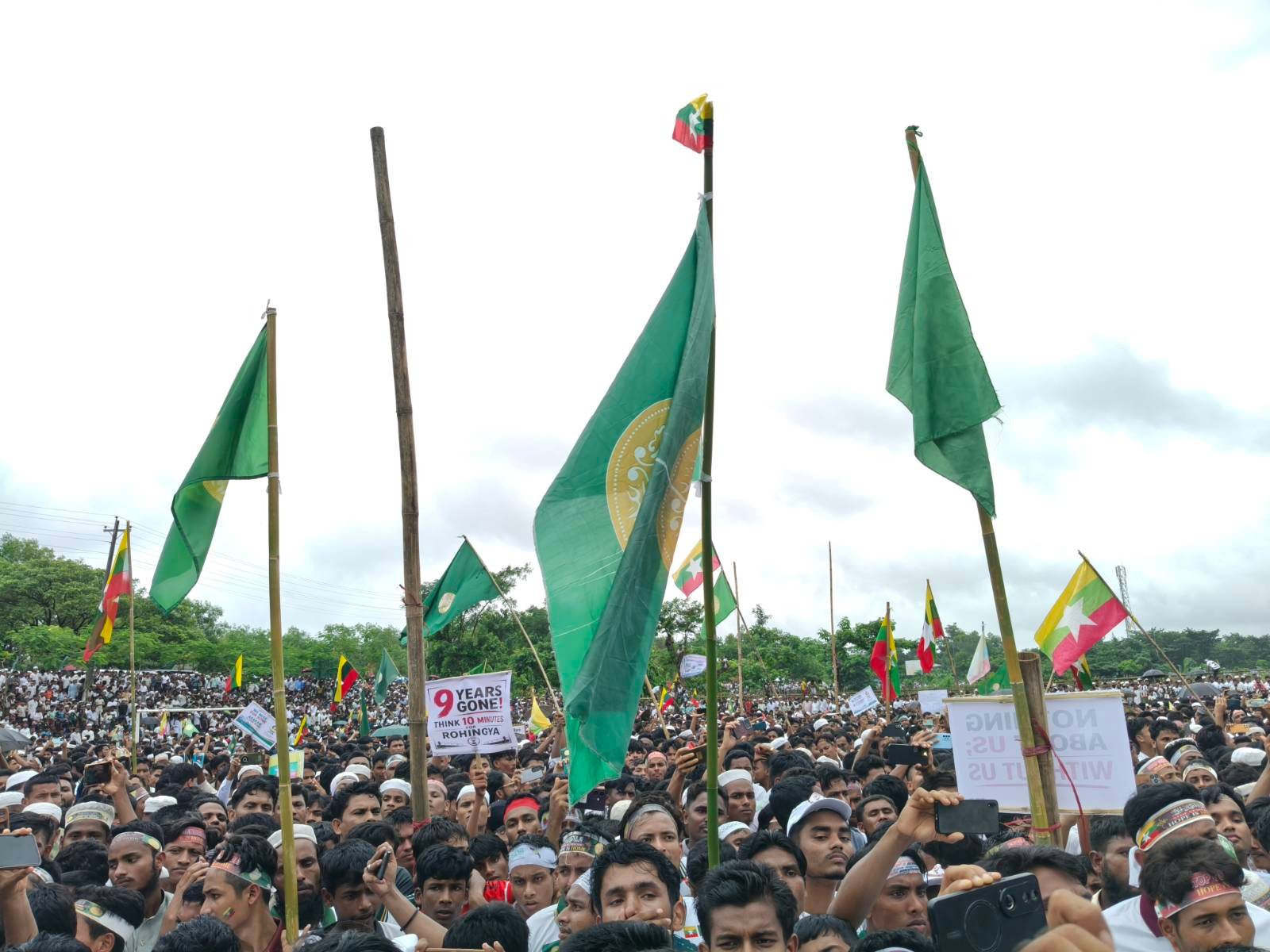
For Rohingya refugees in Cox’s Bazar, August 25 is not simply a date marking the beginning of their mass displacement. It is the day they remember the family members who never made it to Bangladesh. Nine years ago, Myanmar’s military launched a brutal crackdown in northern Rakhine State, forcing more than 700,000 Rohingya to flee to Bangladesh.
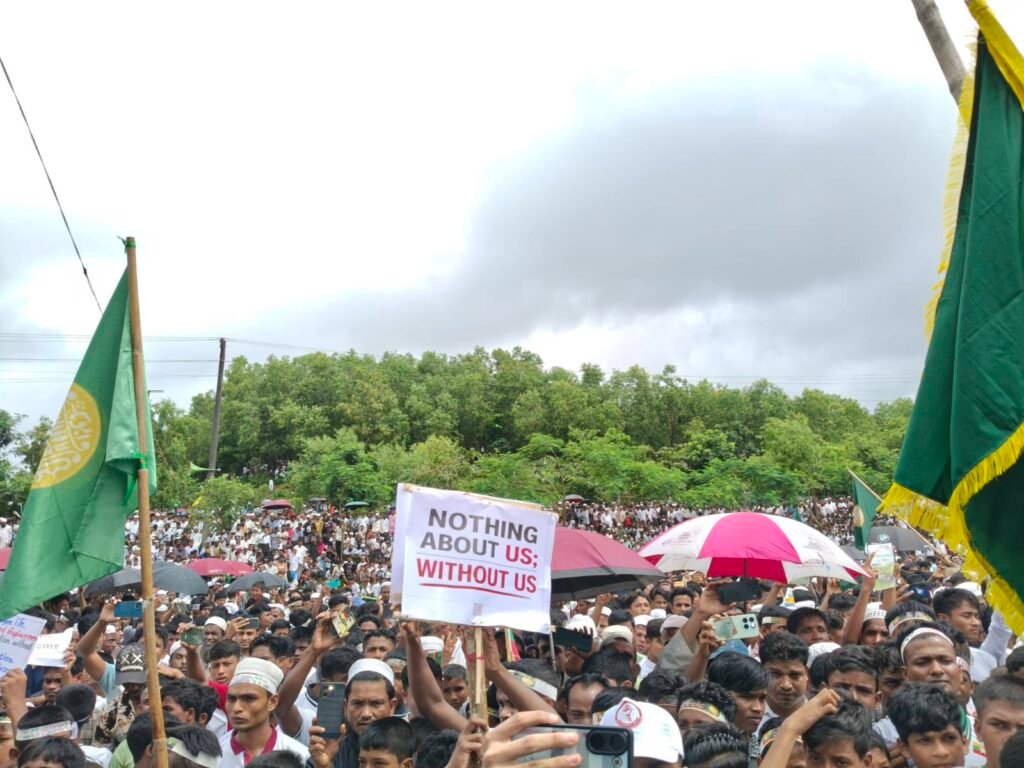
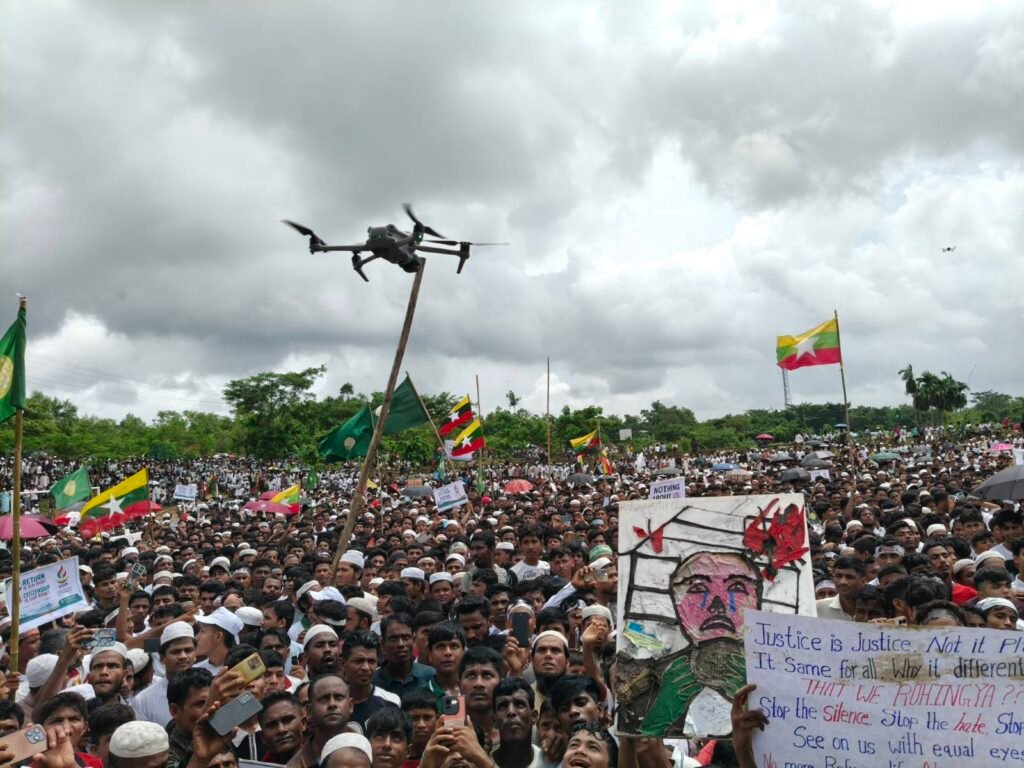
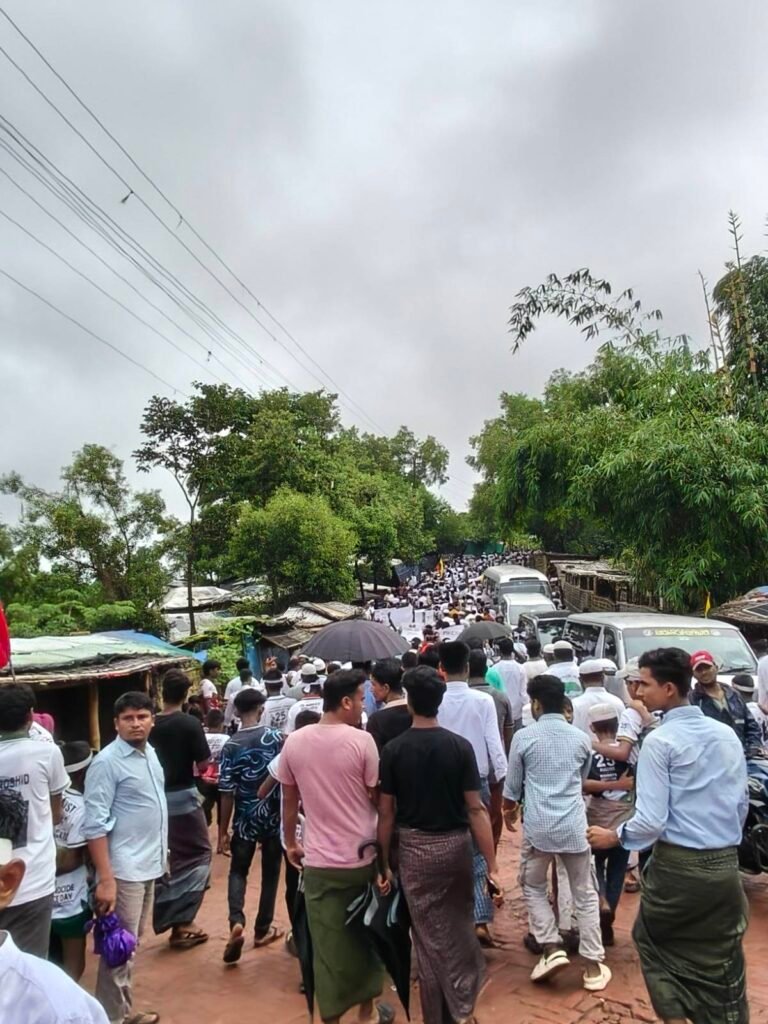
This year, tens of thousands of Rohingya refugees gathered across camps in Cox’s Bazar to mark the ninth anniversary, demanding justice and a safe, voluntary and dignified return to their homeland. At the largest gathering, more than 100,000 Rohingya were reported to have assembled at the Camp 4 Extension football field. Their central message was simple: They want to return home, but not without safety, rights and dignity. But behind the speeches and banners were memories that remain painfully personal.
‘Allah saved me’
Hamida Begum, 44, remembers the evening of August 25, 2017, as a desperate attempt to keep her family alive. When Myanmar soldiers entered her village of Donkhali in northern Rakhine State, her house was set on fire. She and her family fled with her disabled husband, Soyed Alom, who could not walk. Hamida Begum and her eldest son placed him in a large basket and carried him on their shoulders as they tried to escape.
She believed that if they could reach the nearby beach, they might survive. Then the gunfire began.
“Bullets were passing right beside my body. Allah saved me,” Hamida Begum recalled.
She said soldiers were firing from the east toward the fleeing villagers. While still carrying her husband, she and her son crouched down, trying to protect themselves from the bullets.
“I saw many people being hit by bullets and falling to the ground, one after another, like trees falling,” she said.
As they continued fleeing, she realized that soldiers were coming after them. Fearing that the soldiers would catch the whole family, they made a decision that still haunts her. They left Soyed Alom behind and ran toward a nearby dam, where she and her children hid. From behind the dam, she said, she watched her husband.
“I saw my husband being cut with a long knife into two pieces,” she said.
Overwhelmed by what she had witnessed, she began to scream. Her eldest son quickly covered her mouth, fearing the soldiers would hear them.
“I wanted to cry out, but my son stopped me because if they noticed us, they might kill us too,” she said.
From their hiding place, she could see bodies scattered along roads and paddy fields, including men, women and children.
“After killing him, they took my husband away in a truck,” she recalled of the last sight of her husband.
Nine years later, she still carries the memory of the husband she wanted desperately to save.
‘They took two of my sons from my side’
For Sayed Azim, 52, August 25 is the day he lost two sons. When soldiers surrounded Maung Nu village, Sayed Azim, his family and other villagers sought shelter inside a muddy house. They closed the door, hoping they would remain safe. The soldiers forced their way inside, he said. “They opened the door and entered. Then one soldier fired into the group,” Sayed Azim recalled. He said a young child, maybe 9, was killed.
The soldiers then searched the house and took Azim’s 16-year-old son, Hamim, a ninth-grade student. “They took my son Hamim outside and killed him.”
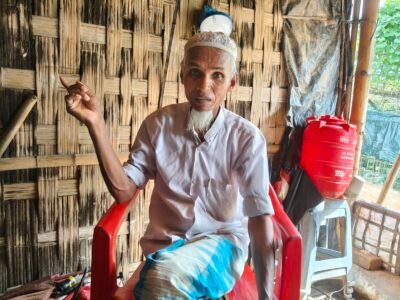
Then his younger son, Noyum, 14, a sixth-grade student, was taken from the arms of his mother, Zubaida, 44. “They took two of my sons from my side,” Sayed Azim said.
He said he watched helplessly as Noyum was taken away from his mother’s embrace and killed. Azim said he witnessed widespread killings around him. He estimated that more than 500 people were killed in the violence he witnessed.
He also said his and villagers’ belongings were looted, some people were buried alive and others were taken away in trucks. His wife, Zubaida, he said, has struggled to recover from the loss. He said she has lost her eyesight and continues to mourn their sons.
“My wife still cries for them,” he said. He remains haunted by what happened. “I always think about my sons and remember how they were killed,” he said. “I have lost my peace. I want justice for my sons.”
‘They killed my father first’
Samira, 22, from Buthidaung, remembers the day in 2017 through the killing of her father and the sexual violence she suffered at the hands of Myanmar soldiers. She said soldiers first shot and killed her father before turning on her.
“They killed my father first,” Samira recalled. She said four soldiers held her down while three raped her brutally. One tore her sarong skirt, grabbed her by the mouth and held her tightly so she could not cry out. Another soldier pressed a knife into her side and kept it there during the assault, she said.
“One military stuck a knife into my side and kept it there while the three were raping me,” Samira recalled. “That was how they kept me in place.” She said she tried to move, causing the wound to bleed more heavily. “I was trying to move and the wound was bleeding more,” she said. “They were threatening to shoot me.”
“Every August 25, I remember my father who was killed and the violence I survived. Nine years have passed, but the pain remains. I want the world to remember the Rohingya victims and stand with us for justice and a safe return home.” Samira said.
Her testimony reflects the sexual violence reported by Rohingya survivors of the 2017 crackdown.
The U.N. Independent International Fact-Finding Mission on Myanmar found widespread sexual assault, including gang rape, and said sexual violence was part of the broader campaign against the Rohingya in a 2019 report.
Call for global solidarity
The consequences of 2017 have extended beyond those who witnessed the violence. Children born in Bangladesh have grown up knowing Myanmar mainly through their parents’ memories.
At this year’s rally, participant Md Yeasin, 35, said he joined the gathering to remember the past and call for a safe return home for future generations. “My children were born here. They know Myanmar from what I tell them. I cannot show them our house or take them to our village,” he said.
A young participant, Shobi Ullah, said he joined the campaign to remember what was lost and renew their call to return home.
“We left our house, our land and our belongings. We thought we would come back after a few days,” he said.
The memories of survivors were echoed by Rohingya leaders.
Sayed Ullah, president of the panel of the United Council of Rohingya, called on people around the world to pause and stand with the Rohingya for 10 minutes as part of the August 25 campaign. The campaign theme, “Nine years gone, think 10 minutes for Rohingya,” was intended to turn remembrance into a moment of global solidarity.
A U.N. special rapporteur issued a statement marking nine years since the violence that drove hundreds of thousands of Rohingya from Myanmar.
The statement, titled “Rohingya Remembrance Day: Remembering the Victims, Confronting Impunity, Upholding the Rights and Dignity of the Rohingya,” explicitly referred to the “genocidal campaign” launched in northern Rakhine State in 2017.
The rapporteur called for the victims and survivors to be remembered and for accountability and the rights and dignity of the Rohingya to be upheld.
In the camps, the Rohingya are still waiting for the chance to return home.
“We survived the violence, but we do not want our children to lose their future. We gathered here today to ask the world to help us return home safely, with security and citizenship rights,” Md Yeasin said.
This article is published as Creative Commons.