
The reporting for this project was funded by Open Development Cambodia.
Cambodia’s electricity mix has transformed almost completely since 2000, when oil supplied over 90% of electricity and hydropower filled the rest. Hydropower surged after 2012 as new dams came online, briefly dominating the mix.
Coal has since overtaken it, climbing from zero in 2013 to over 60% by 2024, while oil has nearly disappeared. Solar only entered the picture in 2018 and has grown steadily since, reaching about 11% by 2025.
Today, there are 10 hydropower dams in operation, while another 14 projects are under construction or proposed, according to the country’s master plan.
But previous investigations and academic studies have documented forest loss, flooding of protected areas, disruption of wildlife habitats, and displacement of Indigenous communities associated with several existing hydropower projects.
This raises a broader question than whether Cambodia simply needs more electricity. Before approving another generation of hydropower projects, what environmental lessons can be learned from existing dams? What are the alternatives? Could upgrading existing hydropower facilities help meet part of Cambodia’s future energy needs while reducing pressure on forests and protected areas?
To answer these questions, this explainer combines Cambodia’s power development master plan, satellite-based forest cover data, and previous studies to examine how much forest has been lost to existing hydropower projects, how much could be affected by future dams, and whether experiences from neighbouring countries offer an alternative pathway.
How widespread is hydropower development in Cambodia?
Precisely how much of Cambodia’s power comes from dams today is harder to pin down than it should be. Official figures are scattered across ministry statements, donor reports and industry trackers, and don’t always agree. The Asian Development Bank’s energy sector assessment in 2018 put installed hydropower capacity at roughly 980 MW built, with about 400 MW under construction and another 90 MW in feasibility studies, against a technical potential the ADB estimates at 10,000 MW.
Stimson Center trackers put total installed hydropower capacity around 1,300–1,800 MW as of the early-to-mid 2020s. The uncertainty reflects projects moving in and out of “under construction” status, and the lack of a single public, continuously updated dam registry.
Cambodia’s Power Development Master Plan (PDP) 2022–2040 with the Asian Development Bank targets 3,000 MW of hydropower capacity by 2040.
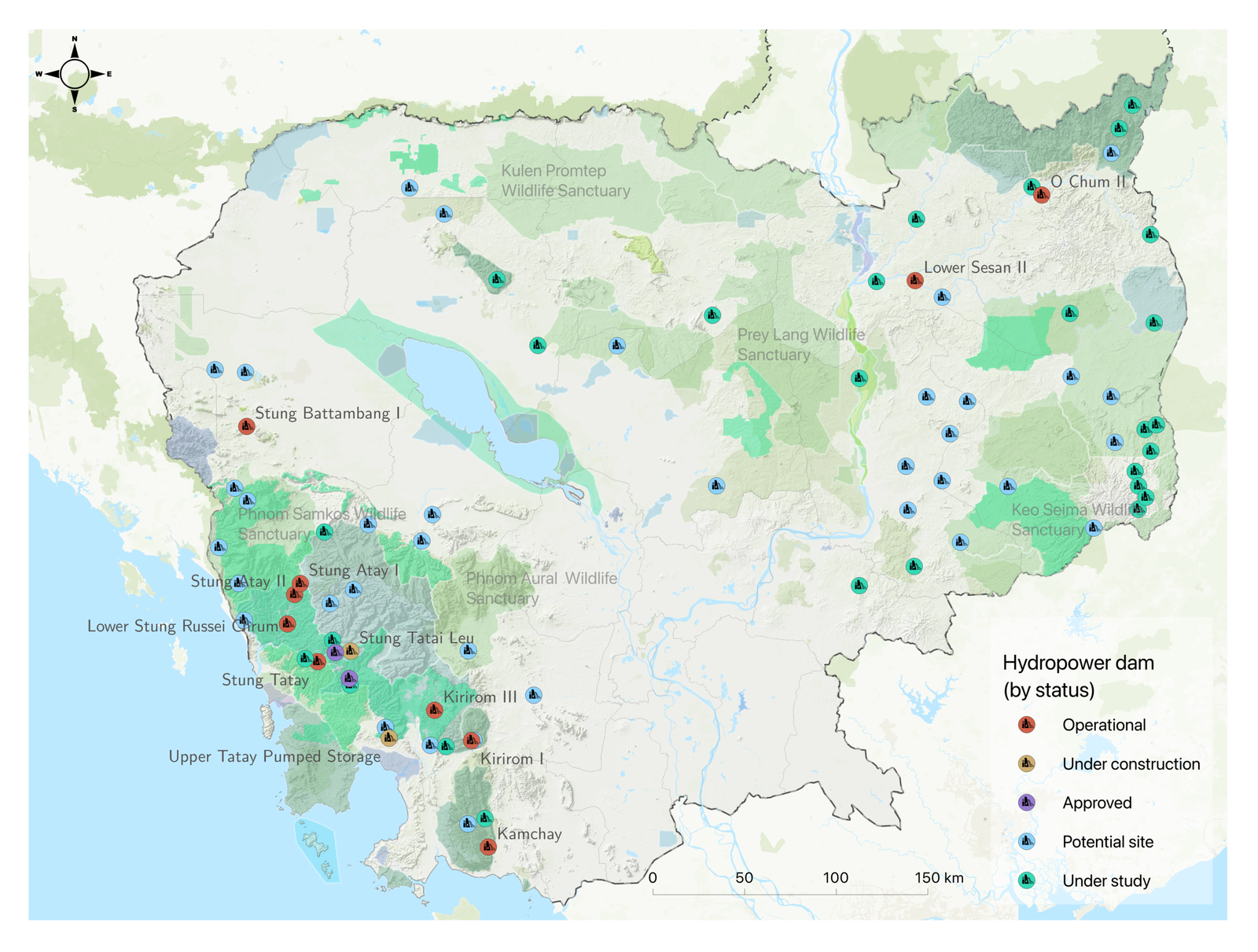
Many of these projects are concentrated in Cambodia’s southwest and northeast, where major river systems pass through some of the country’s largest remaining forest landscapes. Since the late 2000s, Cambodia has accelerated hydropower development through a series of Build-Operate-Transfer (BOT) agreements, many involving Chinese state-owned enterprises.
Cambodia now has 10 operational hydropower dams with a combined installed capacity of approximately 1353 MW while there are three under construction and dozens more under study, according to a list compiled by Open Development Cambodia. (The full list is at the bottom of this article.)
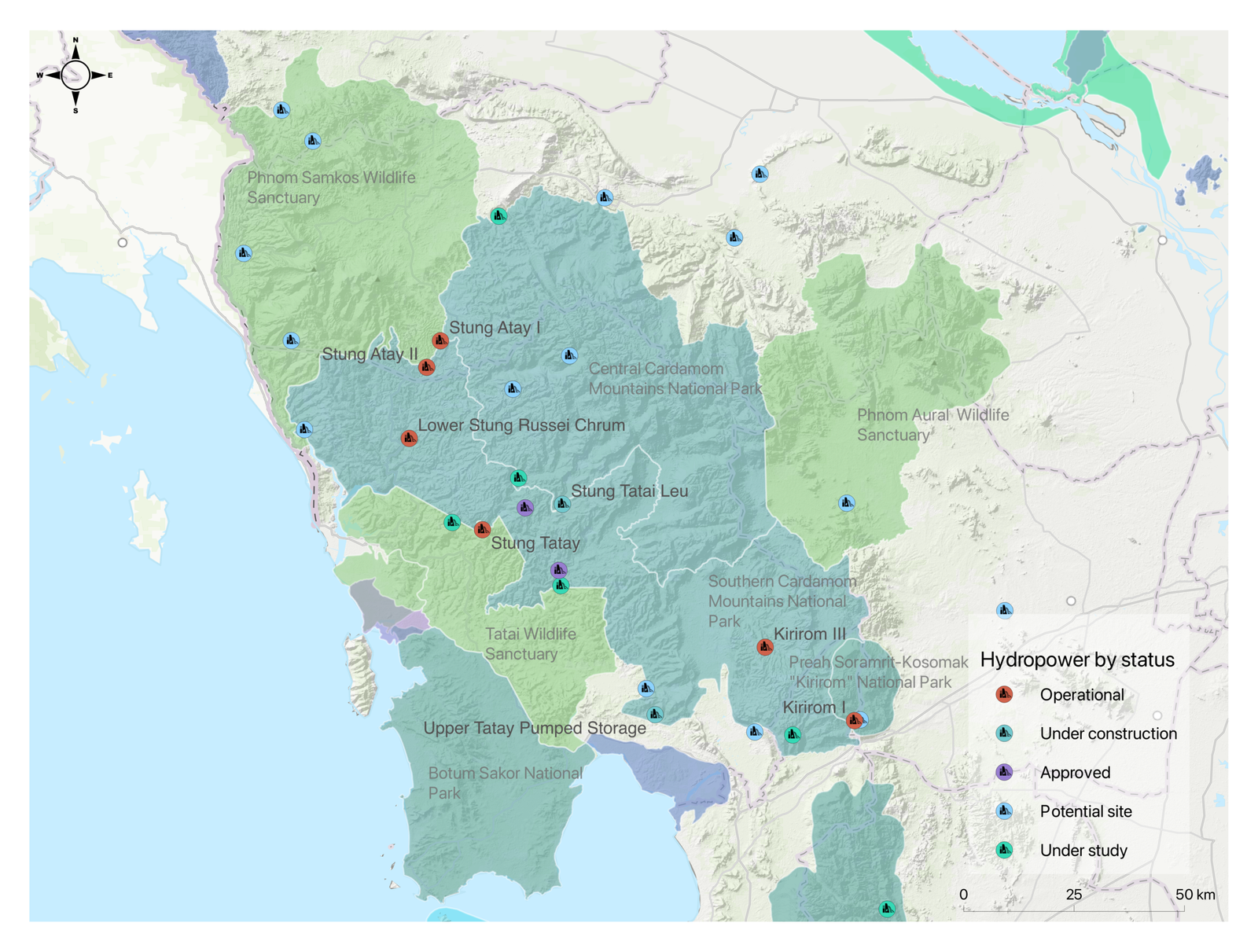
Among those, in the Cardamom region, home to several protected areas, there are six operational hydropower dams and two under construction, two more approved, 15 potential sites, and five under study.
How do hydropower dams lead to forest loss?
Hydropower is widely regarded as a renewable energy source because it generates electricity without burning fossil fuels. Unlike solar or wind energy, however, large hydropower projects require significant changes to the natural landscape. To generate electricity, dams block rivers and create reservoirs that inundate valleys, forests, farmland, and surrounding land.
It leads to forest loss through a combination of direct environmental impacts, infrastructure requirements and a recurring pattern of systemic illegal logging facilitated by dam concessions. Reports have found that improved access to previously remote forests can increase illegal logging and land encroachment.
Developers must also clear reservoir basins of vegetation to prevent methane emissions from decaying organic matter once the area is submerged, which often becomes a lucrative opportunity for logging.
There is no single official estimate of the total forest area lost to hydropower development in Cambodia. However, previous investigations, academic studies, and satellite analyses have documented significant forest loss linked to individual dam projects, particularly those built within or near protected areas. These findings are especially concerning given that Cambodia has experienced one of the highest rates of deforestation in Southeast Asia over the past two decades.
Among the earliest documented cases was the Stung Atay hydropower dam in Pursat province. During the clearing of its 4,179-hectare reservoir, investigations found that the project was used as cover for widespread illegal logging, with an estimated 200,000 hectares of protected forest reportedly harvested during the period. Although much of the logging occurred outside the reservoir boundary, the project opened access to previously remote forests and accelerated deforestation on a much larger scale.
The Lower Sesan 2 hydropower dam, completed in 2018, inundated an estimated 34,000 to 36,000 hectares of land. Investigations later reported that the project area was also used to launder illegally harvested timber transported from forests beyond the reservoir, illustrating how environmental impacts can extend well outside the area directly flooded by a dam.
The Kamchay hydropower dam in Kampot province flooded approximately 2,000 hectares of forest inside Bokor National Park, affecting protected habitats and reducing local communities’ access to forest resources.
What are the alternatives?
Building new hydropower dams is not the only way to increase renewable electricity generation.
Two experts suggested solar and wind farms, floating solar at hydroelectric sites, and upgrading existing hydropower dams.
Vietnam offers one example. In 2025, Vietnam Electricity completed an expansion of the Hoa Binh Hydropower Plant, adding two new generating units that increased the plant’s capacity by 480 megawatts. Because the expansion used the existing dam and reservoir, it did not require flooding additional land or clearing new forests.
By comparison, the 480 MW added at Hoa Binh is more than triple the 150 MW capacity of the new Stung Tatay Leu dam currently being built inside the Central Cardamom Mountains National Park. While the Hoa Binh upgrade required minimal new land clearing, five new dams under construction in the Cardamoms will collectively damage over 15,000 hectares of protected forest.
Courtney Weatherby, deputy director for the Energy, Water, and Sustainability Program at the Stimson Center cautioned that the comparison has limits. “The potential will vary significantly by dam, and frankly it’s hard to estimate without a detailed technical analysis,” she said.
In general, older dams offer the clearest upgrade opportunities, but Cambodia’s hydropower fleet is comparatively young. “It may be difficult to pursue significant power improvements through simply upgrading existing power facilities,” Weatherby said.
Weatherby said floating solar could also be built on hydropower reservoirs, citing existing examples such as Thailand’s Sirindhorn Dam and Vietnamese projects.
Building solar farms on hydropower reservoirs could reduce evaporation and complement dry-season power generation. In some cases, peak solar production could rival the capacity of the existing dam, she said.
An independent expert who declined to be named due to conflicting interests with his current work said such floating solar arrangements could be paired with pumped-storage, meaning electricity from the peaks of solar generation could be used to fill additional water reservoirs, and released when demand exceeded production.
He said this “basically turns the dam into a large battery” and, because it uses existing infrastructure, “many of the negative impacts of dam construction” could be avoided. Weatherby, however, cautioned that such projects must be “carefully sited and operated” to avoid impacts on rivers and fisheries.
The independent expert also suggested simply building more solar, though it has the downside of uneven power generation depending on how much the sun is out. “Solar farms are cheaper, can be installed on already degraded land or floating on lakes and ponds, even those connected to hydroelectric projects and are far less destructive to communities and nature.”
He added that the changing climate in Cambodia was making hydropower less reliable, and economic changes — such as a recent crackdown on the country’s criminal scam industry — together with potential alternatives “likely mean many of the 14 planned projects could remain unbuilt.”
Mekong Independent has contacted Keo Rottanak, Minister of Mines and Energy, for a response.
The Stimson Center’s Weatherby said that in the years since the Cambodian master plan was written in 2022, solar deployment had already shot above projections for 2030.
A project for 150 MW of wind was underway and not accounted for in the plan. The war in Iran and the Cambodian-Thai border conflict would also give a greater motive for renewable energy independence.
“This actually echoes a trajectory that was visible in Vietnam: once solar potential was unlocked, investment interest skyrocketed in both solar and energy storage, and it was possible for private sector investments to rapidly expand potential capacity well beyond initial targets,” she said.
“Solar/wind/energy storage could make up a larger percentage than was initially considered with robust associated grid investments to accommodate.”
Below is Open Development Cambodia’s full list of active and potential hydropower projects as of September 2026:
| Name | Status | MW | Year | Company | Province |
|---|---|---|---|---|---|
| Stung Chikreng | Under study | 1 | Not found | Siem Reap | |
| Lower Sesan III | Under study | 375 | 2017 | KTC Cable (South Korea) | Ratanak Kiri |
| Upper Stung Russei Chrum | Potential site | 32 | 2017 | KTC (South Korea) | Koh Kong |
| Middle Stung Russei Chrum | Potential site | 125 | 2018 | KTC (South Korea) | Koh Kong |
| Stung Staung | Potential site | 4 | Not found | Kampong Thom | |
| Prek Liang II | Under study | 64 | 2016 | KTC (South Korea) | Ratanak Kiri |
| Prek Liang I | Under study | 64 | 2016 | Korea South-East Power | Ratanak Kiri |
| Lower Srepok II | Potential site | 222 | 2018 | China Huandian Corporation | Stung Treng |
| Lower Srepok III | Under study | 330 | 2018 | Huadian Corporation, Guangxi Guiguan Electric Power (China) | Ratanak Kiri |
| Lower Srepok IV | Under study | 48 | Huadian Corporation, Guangxi Guiguan Electric Power (China) | Ratanak Kiri | |
| Stung Treng | Under study (Mekong moratorium – suspended until 2030+) | 980 | 2018 | Open Joint Stock Company Bureyagessttroy/Regional Oil company (Russia, Vietnam) | Stung Treng |
| Sambor | Under study (Mekong moratorium – suspended until 2030+) | 2600 | 2019 | China (Cambodia) Rich Investment | Kratie |
| Prek Chhlong II | Under study | 25 | Not found (Singapore) | Kratie | |
| Stung Sen | Under study | 38 | 2015 | Royal Group (Cambodia) | Preah Vihear |
| Stung Battambang I | Operational | 24 | 2014 | KTC (South Korea) | Battambang |
| Stung Battambang II | Potential site | 36 | 2019 | KTC (South Korea) | Battambang |
| Stung Meteuk I | Under construction (suspended) | 150 | Stung Meteuk Hydropower (Ly Yong Phat, CPP senator); new operator: Koh Kong Hydropower (Jan. 2025) | Pursat | |
| Stung Meteuk II | Under construction (suspended) | 210 | Stung Meteuk Hydropower (Ly Yong Phat); new operator: Koh Kong Hydropower (Jan. 2025) | Pursat | |
| Stung Meteuk III | Under construction (suspended) | 50 | Stung Meteuk Hydropower (Ly Yong Phat); new operator: Koh Kong Hydropower (Jan. 2025) | Koh Kong | |
| Stung Pursat I | Under construction | 80 | 2026 | SPHP (Cambodia) / POWERCHINA (technical partner); Owners: Erex 34%, Asia Energy Power 33%, ISDN Holdings 33% (South Korea) | Pursat |
| Stung Tatay | Operational | 246 | 2014 | China Gezhouba Group, China National Heavy Machinery | Koh Kong |
| Lower Stung Russei Chrum | Operational | 338 | 2015 | China Huadian Lower Russei Chrum Hydroelectric project (Cambodia, China) | Koh Kong |
| Stung Cheay Areng Dam | Cancelled / Shelved | 108 | 2016 | China Guodian Corporation | Koh Kong |
| Stung Kep II | Under study | 26 | Not found | Koh Kong | |
| Stung Piphot | Potential site | 25 | Not found | Koh Kong | |
| Kamchay | Operational | 194 | 2011 | Sinohydro Kamchay Hydroelectric Project (China) | Kampot |
| Bokor Plateau | Potential site | 28 | Not found | Kampot | |
| O Chum II | Operational | 1 | Commissioned in 1993. It is owned and operated by the Cambodian government (EDC). | Ratanak Kiri | |
| Prek Rwei II | Potential site | 5 | Not found | Ratanak Kiri | |
| O Phlai III | Under study | 5 | Not found | Mondul Kiri | |
| Prek Kampi I | Potential site | 2 | Not found | Kratie | |
| O Phlai II | Under study | 4 | Not found | Mondul Kiri | |
| O Phlai I | Under study | 5 | Not found | Mondul Kiri | |
| Stung Chinit | Potential site | 5 | Not found | Kampong Thom | |
| Stung Siem Reap | Under study | 2 | Meritec Pre-investment Study (World Bank 2002) | Siem Reap | |
| Stung Tanat | Potential site | 4 | Not found | Siem Reap | |
| Stung Pursat V | Potential site | 2 | Not found | Pursat | |
| Stung Pursat IV | Potential site | 2 | Not found | Pursat | |
| Kirirom II | Potential site | 1 | CETIC International Hydropower Development (China) | Kampong Speu | |
| Stung Kep I | Under study | 4 | Not found | Koh Kong | |
| Prek Liang IA | Potential site | 11 | Not found | Ratanak Kiri | |
| Prek Krieng II | Potential site | 6 | Not found | Kratie | |
| Prek Krieng I | Potential site | 8 | Not found | Kratie | |
| Prek Kampi II | Potential site | 6 | Not found | Kratie | |
| Prek Ter II | Potential site | 10 | Not found | Mondul Kiri | |
| Prek Ter I | Potential site | 17 | Not found | Mondul Kiri | |
| Prek Ter III | Potential site | 13 | Not found | Kratie | |
| Prek Chhlong I | Potential site | 7 | Not found | Kratie | |
| Upper Prek Ter | Potential site | 15 | Not found | Mondul Kiri | |
| Prek Rwei I | Potential site | 7 | Not found | Mondul Kiri | |
| O Phlai IV | Under study | 7 | Not found | Mondul Kiri | |
| Prek Por III | Under study | 9 | Not found | Mondul Kiri | |
| Prek Por II | Under study | 8 | Not found | Mondul Kiri | |
| Prek Por I | Under study | 17 | Not found | Mondul Kiri | |
| Stung Mongkol Borey II | Potential site | 7 | Not found | Battambang | |
| Stung Mongkol Borey I | Potential site | 7 | Not found | Battambang | |
| Stung Pursat II | Potential site | 17 | 2017 | Guangxi Guohong (China) | Pursat |
| Prek Thnot | Potential site | 18 | Not found | Kampong Speu | |
| Kirirom III | Operational | 18 | 2012 | CETIC International Hydropower Development (China) | Koh Kong |
| Kirirom I | Operational | 12 | 2002 | CETIC International Hydropower Development (China) | Kampong Speu |
| Stung Sreng | Potential site | 7 | Not found | Oddar Meanchey | |
| Stung Sva Slapp | Potential site | 4 | Not found | Kampong Speu | |
| Phnom Batau | Potential site | 4 | Not found | Koh Kong | |
| O Sla | Under study | 2 | Not found | Preah Sihanouk | |
| O Tourou Trav | Under study | 1 | Not found | Kampot | |
| Stung Battambang III | Potential site | 13 | Not found | Battambang | |
| Prek Chbar | Potential site | 5 | Not found | Ratanak Kiri | |
| Se Kong | Under study | 148 | 2018 | EVN International Joint Stock Company (Vietnam) | Stung Treng |
| Lower Sesan I,Lower Sesan 1/5 | Under study | 90 | 2007 | Electricity of Vietnam | Stung Treng |
| Stung Atay II | Operational | 120 | 2013 | China Datang Corporation | Pursat |
| Stung Atay I | Operational | 120 | 2013 | China Datang Corporation | Pursat |
| Upper Sesan IV | Under study | 350 | Not found | Ratanak Kiri | |
| Lower Sesan II | Operational | 400 | 2018 | Royal Group, Hydrolancang International Energy (China), EVN International Joint Stock Company | Stung Treng |
| Stung Tatai Leu | Under construction | 150 | 2026 | China National Heavy Machinery Corporation (CHMC) | Koh Kong |
| Upper Tatay Pumped Storage Hydropower Project | Under construction (groundbreaking Apr 10 2026) | 1000 | 2029 | China National Heavy Machinery Corporation (CHMC) | Koh Kong |
| Stung Russei Chrum Kandal Hydropower Plant | Approved / Pre-construction | 70 | Khmer Electrical Power (combined project $447.5M with Stung Veal Thmor Kambot) | Koh Kong | |
| Stung Veal Thmor Kambot (Stung Veay Thmar Kambot) | Approved / Pre-construction | 100 | Khmer Electrical Power (combined project $447.5M total) | Koh Kong |
This article is published as Creative Commons.