
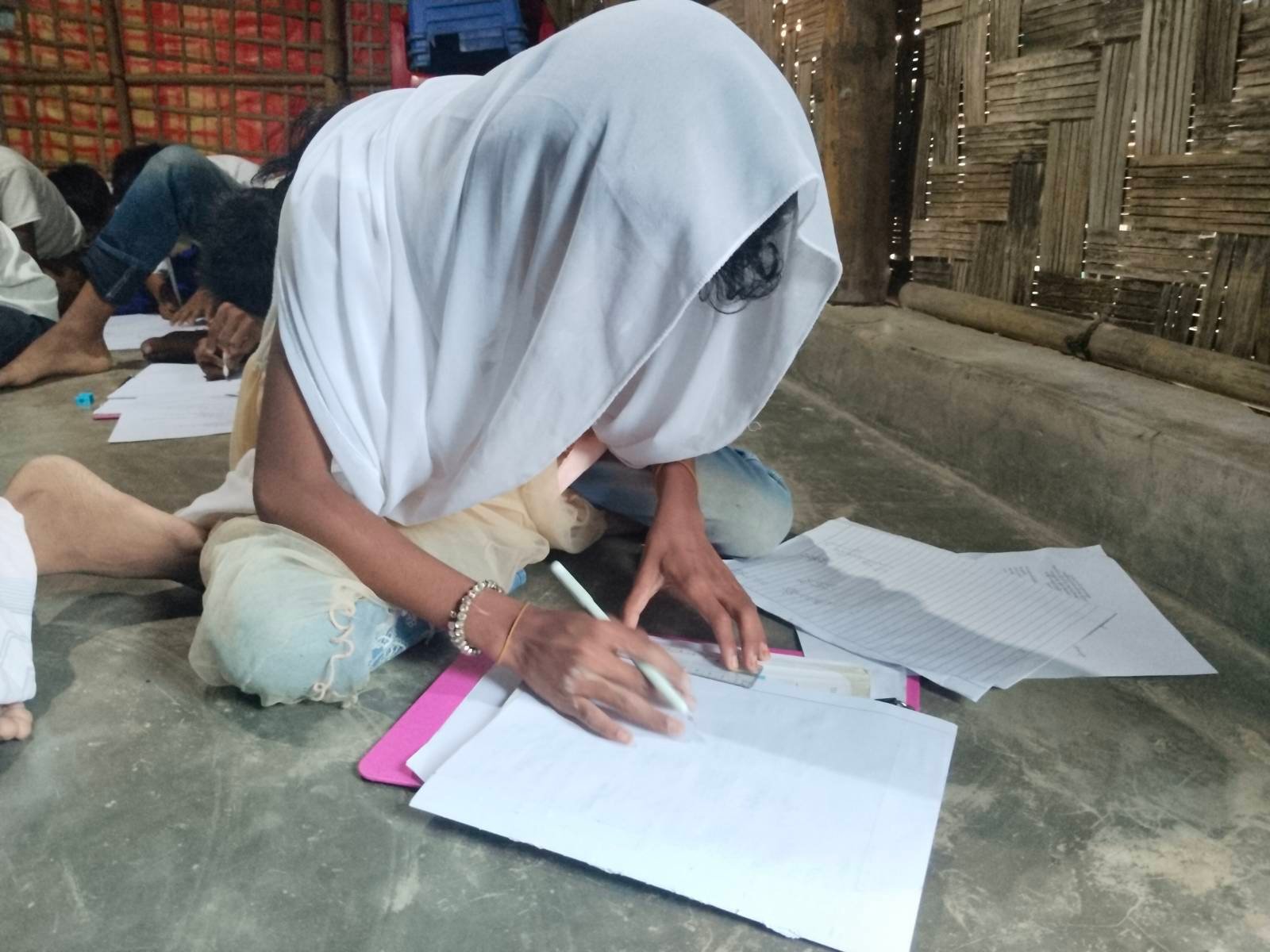
Seventeen-year-old Shobika had only a short walk to her learning center in a refugee camp in Cox’s Bazar, Bangladesh, where she’d been living for about nine years.
Although the walk was only 300 meters, she soon faced daily harassment at an intersection from a young man who lived nearby.
“He asked, ‘Will you marry me?’ ‘Why are you still studying at this age?’ and ‘You should get married instead of going to school,’” Shobika recalls, asking to be identified by her first name only. It didn’t take long for the questions to turn menacing.
“Sometimes he even threatened me, saying, ‘If you don’t marry me willingly, I’ll take you away by force.’”
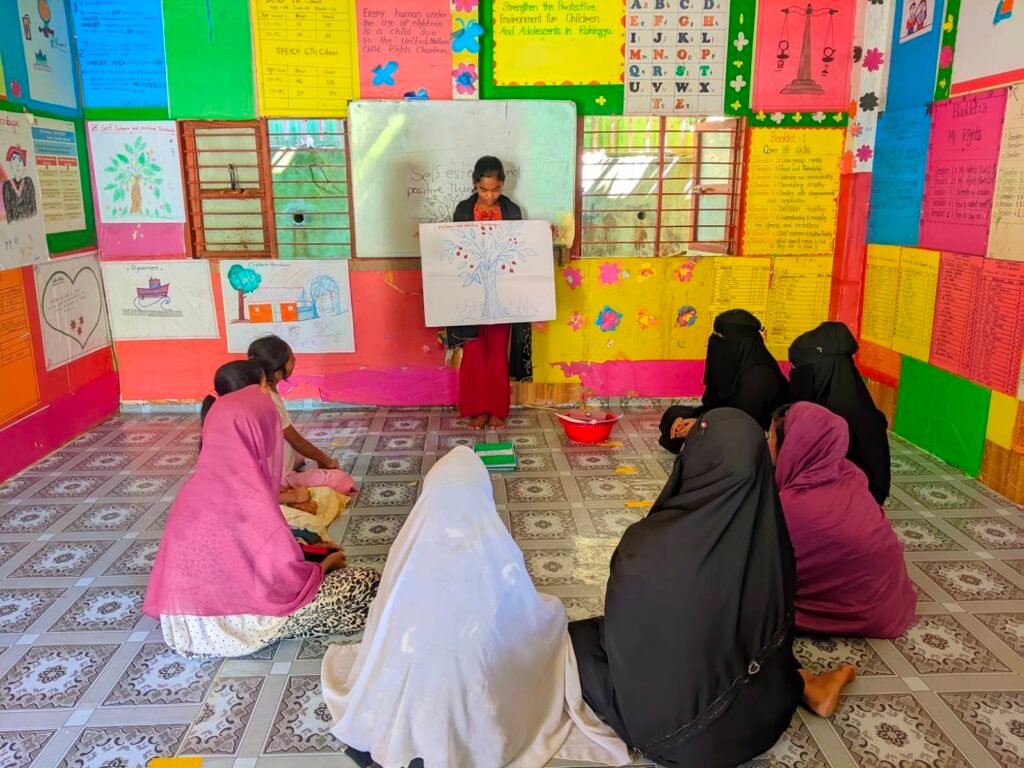
Both male and female students struggle to access education in Cox’s Bazar, Bangladesh’s largest refugee camp, attending unaccredited learning centers in the country operating with bare bones supplies and staff. There are roughly more than 1.2 million Rohingya living in Bangladesh following a genocide that began in 2017 in Myanmar’s west.
However, girls face unique pressures to drop out, including safety concerns and pressures to get married, community educators, students, and families told Mekong Independent.
In 2024, 75% of girls aged 5 to 14 in the Cox’s Bazar camps were reported to be enrolled in school. But these numbers dropped sharply to just 8% for girls 15 to 18 years old, according to education nonprofit Girls Rising citing a survey by UNICEF, the United Nations’ agency for children.
Those who had dropped out reported that they felt too old to study, had responsibilities at home, were facing pressure to get married, did not have the support of their parents, or did not have access to female teachers.
According to Shobika’s brother, Khala Miya, the repeated harassment wore down the family. As her attendance declined, they arranged for Shobika to marry a neighbor.
“She was a regular learner,” Khala Miya said. “But after she repeatedly told us about the harassment and threats she faced on her way to school, I stopped her from attending because I feared she might be abducted or sexually harassed.”
Interventions
Setra Khatun, one of Shobika’s teachers, said several members of staff tried to intervene and keep her in school.
“She told me she was afraid to leave home because a stranger had threatened to kidnap her,” Setra Khatun said. “I even offered to accompany her to the learning center every day, but she was too frightened to return.”
Setra Khatun said teachers regularly visited families when girls stopped attending classes, but their efforts were not always successful.
According to a report from the International Rescue Committee, 1 in every 4 women and girls in the Rohingya refugee camps has reported experiencing gender-based violence, and the actual number who have experienced violence is likely higher.
“We explain the importance of education and encourage parents to continue sending their daughters to school,” Setra Khatun said. “Some girls return, but many do not because their families fear for their safety or face pressure from the community.”
Some, facing few options inside the camp, choose to leave for good.
Azida Khanam, a 16-year-old in grade eight, had asked her mother repeatedly what would happen to her after she graduated, disturbed by the sight of older students finishing school with no opportunities.
In January 2026, Azida Khanam left the camp through a trafficking network operating from Teknaf, a border town on the Naf River near Cox’s Bazar. Before boarding a boat bound for Malaysia, she called her family.
“She told us she was on the boat and would call again later,” her mother recalled. That was the last contact the family received.
“Four months have passed,” she said. “We don’t know where she is. We don’t know whether she reached Malaysia or whether something happened to her.”
Desperate for other opportunities and to escape violence, Rohingya have boarded boats en masse from both Bangladesh and Myanmar’s Rakhine State, many of which have sunk and their passengers presumed dead.
As recently as June 29, an estimated 530 Rohingya departed from Rakhine State in two boats. Three weeks later, they have seemingly vanished, with many assuming the boats capsized like others have in recent years.
Azida Khanam’s disappearance was not an isolated case, said Muhib Ullah, the chief head, or maji, of Camp 7.
“Every month, we hear of many adolescent girls leaving or attempting to leave the camps in search of education, safety or work,” he said. “Many families later lose contact with them.”
Lack of hope
Authorities are taking measures to address reported incidents and prevent further cases, said Refugee Relief and Repatriation commissioner Mohammed Mizanur Rahman, adding that Bangladesh is working with humanitarian organizations and the Armed Police Battalion to improve the safety and security of girls.
This includes increased security patrols, expanding community awareness, and improving both reporting mechanisms and support services, he said.
If things don’t change, schools will continue to lose girls to early marriage and trafficking, said community leader Eman Hossain.
“For many Rohingya girls, the journey out of education does not begin with a single decision,” he said. “It begins with repeated harassment, growing fear, social pressure and the absence of opportunities beyond the classroom.”
For 18-year-old Jamila, it was community pressure that convinced her father to stop sending her to school.
She had attended the learning center with the goal of starting her own home-based learning center to help girls stay in school, given the limited number of female teachers.
But in her mid-teens, she started to notice people whispering about her on the streets and at the mosque and criticizing her family for still allowing her to study.
In the end, her father felt the pressure was overwhelming.
“People repeatedly told me to stop sending my daughter to school,” Abdul Rokim said. “They said if she continued studying at her age, other girls would follow her example and it would negatively affect our society.”
Abdul Rokim arranged for his then 16-year-old daughter to be married, while she pleaded with him to reconsider.
“I cried and begged them to let me continue studying,” Jamila recalled, adding that she was not interested in marriage. “But my education ended.”
Now 18 years old and four months pregnant, she often thinks about the future she lost.
“When I see girls carrying books to the learning center, I remember my own dream,” she said. “I wanted to stand in front of a classroom and teach Rohingya girls. Instead, my education ended before I could even complete it.”
This article is published as Creative Commons.