
This article was originally published on HaRDstories as Creative Commons.
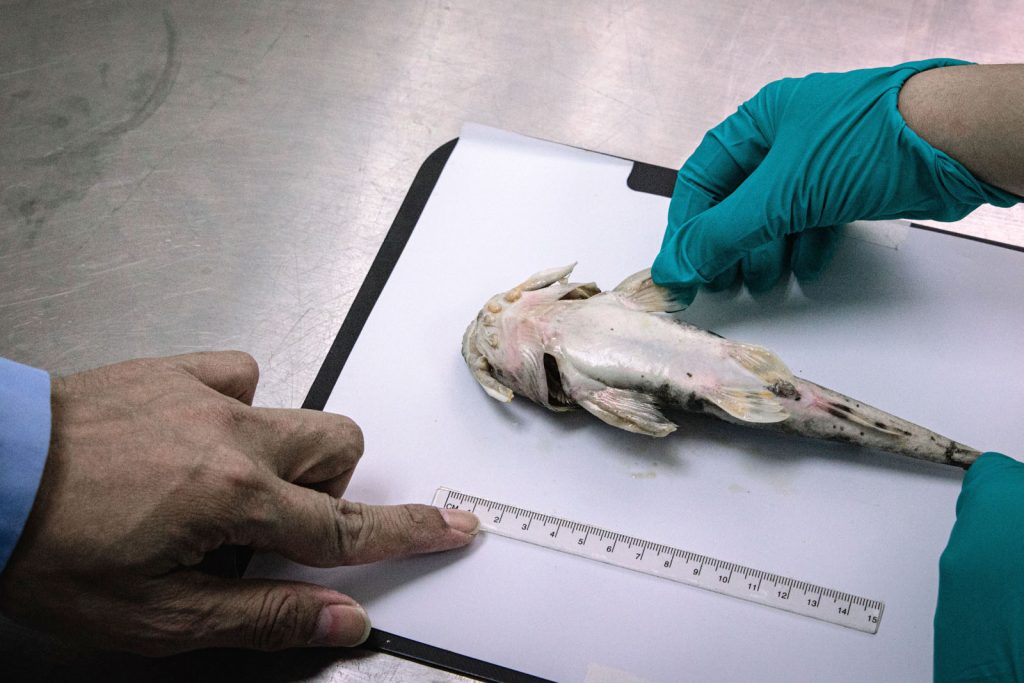
In the heavy heat of late April, a fisherman carried freshly caught fish from his small boat on the bank of the Mekong River. His catch was all common Mekong species, but one stood out: a tiny Bagarius with unusual bumps and lesions across its body.
It was not the first time such a fish had been caught from the Mekong River Basin. A year earlier, on the same date (22 April 2025) a Bagarius with the same disfiguring lesions was pulled from the Kok River, a Mekong tributary, in Chiang Rai. But this time the fish was caught at Chiang Khan district in Loei province, roughly 500 kilometres downstream from the affected stretch in Chiang Rai.
Four days after that first deformed fish was found in the Northeast, two more disfigured Bagarius were caught at Nong Khai, around 200 kilometres further downstream, according to Ormbun Thipsuna, a local community-based researcher.
As the fish samples were sent to Naresuan University for laboratory analysis, Assistant Professor Tanapon Phenrat of the university’s Department of Civil Engineering released test results on 11 May showing that the fish had been exposed to elevated levels of heavy metals, which he said led to the deformities.
“The sickness is caused by exposure to heavy metals,” Tanapon said. “The fish sample from Chiang Khan was found to have substantially high levels of lead and mercury compared to normal fish, indicating a link to mine pollution.”
The samples from Nong Khai also showed high levels of cadmium and manganese, he said.
Blood analysis conducted by Natthawut Charoenphon of Naresuan University’s Faculty of Medical Science revealed abnormal red blood cells and an elevated white blood cell count, findings that Tanapon said indicated DNA damage caused by heavy metal exposure.
“It is quite clear that the fish deformity is caused by exposure to heavy metals in the river, which caused the fish to fall ill and allowed parasites to infect them,” he said. “But it is still too early to say whether it is safe to consume fish from the Mekong River.”
Tanapon called for more comprehensive and frequent testing of fish and water samples from the Mekong to monitor the situation and provide timely warnings to communities about potential health risks.
Locals fear economic fallout
Channarong Wongla, coordinator of Rak Chiang Khan, a local conservation group, said the finding had alarmed fishing communities in Chiang Khan, as residents rely heavily on the Mekong’s fisheries for their livelihoods.
According to local fisheries data covering the stretch from Chiang Khan to Pak Chom in Loei province, fishermen can catch up to 96 species of fish from that reach of the river alone, generating up to 500,000 baht (around 15,500 USD) in income for local communities each month, Channarong said.
Unless the government takes serious measures to address mining pollution at its source, he warned, fishing communities along the Mekong in the Northeast face loss of income, inability to sell fish, and families going hungry.
A team from the Pollution Control Department takes water samples from the Mekong River at Chiang Saen District of Chiang Rai. Due to the ongoing pollution issues, the department is taking water samples from all rivers downstream of the mining activities including the River Kok. Photo: Wissarut Weerasopon/HaRDstories

The Living River Siam Association has documented a similar crisis on the Kok River in Chiang Rai, where fish biodiversity has declined sharply and fishermen reportedly could not sell any catch from June to September 2025 due to contamination fears.
“The problem in Isan gets far less public attention than the North,” Channarong said. “I want the authorities to take it more seriously and conduct more frequent testing of water, sediment, and fish samples – and of the health of people living along the river.”
Call for emergency talks
Suebsakun Kidnukorn, a lecturer at Mae Fah Luang University in Chiang Rai, said the widening of the crisis area was a direct result of what he described as the government’s failure to act against unregulated Chinese mining operations in Myanmar.
He called on Prime Minister Anutin Charnvirakul to convene an emergency meeting on transboundary river contamination, to include government agencies, academic experts, and civil society, in order to identify solutions at the source and develop risk management plans “before further irreparable damage is done.”
Suebsakun also urged the government to enter negotiations with Laos, Myanmar, China and ethnic armed organisations in Myanmar to halt mining operations with transboundary environmental impacts, and to ban private companies from importing key minerals from Myanmar and Laos.
Earlier on 9 May, Natural Resources and Environment Minister Suchart Chomklin told the media that he had instructed the Department of Water Resources to closely monitor the transboundary pollution situation in the Kok River, Sai River, Ruak River, and Mekong River.
“All relevant agencies have been instructed to expedite assistance to the affected population and continuously monitor the situation to ensure that solutions are implemented as quickly as possible,” Suchart said.