
The cousin of Cambodia’s prime minister says that even though he was formerly a 30-percent shareholder in a digital payments firm penalized by the U.S. for alleged involvement in scams and money laundering, he didn’t have any decision-making authority or receive profits.
Huione Pay, a Cambodian payment services provider, was severed from U.S. financial systems in October with the U.S. Treasury alleging it served as a “critical node” in laundering the proceeds of North Korean cyber heists as well as transnational scam operations. The U.S. alleged that Huione received at least $4 billion in illicit proceeds between August 2021 and January 2025.
The company lost its payment services license in Cambodia in 2024, and its chairman, Li Xiong, was extradited to China this year.
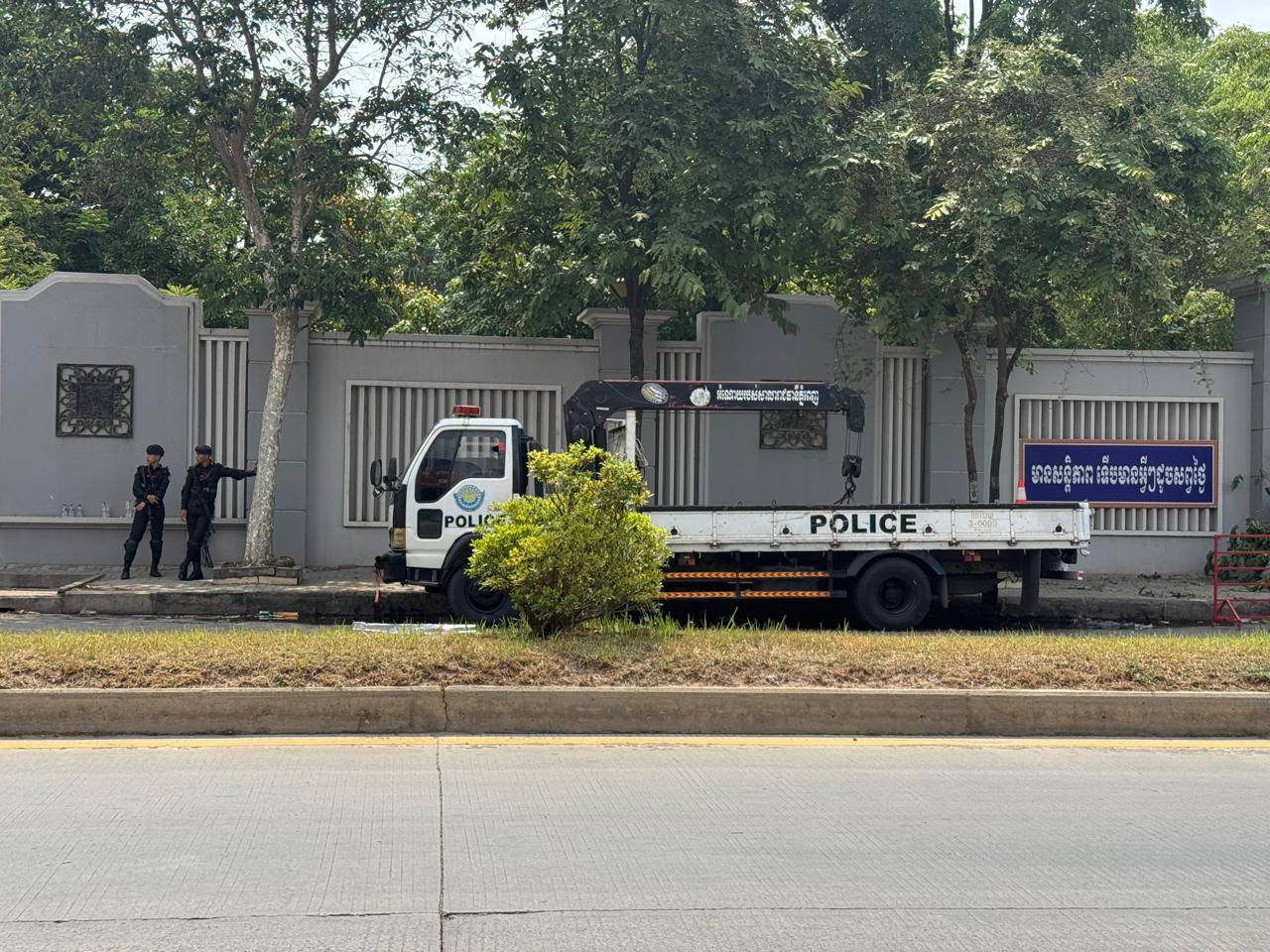
Huione customers in Cambodia have been protesting outside the National Bank of Cambodia and other institutions in recent weeks seeking the recovery of lost and frozen accounts. Two men were arrested last week over the protests.
Hun To — who is a cousin of Prime Minister Hun Manet — issued a statement on Wednesday via his lawyer Se Youran denying any decision-making role in the company.
Hun To “previously had held 30% of the shares” in Huione Pay as specified in the company’s articles of incorporation acknowledged by the Ministry of Commerce in 2020, the statement said.
However, he “did not contribute the required capital in cash corresponding to my 30% shareholding for the company’s operations,” and so did not hold any managerial authority following the company’s establishment in 2020, it said.
The company did not allocate any authority or decision-making rights to him. “I have never received any invitation for any meeting, general assembly of shareholders. I have never been appointed nor have authorised any proxy or nominee to act on my behalf as a shareholder in the company … I have never received any profit, dividends, or assets from the company,” Hun To said in the statement.
A shareholder statement about Huione Pay said the chairman, Li Xiong, was a 62 percent shareholder.
The Phnom Penh Municipal Court charged two men on April 30 in connection with the protest against Huione at the National Bank of Cambodia.
A court statement said Suon Sovannthai, 37, and Vath Makara, 36, had been charged with incitement to disrupt social security and obstructing public traffic in relation to an “illegal demonstration” on April 27.
“Suon Sovannthai and Vath Makara and its group have organized an ill[-intentioned] plan by creating a Telegram group, Huione Victims, with 1,200 members to hold illegal demonstrations,” the court said.
It alleged the group had hired 90 “workers” to participate in the protests at 25,000 riel each, or about $6.25. It also hired 10 media outlets for 100,000 riel each, or about $25, to “disseminate its activities,” the court statement alleged.
Suon Sovannthai’s wife posted a video on social media denying her husband had hired people to stage a demonstration.
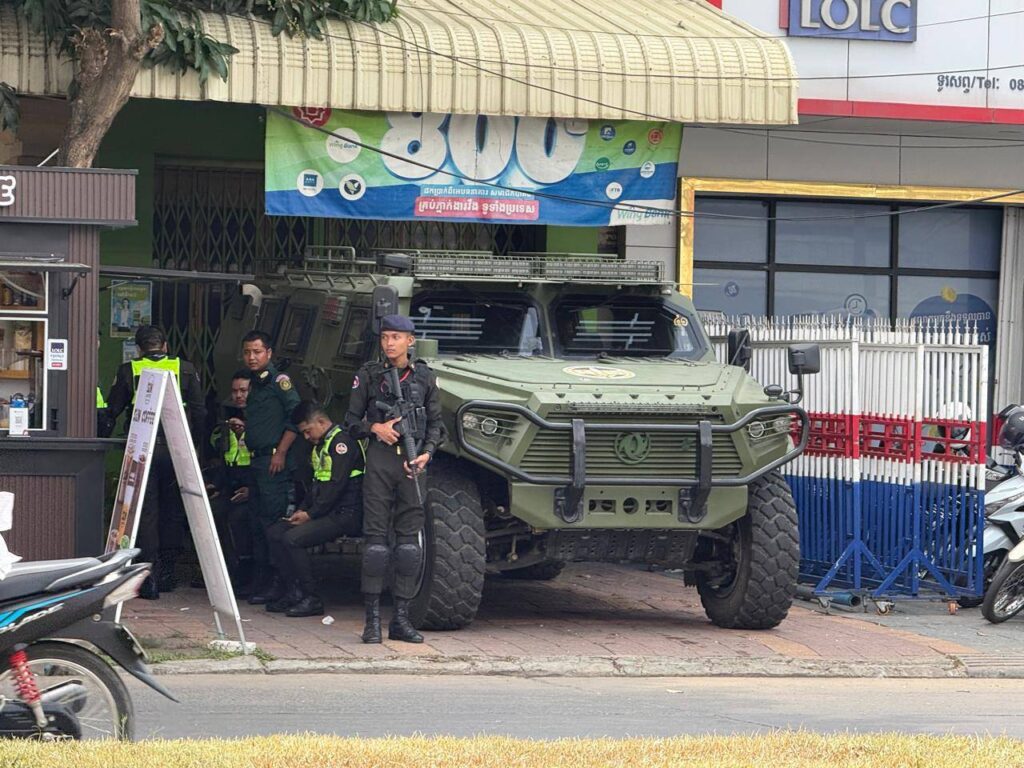
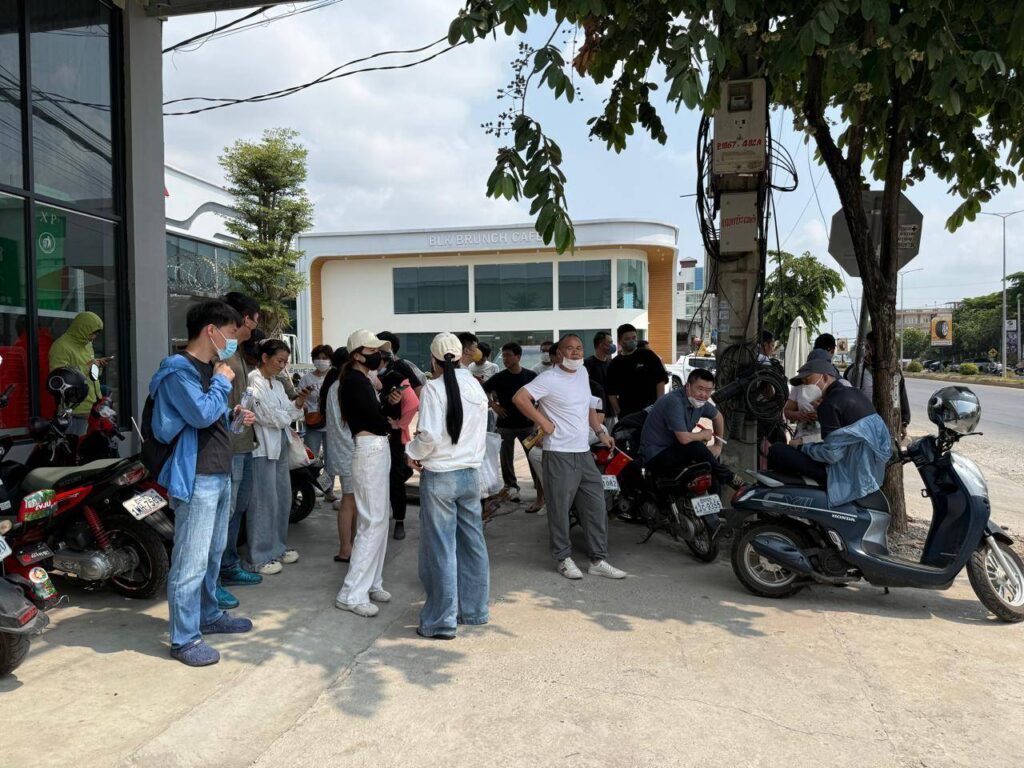
On April 27, Huione protesters clashed with security as they tried to march toward the National Bank while raising banners.
Security pushed the protesters, and some were seen suffering injuries.
A protester in her 40s said the force was excessive.
“People who are all victims have tried to protest, and some authorities blocked and pushed them,” she said. “As a Cambodian I am shocked to see many military police and police officers armed with AK[-47 rifle]s and tanks.”
“I am very shocked after having seen this attack. This is my first. Before we only saw it on social media, but now we’ve experienced it.”
The financial toll of losing funds in Huione was heavy, she said. “We need the money to pay our debt, and this is only our hope to get the money to pay our debt. … People keep coming to ask me to pay debts.”
Another protester said she had sold her car to pay construction workers, and still owed wages to 50-60 of them.
She claimed she had not realized that the company was involved in scams.
The violence was brutal, she said. Authorities had accused protesters who were carrying umbrellas to protect from the sun of carrying weapons. “They were bleeding, broke their skull. … We didn’t dare move forward because we live in Cambodia, we know the situation clearly. But the Chinese [protesters] insisted we move forward.”
This article is published as Creative Commons.