
This article was originally published on Prachatai.
In recent weeks, Thailand’s Chiang Mai Province has been engulfed in toxic air pollution, which has reached dangerous levels. Residents have been forced to live with the smog, as well as unprecedented scorching weather this summer.
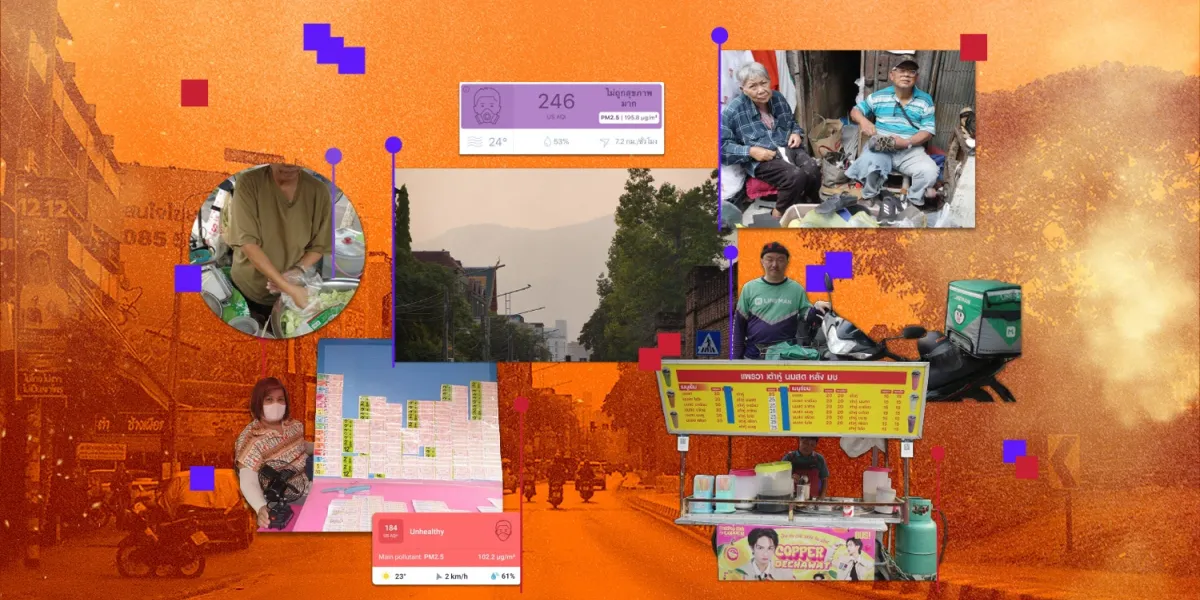
While people have been advised to stay indoors, many still have to make ends meet. Stopping work means no money to feed themselves and their families. “I am also afraid of PM2.5 entering my body, but I can’t do anything. I have to keep living like this.” said a 40-year-old food stall owner. Here’s how the bad air is affecting Chiang Mai residents.
Food delivery rider from Doi Pui
As a food delivery rider, 45-year-old Chatri has to spend most of his time outdoors. His schedule runs from 9 a.m. until midnight to support his three children.
Severe pollution has made it difficult for him to drive, as it irritates his eyes. Wearing a face mask made it harder to breathe in the hot weather. He also adds that he sometimes has a runny nose and a dry cough.
Chatri stressed that he faces this situation every year, but if the rain comes early, the condition improves. He added that he tried to work out, hoping that it would help protect him from the toxic pollution.
The rider, who is Hmong and from Doi Pui, noted that he returns to his hometown every year to help build firebreaks to prevent wildfires, a key factor contributing to pollution in Thailand’s northern region.
He remarked that the villages on Doi Pui have also been affected by PM2.5 pollution, just like people in the lowlands, but the difference is that the air up there is cooler. Having been a food delivery driver in the city for five years, Chatri has faced accusations that people living in the mountains are responsible for forest burning.
When asked if he could stop working to avoid the toxic pollution and protect his health, he replied, “I can’t. This is my income. Some days my gout flares up, and my arms and legs are in pain, but I still have to go out to drive.”
He added that his two children depend on him financially, and his eldest child is going to graduate from university.
Lottery seller at Warorot Market
Toi, a lottery ticket seller at Warorot Market, usually arrives at 8.00 a.m. and works until 4.00 p.m. She relies on a portable fan to get through days of scorching weather and severe pollution.
Toi said she wears a face mask all the time, removing it only to eat. “Sometimes I wear glasses, and when I get home I rinse my eyes. It’s like this every year, but this year seems worse, as It’s hotter too. Normally it’s not this hot at this time, but now it’s very hot and there’s lots of dust.”
Without the portable fan she brings from home, it would be almost impossible to sit and sell lottery tickets amid the intense heat. Each day, she has to prepare five batteries for the fan, and for today, she has already replaced three.
Typically, Toi would spend time selling a lottery tickets till 5 or 6 p.m,, but the harsh conditions now force her to go home by 4 p.m.
When asked whether she could use some other way to sell lottery tickets or temporarily stop working outdoors, Toi revealed that she reduced her working days, choosing to sell only on the days closer to the draw date. She then takes a 4–5 day break.
She noted that since this latest wave of severe pollution hit Chiang Mai, no officials or state agencies have come to check on or distribute masks to outdoor workers. “No one (official) has come to ask anything. I used face masks I bought in previous years. There’s been no campaign, nothing at all. The only thing is the phone alerts (SMS warnings).”
When asked what she would like the government and authorities to do, she said the problem may be difficult to fix, as burning happens every year and the smog only goes away when the rain comes. Still, she hoped the pollution could at least be less severe.
Food vendor
Suphani, a 56-year-old vendor who sells steamed meatballs at a tourist attraction in Chiang Mai, said she works daily from 2 p.m. to 8 p.m., despite the smog. For her, taking a break is not an option. Suphani is affected not only by the toxic pollution but also by the rising cost-of-living and increasing ingredient prices due to the fuel crisis.
The food vendor disclosed that she rarely wears a face mask, given that she is already exposed to heat from the stove and the scorching weather. Wearing a face mask could make it more uncomfortable for her. Wen she gets home, she has to rinse her eyes and nose to remove blackish residues.
“This year seems bad. Actually, it gets bad every year, but this year, I can’t even see the mountain,” said Suphani.
She recounted that two days ago, while she was boiling glass noodles, black ash from burning floated into the pot in front of her and her customers. She had to throw the boiled noodles away.
The 56-year-old said she didn’t expect the government to solve the problem completely, but believed the authorities should at least distribute face masks, especially to those struggling to make ends meet.
When asked whether she was worried about the potential long-term health effects resulting from PM2.5, she said, “What can I do?. I have to make a living. I can’t stop. This is my livelihood.”
Street vendor selling soy milk
40-year-old Niyom runs a soy milk stall behind Chiang Mai University, setting up his cart at noon and working until 8 p.m. Being exposed to the smog for hours, he sometimes experiences irritation in his eyes.
Niyom chooses not to wear a face mask since it’s difficult for him to breathe during this scorching summer. Despite concerns about PM2.5, he accepted the reality that he has to live with it.
The economic downturn has reduced his sales, and pollution has made things worse. He can’t stop working just to avoid the smog.
Like others, he was pessimistic about the government’s efforts to address the pollution, saying that the government has been dealing with the pollution for years, and it has made no difference.
Shoe repair shop owners
Uncle Sak and Auntie Bualoi run a small shoe repair shop at Warorot Market. They open the shop from 10 a.m. to 6 p.m. without a day off.
Neither of them wear face masks. Sak admits that he has never worn one. He is aware of the pollution, but he said he has never experienced noticeable health effects from the smog.
For them, economic survival outweighs the consequences of toxic pollution.