
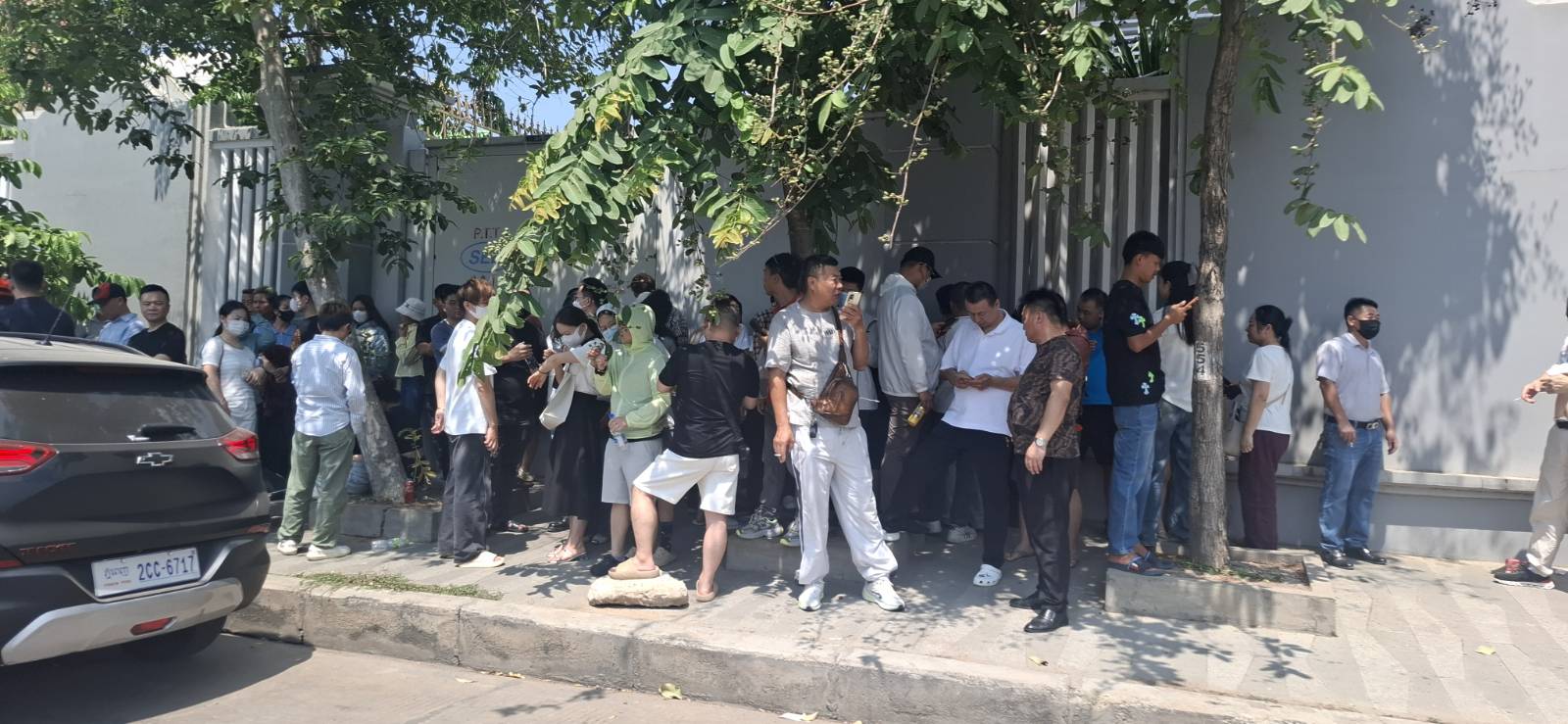
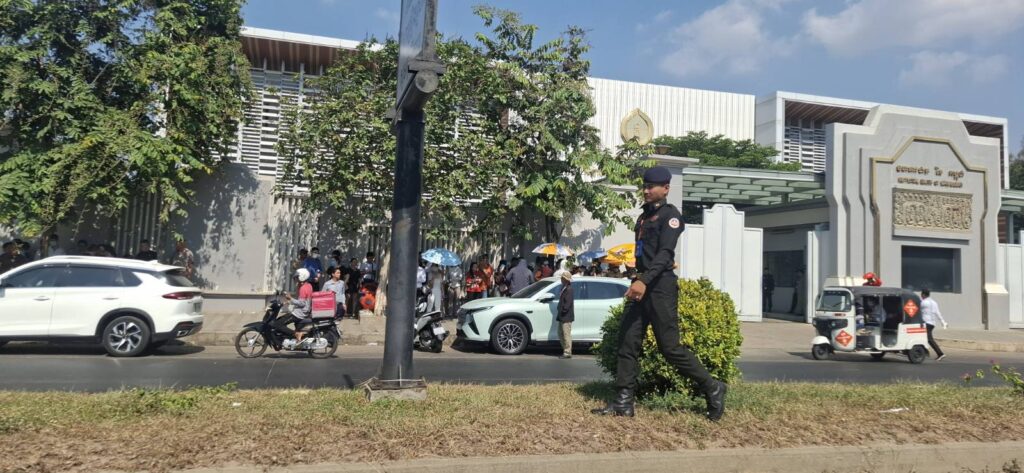
Huione customers say they are not satisfied with the National Bank of Cambodia’s response so far to their complaints, with roughly 200 people showing up outside the bank to continue seeking repayment of their frozen funds.
Customers distributed bottles of cold tea and pastries among each other in the 39 C afternoon heat, gathering outside the gate of the NBC headquarters from around 1 p.m. to seek a solution for their cases. There appeared to be more clients than the previous gathering of Huione clients on Friday, when about 100 people came to the central bank.
Discontent has been rising among users of Huione and H Pay — which are two different companies in official records, even though customers said in their experience H Pay was simply a rebrand of the original Huione Pay app — after former Huione director Li Xiong was extradited to China on April 1.
The National Bank of Cambodia publicly disclosed the liquidation of Huione Pay Plc. on December 3, adding that the bank had revoked its payment services license more than a year before and began liquidation in June. Meanwhile, customers of two other banks that had been recently liquidated — Panda Bank and Prince Bank — have met with the financial institutions’ staff and received reassurance about compensation.
Huione Pay and H Pay users say they received no such confirmation. Instead, the NBC sent a letter to customers, reviewed by Mekong Independent, saying “there is no sufficient basis” in the law for the government bank to assist clients’ complaints. Clients said they would continue to seek a solution, gathering again yesterday on Tuesday, April 7, after their previous demonstration last week.
Around 2 p.m., a district official came to address the crowd, asking the waiting clients to stay on the sidewalks in front of the NBC.
“When there are many people like this we do not know, any incident could happen. … When there are too many of you, it will impact the traffic along the roads,” he said.
Some members of the crowd asked the official, who didn’t offer his name, if the NBC would address them, and he asked if they had already seen the previous announcements from the bank.
“The solution is not up to me to decide, it is between the NBC and you. … We are local authorities and we can only do this.”
A Cambodian man in his 20s who sells clothes and other retail products said that the NBC had refuted customers’ claims for compensation because NBC had already taken action against Huione for several months. He added that he was able to still use Huione and H Pay services through the end of 2025 — a statement repeated by other clients.
“I was still able to withdraw money from H Pay at U Mall in Kampong Som province,” he said, using an older name for Preah Sihanouk province.
The man said that the NBC had told clients they should have claimed debts against Huione late last year, but customers were unaware of this announcement. “No one had received any information while people across the country still use it and Chinese bosses continue to use it to give salaries to workers, and businessmen still operate this [app] normally and exchange with Chinese currency.”
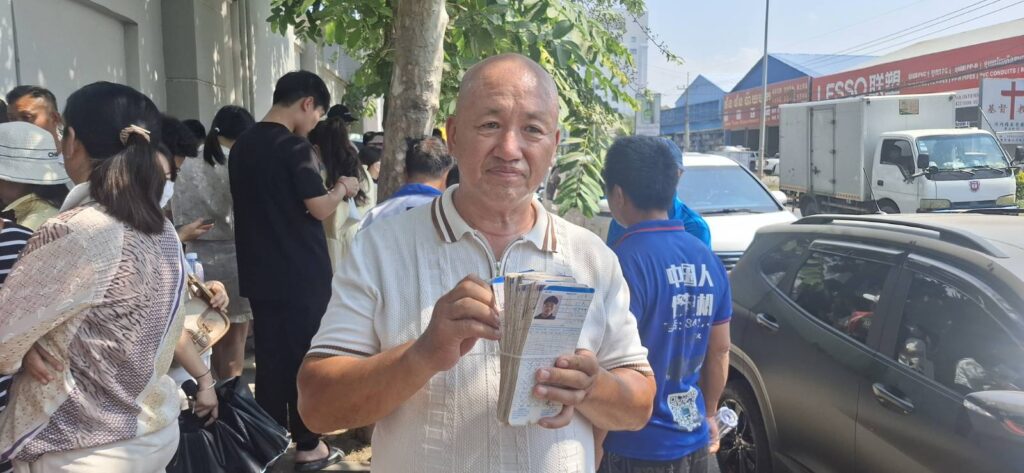
Wang Xijun, a Chinese construction company owner, showed a reporter a stack of cardboard paycards that he had brought to the NBC. Via another Huione customer who could speak English, he told Mekong Independent that he owed two months of salary payments to his 78 employees, but his funds were locked up in the H Pay system.
Via his peer who was translating, he asked a reporter to take a picture to show that “ordinary Chinese workers” were using the app, not just wealthy business owners and scam bosses.
A woman in her 20s added that her income was locked in Huione, as well as the salaries she needed to pay to her staff.
“Huione is like ABA … we need to take money to do business,” she said. “We have exchanged money that Chinese people [send] and saved up money. We have been using it for many years and it had been OK” until the accounts froze this year, she said.
She said she believed in the NBC to provide them a solution, which is why she joined the gathering on Tuesday.
Similar to other Cambodian customers of Huione, business owner Hao said he had adopted the payment app because he worked with Chinese clients. He said he was aware that Chinese customers made their payments in USDT and then it would be converted to dollars in the app. But Hao said he had never used USDT itself.
“I don’t really know how USDT works,” he said, but he knew it was a cryptocurrency weighted against the U.S. dollar.
Though he was aware that the company used cryptocurrency, Hao said he had been shocked to learn via the National Bank of Cambodia that the company lost its license the year before.
He was also under the impression that Huione and H Pay were the same company, as the payment app simply updated with a new name.
“May,” a Chinese business owner who asked not to use her real name to speak freely, told Mekong Independent that she questioned why the National Bank of Cambodia would treat Huione or H Pay as separate companies from Panda Bank or Prince Bank, whose customers have started to receive repayments. She noted that news reports and foreign governments have demonstrated links between all the companies.
“It’s just a different face but in reality they’re one,” she said.
May said she was in a Telegram group with more than 1,000 members, all of whom allegedly were Huione or H Pay clients who were filing complaints to the NBC. She said she would like to find a lawyer to take these cases but it required another investment.
She said she was also frustrated with the letter sent by the National Bank to Huione customers, saying she felt it was accusing small business owners of committing a crime, when it was the company that operated with cryptocurrency for so long, in spite of the NBC’s policy banning financial institutions from using digital currencies.
“We all welcome the crackdown on the scams, no one wants to fight that,” she said. “But the small vendors have no choice.”
This article is published as Creative Commons.
Correction: A photo caption previously misidentified a military police officer as a district security guard.