
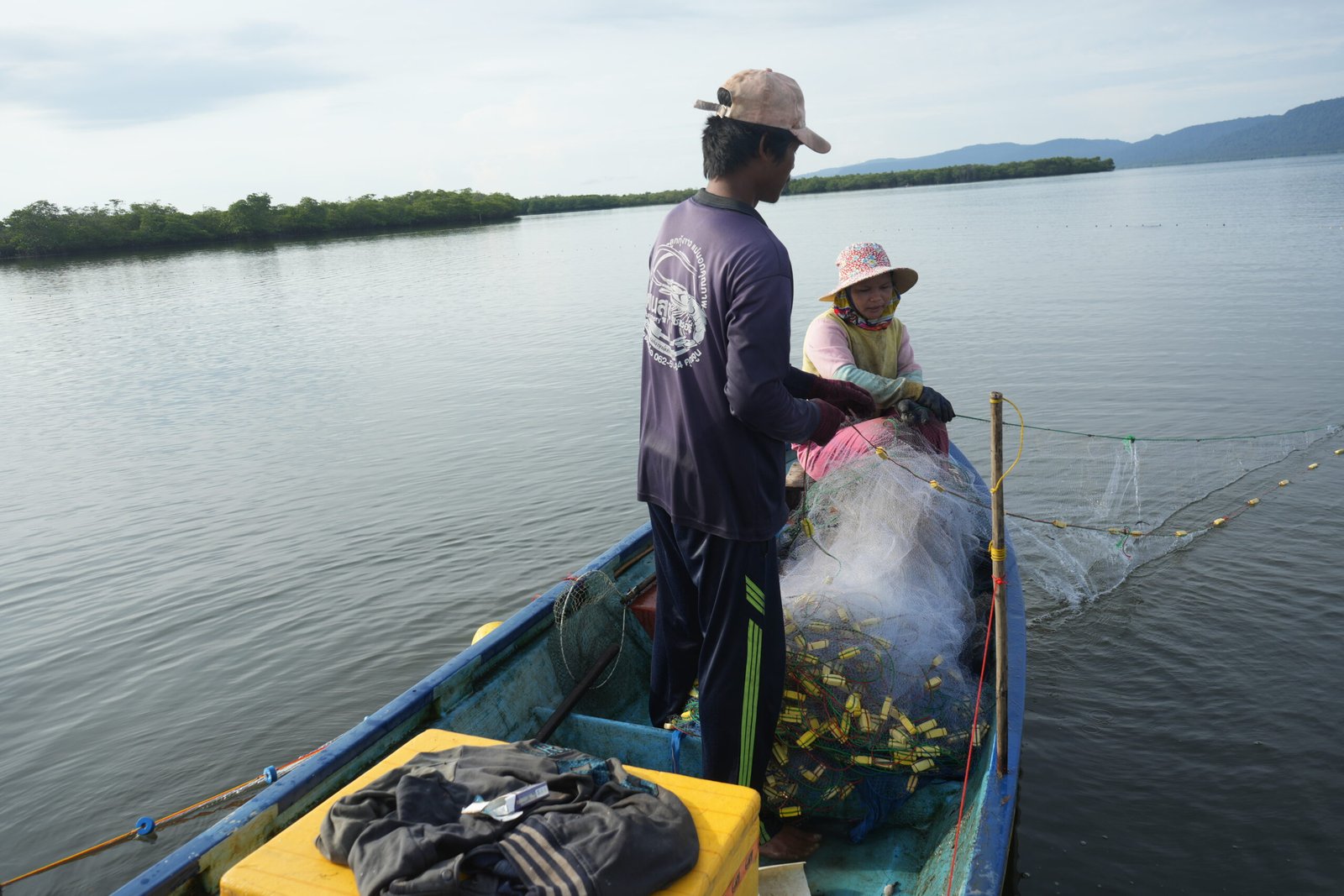
Koh Kong — As negotiators gathered in conference rooms to debate ocean-related policies at COP31 in Antalya, Turkey, Cambodia’s coastal communities were searching for solutions to both human-made problems like illegal fishing and how the changing weather was harming their community.
Cambodia’s coastal communities rely on fishing as their main sources of income but the impact of climate change compounded by the recent El Niño effect has put their livelihood at risk. They say they need direct support from the government to protect the marine resources for the sustainability of their community.
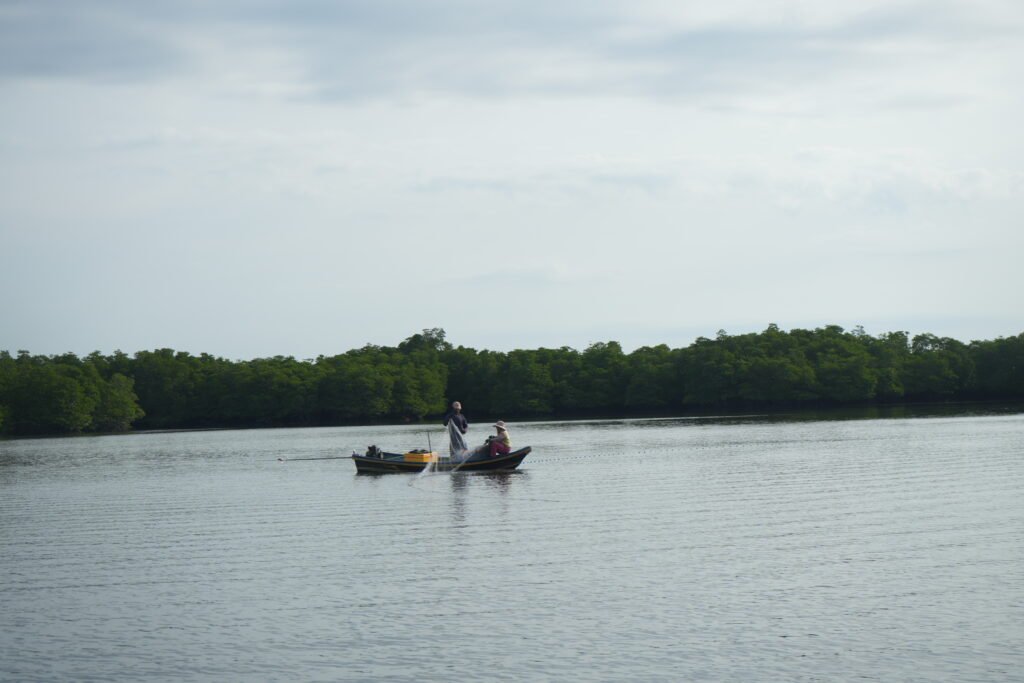
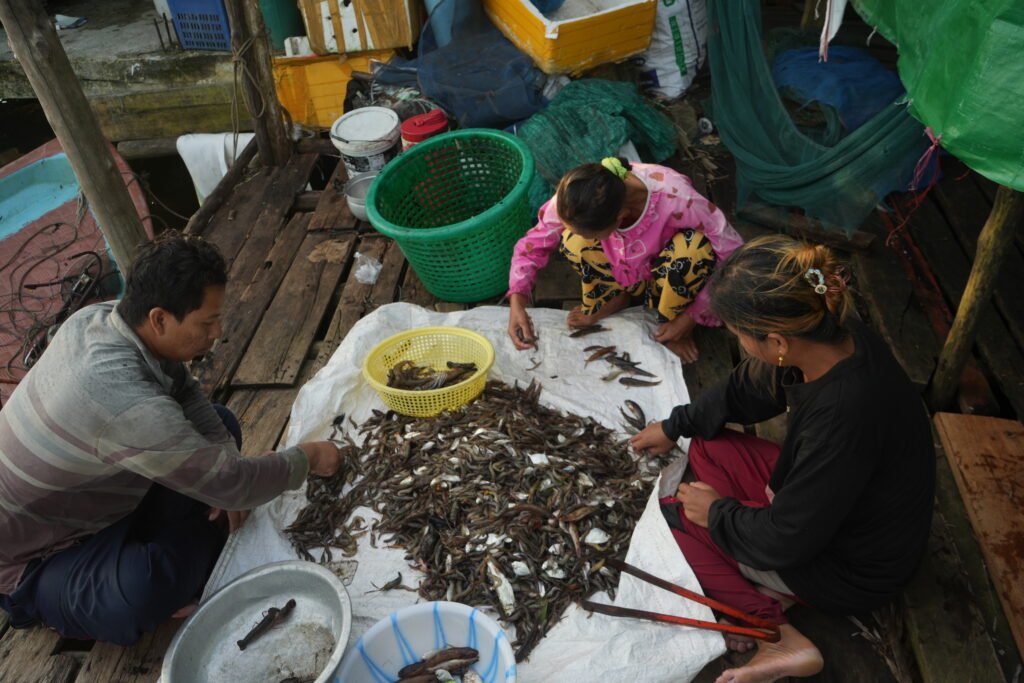
A resident of Koh Sralau island in the Peam Krasop Wildlife Sanctuary, Tuo Hiet, 60, said his community continues to face extreme heat, saying this year was the hardest year, with a stark difference compared to 10 years ago. Many residents go fishing to make a living by casting fishing nets, picking up crabs and other mollusks, but he said year by year the numbers of these ocean species have declined.
Peam Krasaop Wildlife Sanctuary has a tropical monsoon climate, with warm temperatures year-round — typically ranging from 22 C to 33 C with heavy annual rainfall of about 3,724 mm.
“I go fishing by casting nets but I cannot earn a good income from it now. I can earn only $7.5 to $10 at a time. If I deduct the petrol fee, I don’t have much left,” Tuo Hiet told Mekong Independent. “This year I heard that there will be more extreme heat. When the sea becomes hotter, those species would move to deeper areas. That will be more difficult.”
Tuo Hiet has been doing fishing for over 30 years since he first settled in Koh Sralau in 1993. He said the conservation effort in his community has been limited due to the community’s capacity, and that their voices are not equally included in policy discussion.
“The government has the policy, but we are simple city citizens. How can we claim such things?” he said. “The conservation is managed by the Fisheries Administration and we can only see their work.”
Mangroves feed community, protect globe
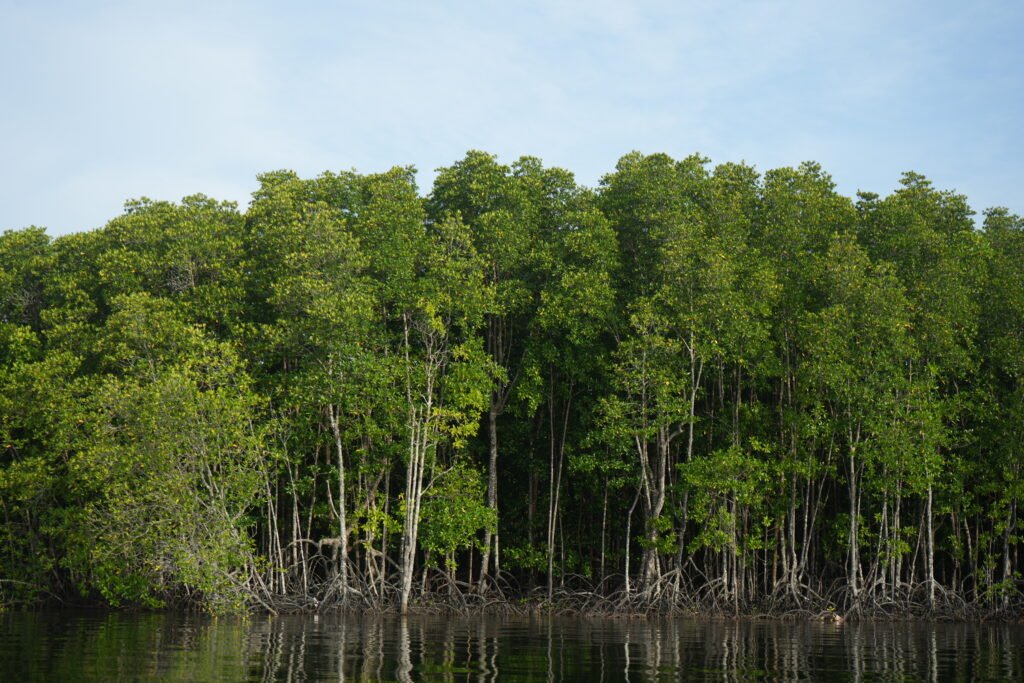
The Peam Krasop Wildlife Sanctuary and the adjacent Koh Kapik Ramsar site in Koh Kong province illustrate what is at stake.
A biodiversity survey by Fauna & Flora and the Fishing Cat Ecological Enterprise identified more than 700 unique species in the area using camera traps and rapid biodiversity surveys. The findings showed that Cambodia’s largest mangrove forest expanse is not empty space; it is a living system that supports wildlife, fisheries, carbon storage and coastal protection.
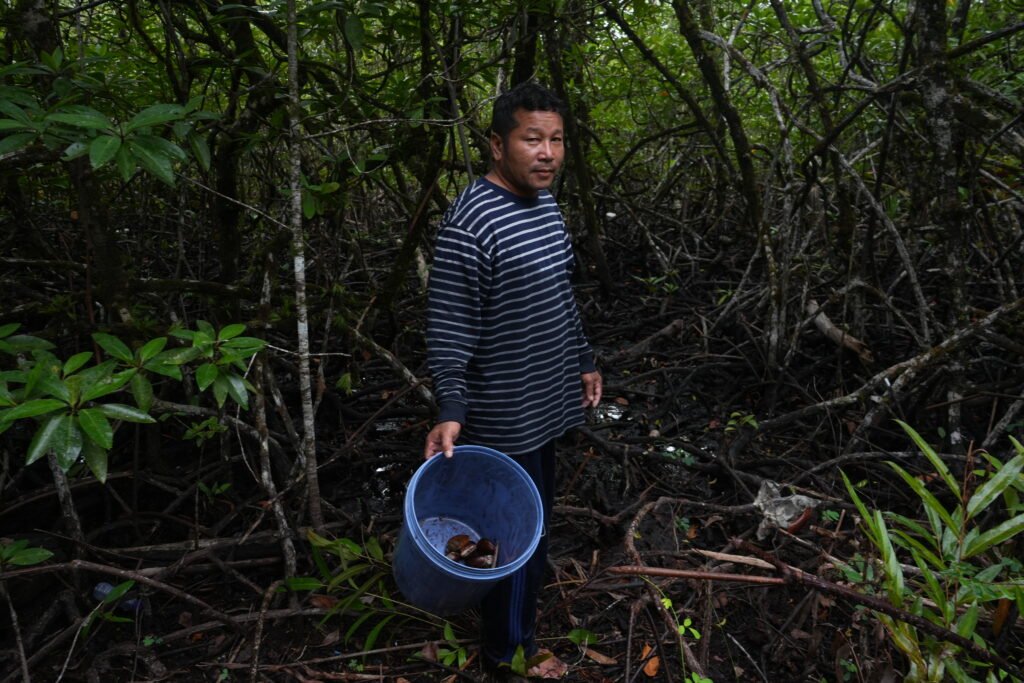
Phin Sophany, the deputy chief of Koh Sralau’s conservation committee, said the mangrove forest hosts many ocean species and provides food for the community.
“In 2015, the mangrove forest faced critical loss due to human activities, but we have worked to restore it. People also have knowledge of its significance.”
He wants to see the mangroves in his community continue to provide a barrier against climate change’s harshest impacts. But for now, support is still limited, he told Mekong Independent.
“If we want to sustain our community, we need to strengthen our own capacity so our community can last. People need to be aware of pollution, biodiversity loss, and illegal fishing,” Sophany said.
“Extreme heat really impacts our community, especially ocean species. So if we have money from developed countries to support local initiatives, that would be great.”
The Ministry of Environment has launched a project called Climate+ within the Peam Krasop Wildlife Sanctuary and the Koh Kapik Ramsar Site, covering approximately 31,000 hectares. This project is aimed at rebuilding degraded ecosystems, protecting fisheries, and linking conservation with community livelihoods and ecotourism.
Protecting mangroves in Cambodia serves two goals at once: reducing emissions by preserving carbon-rich ecosystems, and helping communities adapt to storms, erosion and sea-level rise. Like land-growing trees, mangroves both absorb and store carbon in their trunks, leaves and soils, while their root systems buffer coastlines and support fisheries-based livelihoods. For these reasons, climate experts globally are increasingly promoting the protection and expansion of mangrove forests and seagrass beds as vital “blue carbon” projects.
Parties pushed for ocean dialogue
Ocean topics are largely missing from the highest-level negotiation agenda at COP. Ocean appears mainly in side events, the Action Agenda, and a possible “cover decision,” rather than as a dedicated negotiating track with binding commitments.
At a press conference, U.N. Climate Change executive secretary Simon Stiell recalled this year’s pre-COP conversations in Fiji, highlighting the importance of the ocean in the agenda.
“I think it has been very helpful in raising the profile of this, and additional spaces being made here in Antalya to discuss this, and one would expect that that would be reflected in one way or another in the final outcome to continue to build that momentum,” he said.
However, civil society continues to push for the recognition of ocean solutions while needing to strengthen the ocean-climate dialogue within existing work.
In the draft text of COP31’s “cover decision” — or the main text of promises to come out of each annual climate conference — seen by Mekong Independent, parties recognized that ocean-based climate actions are integral. They also recognized the importance of adaptation, resilience-building, food security and poverty eradication.
The draft text says that the parties at COP31 “recognize” the importance of including oceans in the dialogue about climate change, and “encourage” efforts to include ocean-based climate action in the climate conference’s mandate, but the language remains loose enough that it’s not an obligation in future COPs.
Karen Landmark, managing director of the environmental nonprofit GRID-Arendal, told Mekong Independent that a strong outcome would connect coastal adaptation efforts with accessible finance, technical support and meaningful community participation.
“Its value will depend on what is delivered after COP,” Karen Landmark said.
“Coastal communities need funding they can actually access and use. Support to prepare a project can be just as important as the funding to carry it out.”
As the COP31 presidency finalized its decisions, it called for accelerated action to phase out fossil fuels, including through an “immediate transition away from fossil fuels in energy systems,” urging efforts to limit both the magnitude and duration of any overshoot of the 1.5 C temperature goal under the Paris Agreement.
Australia’s climate change minister Chris Bowen said the COP31 deal was issued early to allow more time for the strongest negotiations.
“This is the draft, the first draft. It won’t be the final draft. It is very much enabled, to enable consideration over the next week,” he said.
But the draft leaves questions about climate adaptation finance. According to an expert’s analysis shared to Mekong Independent, the draft includes no clear paths to meeting last year’s commitment to at least triple adaptation finance by 2035.
The U.N. Environmental Program has estimated earlier this year that developing countries will need around $305 billion annually by 2035 for climate adaptation, but international contributions toward climate adaptation were far below that figure, $28.2-31.7 billion in 2024.
Rebecca Thissen, global advocacy lead at Climate Action Network (CAN) International, during a press conference questioned whether the centerpiece agreement to come out of COP negotiations this year held any obligations to wealthier nations participating.
“Cover decisions, at the end of the day, have the danger of becoming a distraction, something that takes us away from the focus areas of those negotiations,” she said. “That’s where the questions are, and we should ask these questions to the presidency too.”
The question for Cambodia’s coastal communities
Cambodia’s challenge is to turn its Blue NDC Challenge commitment for coastal protection into a national plan with clear priorities, budgets and delivery mechanisms.
The Blue NDC Challenge calls on countries to integrate ocean-based solutions into their Nationally Determined Contributions, or NDCs — the national climate plans required under the Paris Agreement.
Practically, that means identifying which coastal ecosystems need protection, which communities are most vulnerable, and which projects can deliver measurable results. It also means ensuring that women, youth, small-scale fishers, and marginalized coastal groups have a voice in decisions about conservation and finance.
The Asian Development Bank’s Asia-Pacific Climate Report 2026: Coastal Risks on the Rise warns that rising sea levels, erosion and coastal flooding could cause annual damages of $172 billion to $199 billion by 2050 across 30 regional economies, rising to $520 billion to $739 billion by 2100 without stronger adaptation.
The report specifically identifies Cambodia’s coastal provinces such as Koh Kong, Kampot, Kep and Preah Sihanouk as facing severe economic threats. These provinces are home to fishing communities, tourism businesses, mangrove forests, seagrass beds, coral reefs and some of Cambodia’s most productive marine habitats, according to the report.
According to the World Meteorological Organization (WMO)’s data, the global average temperature from January to September 2026 was approximately 1.47 C above the pre-industrial level. A strong El Niño is expected to peak around December, and the WMO warns 2027 could set a new record.
During the Presidency High-Level Event on November 14, André Corrêa do Lago, president of last year’s COP30 in Brazil, said the Paris Agreement established adaptation as equally important to mitigation, and that the two directions advance together. However, progress was slow, he said.
“There is no difference when we agreed on the Paris Agreement that mitigation and adaptation should develop together,” he said. “Most importantly, we placed adaptation at the highest political level in the whole meeting in COP30 because people and communities on the ground were asking us to do so.”
How Cambodia implements its NDC
Cambodia’s Third Nationally Determined Contribution (NDC 3.0) was submitted to the UNFCCC in 2025. It raises the country’s climate ambition, including a target to reduce greenhouse-gas emissions by 55% by 2035 while strengthening adaptation and implementation planning.
By joining the Blue NDC Challenge too, Cambodia has committed to ocean-based climate action, and so mangroves, seagrass, and community fisheries should be visible in national budgets, adaptation plans and climate-finance proposals.
A World Resources Institute’s analysis found that 95% of coastal countries have included ocean-based climate solutions to their 2025 nationally determined contributions plan, up from 73% in the previous round in 2022 and 62% in 2015. However, many of those countries cannot afford to implement them.
More than 60% of ocean commitments depend at least partly on support from outside their national budgets.
Ambassador Carlos Márcio Bicalho Cozendey of Brazil, Co-chair of the Blue NDC Challenge, said in a statement: “Ambition alone is not enough. We must now ensure these commitments translate into concrete action, delivering real benefits for people, nature and the climate.”
In a panel on NDC implementation, speakers noted that countries require transparency systems in order to ensure that NDC commitments can be translated to results on the ground.
Sum Thy, director general of the General Directorate of Policy and Strategy at Cambodia’s Ministry of Environment, said producing reliable data on emissions, policies, finance and progress would help governments turn climate pledges into measurable results.
“I think it’s really important to be consistent with each other,” he said. “And this is about implementation, the planning that we are going to achieve.”
This article was supported by Informed Earth.