
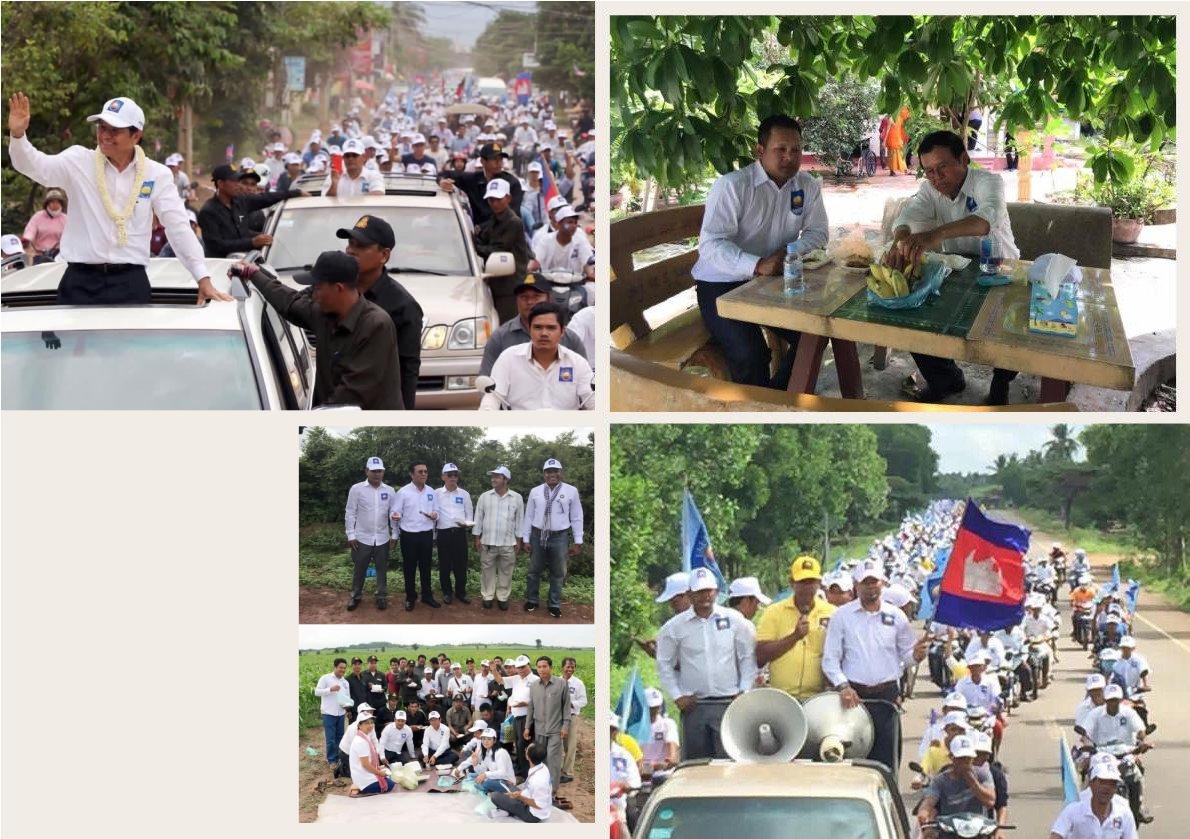
Prak Panh jumped aboard Kem Sokha’s political movement just as the Human Rights Party was getting started almost 20 years ago. Sokha, a celebrated human rights activist, had recently been released from prison, and Prak had just returned from a trip to Cambodia that left him feeling despondent.
When Sokha came through Prak’s hometown of Houston, Texas, in 2008, promising to bring democracy to Cambodia, he was all in. The doughnut shop owner said he has helped to “keep the message going” ever since.
Prak helped build the network of overseas support as the party became a formidable force within Cambodia; cranked up his efforts around the massive 2013 election campaign rallies and demonstrations that followed; then flew to Cambodia to join the 2017 commune elections, Sokha’s last before being placed under house arrest on dubious charges of conspiring with the United States to topple Cambodia’s government.
For most of the past decade, Sokha has been the symbol of resistance to former Prime Minister Hun Sen’s rule over Cambodia, staying in the country as many of his colleagues ran away or went to prison. But that image has been badly tarnished over the past couple of months.
In May, Sokha received a royal pardon that lifted his conviction, but left intact the court-imposed lifetime ban on political participation. Weeks later, Kem Monovithya, his daughter and a former senior opposition official herself, joined the government her father had long fought against, as a special envoy in the foreign ministry. The Sokha family was photographed meeting with Hun Sen on August 16. He called Monovithya “an excellent human resource for the nation.”
Prak, like many opposition supporters, is struggling to explain the developments. Sokha’s health has been declining, he said, and the pardon allowed him to travel to the U.S. in October to get medical treatment. As for Monovithya, maybe she sees a real opportunity to use her experience as a diplomat to help Cambodia, he suggested.
“I’m not gonna sugarcoat it,” he said in a phone call. “It’s a bad look. There’s no doubt about that. But I don’t know what’s inside her heart, you know?”
Others in the pro-democracy movement have come to a harsher conclusion.
“That’s called political suicide,” said Muong Nareth, a former Radio Free Asia personality who now hosts an online news show about Cambodian politics from his home in Long Beach, California.
“I feel like she has no kind of future strategy whatsoever,” he added over the phone. “It’s just like an opportunist, and then when the situation or opportunity avails itself, then grab it. And then she forgets all about the rest of the folks who have been fighting and supporting her all along.”
Nareth recently drew the ire of Prime Minister Hun Manet, Hun Sen’s son, who publicly mocked the commentator over his coverage of alleged Thai border encroachments, which the opposition accuses the government of failing to push back against.
The journalist said he still respects Sokha for his contributions to the fight for human rights and democracy, but feels like he “killed” his legacy. “He just gave in because Hun Sen cracked him, and that’s the saddest part, right?”
Mu Sochua joined forces with Kem Sokha when the Human Rights Party merged with the Sam Rainsy Party ahead of the 2013 election, forming the Cambodia National Rescue Party (CNRP). The former CNRP vice president now heads the nominally independent Khmer Movement for Democracy, and said she has “no idea” what Sokha is doing.
“The fact that Mona also came into the picture at the same time? It has to be a deal,” she said in a phone call from Providence, Rhode Island, referring to Monovithya.
“Why would he deal a deck that gives him no real viable cards?” she added of Sokha. “I don’t know.”
Sochua said she crossed paths with Monovithya in Geneva, Switzerland, where they were both attending an October 2 United Nations human rights meeting focused on Cambodia.
“I represent the diaspora, advocating for what, for human rights, for rule of law. She told me she’s advocating for the rights of the internally displaced people on the border. Huh? Because she works for Hun Manet,” Sochua said. “So forget about the rest. Forget about free and fair elections.”
Monovithya, asked via email for comment on the criticism, said she “can only give information on the issues of my mandate which is the border conflict and to some extent investment promotion in Europe.” She declined an interview request.
Opposition divided
Like Prak Panh, Rithy Oung was in on the ground floor of the Human Rights Party. He recalls urging Kem Sokha to start the party during a meeting in Washington, D.C. before it launched. Oung was already a trailblazing figure in the Cambodian-American community, having been elected to the city council in Lowell, Massachusetts, in 1999.
Prak and Rithy helped build a network of HRP supporters that eventually turned into CNRP-USA, an organization that helped fund Kem Sokha’s activities. A separate group, CNRP-North America, served the same purpose, but was started by longtime Rainsy backers. A brief effort to merge the two sides fell apart before the 2013 election was even held.
In 2018, Rithy, then the president of CNRP-USA, led a new merger push, combining with CNRP-North America to form a third organization, CNRP-America. Some Kem Sokha diehards, including Prak and Monovithya, opposed the move.
Prak says the Rainsy faction never viewed Sokha’s backers as equal partners, and wasn’t willing to commit to fair power-sharing arrangements. Rithy, who now leads the merged CNRP-America, said it made sense to join forces and pool resources.
“I still have faith in CNRP and I believe in unity. If you want to really bring justice, freedom, and democracy back in Cambodia, we have to work together as the parties that believe in the cause,” he said in a phone call from Lowell.
After the merger in 2018, the CNRP held a world conference in Atlanta, Georgia, where members elected Rainsy to serve as the party’s interim president until Sokha had his political rights restored. Sokha had taken the mantle after Rainsy fled the country under a torrent of legal threats.
Rithy said Sokha was always welcome back into his leadership role, if conditions allow and he’s “willing to speak for the people.”
“I don’t support what he does, but I can’t control his decision,” Rithy said of Sokha.
With Cambodia’s democratic space closed off for now, Rithy and the CNRP have largely turned their focus to organizing outside the country.
Rainsy, who formed his eponymous party in 1995 after a brief stint as Cambodia’s finance minister, announced the formation of the “Independent Cambodian Government of October 23” on that date last year, marking the anniversary of the Paris Peace Accords that created a framework for democracy in 1991.
Rainsy now leads the government-in-exile, with a cabinet that includes prominent opposition members from across the overseas diaspora.
To mark the anniversary this year, opposition members met in France to swear in members of the Khmer Overseas Citizens’ Assembly. Its first act was unanimously endorsing the mandate of Rainsy’s government.
The 47-member Assembly is composed of Cambodian pro-democracy activists from around the world; 15 seats for the U.S., 10 for Europe, six each from Canada, Australia and New Zealand, and two each from Japan and South Korea. Elections were held online during the first two weeks of October.
Seng Sophoan, president of the Khmer Overseas Election Commission, which organized the vote, said about 2,000 overseas Cambodians cast a ballot out of some 3,400 who registered. He said 63 candidates were approved to participate. Six applicants were rejected, he added, either because they did not have the required two years of previous democratic experience, or because they “have connections with Hun Sen.”
Asked if those parameters were rather undemocratic, he explained the nine-member commission took a majority vote on each applicant. “So I have to respect that,” he said during a stopover on his return trip from France to Canada, where he lives.
Sophoan hosted a series of debates between candidates that were posted to YouTube and Facebook. Assembly members range in age from 24 to 80-plus years old, he noted.
Keep it moving
Prak, from Houston, is not excited about Rainsy’s government or the overseas assembly.
“I don’t support it and I don’t agree with it, because if you really look at it, I mean, which country are you representing?” he said.
“I think what they should be focused on is trying to unite all the opposition party,” he added. “Because if you really look at it, he’s not united anybody. It’s just his own group of people.”
Sochua, who heads the Khmer Movement for Democracy (KMD), said it’s crucial to keep some momentum going, one way or another. The government-in-exile allows politically motivated members of the Cambodian diaspora to stay engaged, she said.
She started the KMD as a nonpartisan alternative to the CNRP, because many like-minded overseas Cambodians are worried about associating with a group that the actual government describes as terrorists. Sochua accused the ruling party of threatening to block people associated with the CNRP from returning to the country, or even revoking their citizenship.
“Even in the pagodas, the monks are not supposed to have us come and talk about politics. That is very, very clear. Many people now are very careful about not being seen with us because they say, ‘Oh, we have to go home. It’s not that we don’t believe in you,’” she said.
Cambodia’s Ambassador to America, Koy Kuong, is a regular presence at the large Khmer pagoda just outside Washington D.C. Speaking from the main prayer hall during Pchum Ben celebrations, he said Sochua’s claims were “100% false.”
“You know, I work here for all people. You know, my direct telephone on the website, on the Facebook, or the Cambodian community calling me — we just ask, how can I help you? I never ask what political affiliation you belong to,” he said.
He said declining support for the opposition was its own fault.
“They lie to the Cambodian community again and again, and then the Cambodian community realizes it’s lies; they know their propaganda is not true,” Kuong said, claiming the government only wants to unite Cambodians of all stripes.
Asked how that squared with the government banning many opposition figures from politics, Kuong said, “everything is according to the law.”
“Cambodia has no political prisoners, but Cambodia has politicians commit crimes, you know. So law is law. We try, you know, why not unify? Kem Sokha, before, and now they come to us. We accept. The government accepts,” he added.
Sochua thinks the government’s arrangement with Sokha was meant to remove the ruling party’s most formidable foe from the playing field ahead of commune elections next year and national elections in 2028.
While the government has come up with various ways to shut out some opposition parties, it has allowed others to operate — for now.
Yem Ponhearith, a longtime Sokha deputy, is now president of the Progressive Democratic Party. Rong Chhun, a prominent labor organizer who joined forces with the CNRP in 2013, is an adviser to the Nation Power Party.
Rithy, of CNRP-America, said his group supports Rong Chhun’s party “in spirit,” but not formally because of the legal problems it would create inside the country.
Prak said the remnants of the CNRP would be better off focusing their efforts on uniting opposition forces — both inside and outside the country. And he’s not ready to close the book on Kem Sokha’s political career. He said he still meets with members of CNRP-USA every few days to talk about getting the boss back in the mix.
“It’s hard to say a politician is done with politics,” Prak said. “I wouldn’t say he’s done. I mean, you know, he’s done right now because he doesn’t have the freedom to do so.”
This article is published as Creative Commons.