
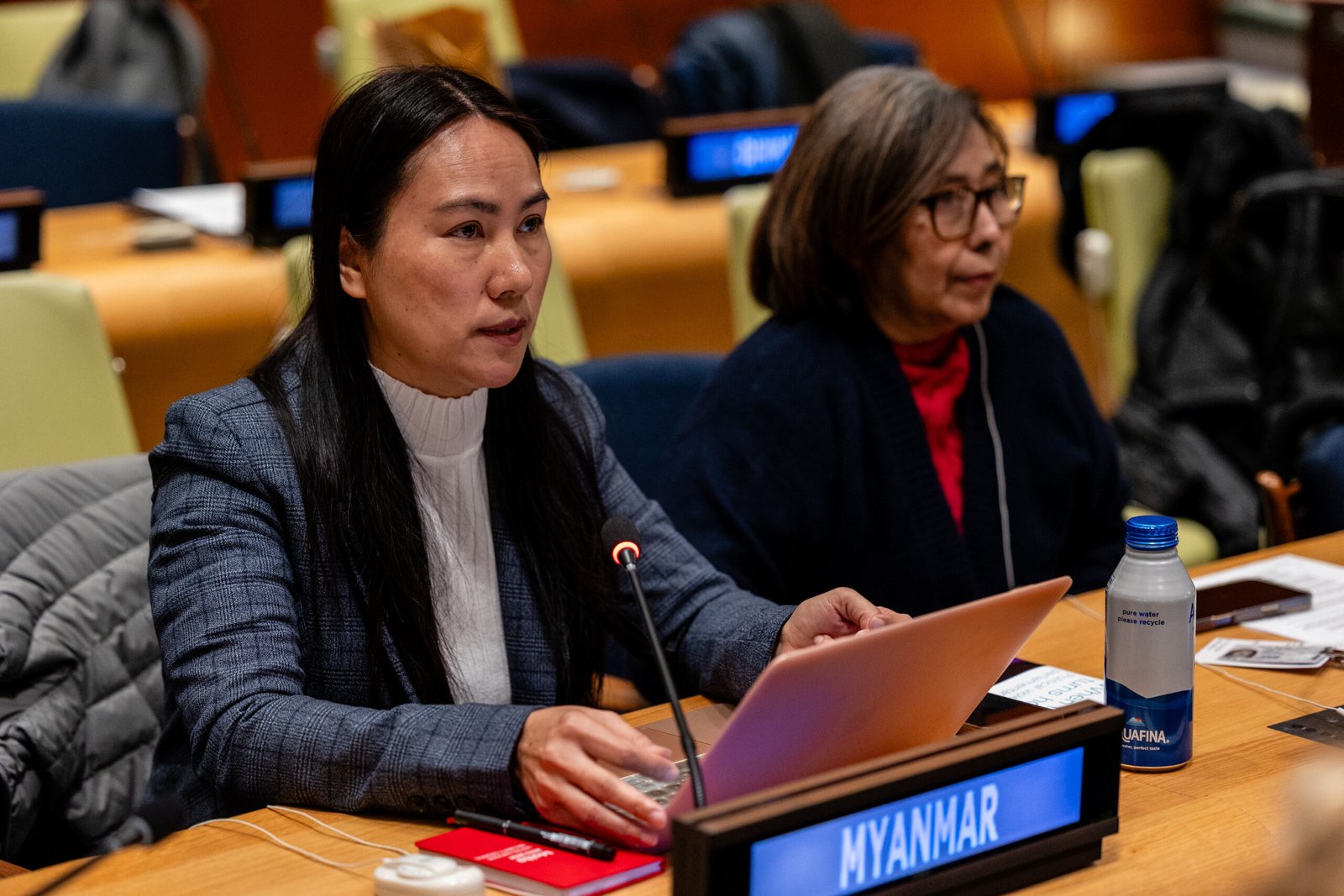
On the night of February 10, 2021, just nine days after the Myanmar military took control of the country with a violent coup, Myat Thida Tun received credible information that she was going to be arrested the next day. The former member of parliament of the National League for Democracy (NLD), the party of Aung San Suu Kyi that won Myanmar’s national elections in both 2015 and 2020, fled her home. She lived in the forest for three months, after which she relocated to the border with Thailand. Three years later she moved to the United States.
From the safety in her new home in the U.S., Myat Thida Tun is, just like thousands of other Burmese people who were forced to flee their country, confronted with a new political reality. Min Aung Hlaing, the general who took power by ousting the elected government of Aung San Suu Kyi over five years ago, has appointed himself as the new president of Myanmar. And in that role he is aiming to find international legitimacy for his government. Since April, he has already traveled to China, India, Russia, Belarus, Thailand, Vietnam, Laos and Cambodia for official visits. And just a week ago he made a highly criticized visit to Malaysia, a country that hosts tens of thousands Myanmar refugees.
For ousted politicians such as Myat Thida Tun, these visits are a major cause for concern. The former NLD MP is currently the chairwoman of the International Relations Committee of the Committee Representing Pyidaungsu Hluttaw, or CRPH, Myanmar’s parliament group in exile. “We are concerned that such high-level visits risk normalizing and legitimizing military rule in Myanmar,” she told Mekong Independent. “This is particularly troubling because, while the junta seeks greater international acceptance, its military continues to carry out air strikes against civilian areas across the country.”
One of those recent air strikes was near a market in Rakhine State, near the border with Bangladesh, and killed at least 50 people. Just two weeks later, air strikes killed another eight people in displacement camps. They were certainly not the first casualties. According to a report by monitoring group Armed Conflict Location & Event Data (ACLED), over 100,000 people have been killed since the military coup. Thousands of others are in prison for political reasons or under house arrest, including former leader Aung San Suu Kyi. Millions of others were forced to flee their homes and either live in internal displacement camps or in exile.
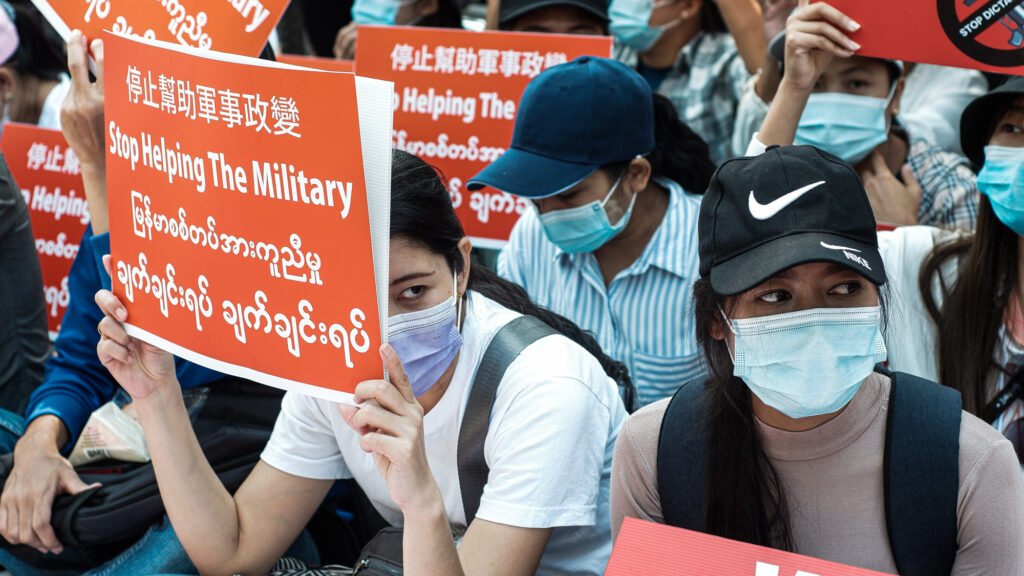
Protection of civilians should be priority
While Myat Thida Tun understands that countries want some diplomatic engagement with Myanmar, this should never become political legitimacy for military rule, she said. “International engagement should prioritize the protection of civilians and support a genuine political process that reflects the will of the Myanmar people.”
The former MP is certainly not alone in this. Many exiled Burmese people are against the official state visits by Min Aung Hlaing. Yadanar Maung, the spokesperson of activist group Justice for Myanmar, says she’s condemning the governments that invite the junta leader to their country. “These visits are an attempt by Min Aung Hlaing to legitimize himself as the ‘president’ following a sham election,” Yadanar Maung said. “He should be in handcuffs and held accountable for his crimes instead of enjoying red-carpet receptions from governments.”
The spokesperson of Justice for Myanmar warns that governments shouldn’t allow Min Aung Hlaing to “rebrand himself as a legitimate president.” Instead, governments should impose targeted sanctions to stop the flow of funds, arms, equipment and aviation fuel. “The military continues to kill innocent civilians from the air. Every barrel of aviation fuel that reaches the military junta enables its warplanes to terrorize the people from the skies.”
Malaysia made a U-turn
Min Aung Hlaing’s recent visit to Malaysia was especially troubling, activists and human rights experts say. Following the military coup, Malaysia’s prime minister Anwar Ibrahim initially called for solidarity with the persecuted Rohingya and offered a safe haven for those who fled from the conflict in the Southeast Asian nation. But the Malaysian prime minister has made a U-turn and recently rolled out the red carpet to welcome Min Aung Hlaing.
Malaysia seems eager to make a deal with Min Aung Hlaing regarding the repatriation of tens of thousands Myanmar refugees. Anwar Ibrahim has pointed to supposedly growing anti-Rohingya sentiments in his country. Some Malaysians allege that the Rohingya are stealing their jobs, straining public resources and are involved in crimes.
Speaking at a press conference the prime minister said that “the refugee issue has continued to worsen over the decades, causing growing concern among Malaysians” and that he wants to find an “amicable solution.” Anwar repeatedly said that he had no choice but to negotiate their return and that a repatriation will be voluntary, safe and dignified.
After meeting with Min Aung Hlaing, the Malaysian prime minister announced that his country would work together with Myanmar to repatriate thousands of people and that his government would do “whatever possible” to ensure Myanmar was re-integrated into ASEAN, the intergovernmental organization of Southeast Asian countries.
Instead of rolling out the red carpet, Malaysia should have arrested Min Aung Hlaing, said Tun Khin, a prominent Rohingya activist and the president of the Burmese Rohingya Organisation U.K. “The Rohingya fled the very crimes for which Min Aung Hlaing is now subject to international arrest warrants. Seeing him welcomed in a country that shelters survivors of those crimes sends the wrong message about accountability.”
Welcoming Min Aung Hlaing to Malaysia was like handing a note of legitimacy to him and his government, said Charles Santiago, a Malaysian politician and the co-chair of the ASEAN Parliamentarians for Human Rights (APHR). “This is quite shameless on the part of Malaysia. It’s allowing Myanmar to run the show. Malaysia is beginning to provide legitimacy to an illegal president, while the Myanmar government is bombing its own people.”
According to Charles Santiago, there’s a real chance that many of the deportees will be conscripted and sent to fight in Myanmar’s brutal war against insurgents. Others may be killed or imprisoned as soon as they return to Myanmar, the human rights defender said. “But somehow Malaysia thinks it’s going to be OK.”
Engagement with the Trump administration
In the meantime, Min Aung Hlaing is hoping for more. In a rare interview with Time Magazine, the junta leader said that he wanted to rebuild ties with the West and that it “would be ideal” if the United States could help Myanmar.
And just last week, Reuters reported that the Trump administration had recently begun direct talks with the Myanmar government. Although these talks focused on securing the release of Adam Castillo, an American businessman who was arrested in Myanmar last June, and shutting down scam centers, they could lead to broader engagement. According to a statement by the U.S. government, the need to cease violence and release of political prisoners was raised, Reuters reported.
Charles Santiago strongly doubts that the increasing engagement with the Myanmar junta will benefit the Burmese people. “It’s quite bleak now, to be very honest. And the more I see, the bleaker it gets. They’re going to have support from China and Russia, and I think the civil war is going to be more intense. That also means more people are going to flee the country.”
Judge the junta by its actions
Thousands of miles away from her home country, Myat Thida Tun warns that engagement with the military rulers of Myanmar should not be unconditional. “Governments and businesses should judge the military authorities by their actions, not their promises,” the former MP said. “The reality on the ground remains one of continued violence. Air strikes against civilian areas, including the internally displaced camps, continue even as the military seeks greater international acceptance. In such circumstances, restoring normal political or economic relations without meaningful conditions risks sending the wrong message and could provide resources or legitimacy to those responsible for the violence.”
Even though there’s no indication that the conflict in her country will end soon or that the military leaders will step down, Myat Thida Tun remains hopeful that one day Myanmar will be a peaceful and prosperous country. “Our hope comes from the determination of the people of Myanmar, who continue to struggle for freedom, democracy and dignity despite enormous suffering. We do not simply want to return to the Myanmar of the past. We want to build a better Myanmar, one based on democracy, federalism, equality, human rights and accountability, where all ethnic nationalities and communities can live with equal rights and dignity. It will take time and sustained international support, but we believe this future is possible.”
This article is published as Creative Commons.