
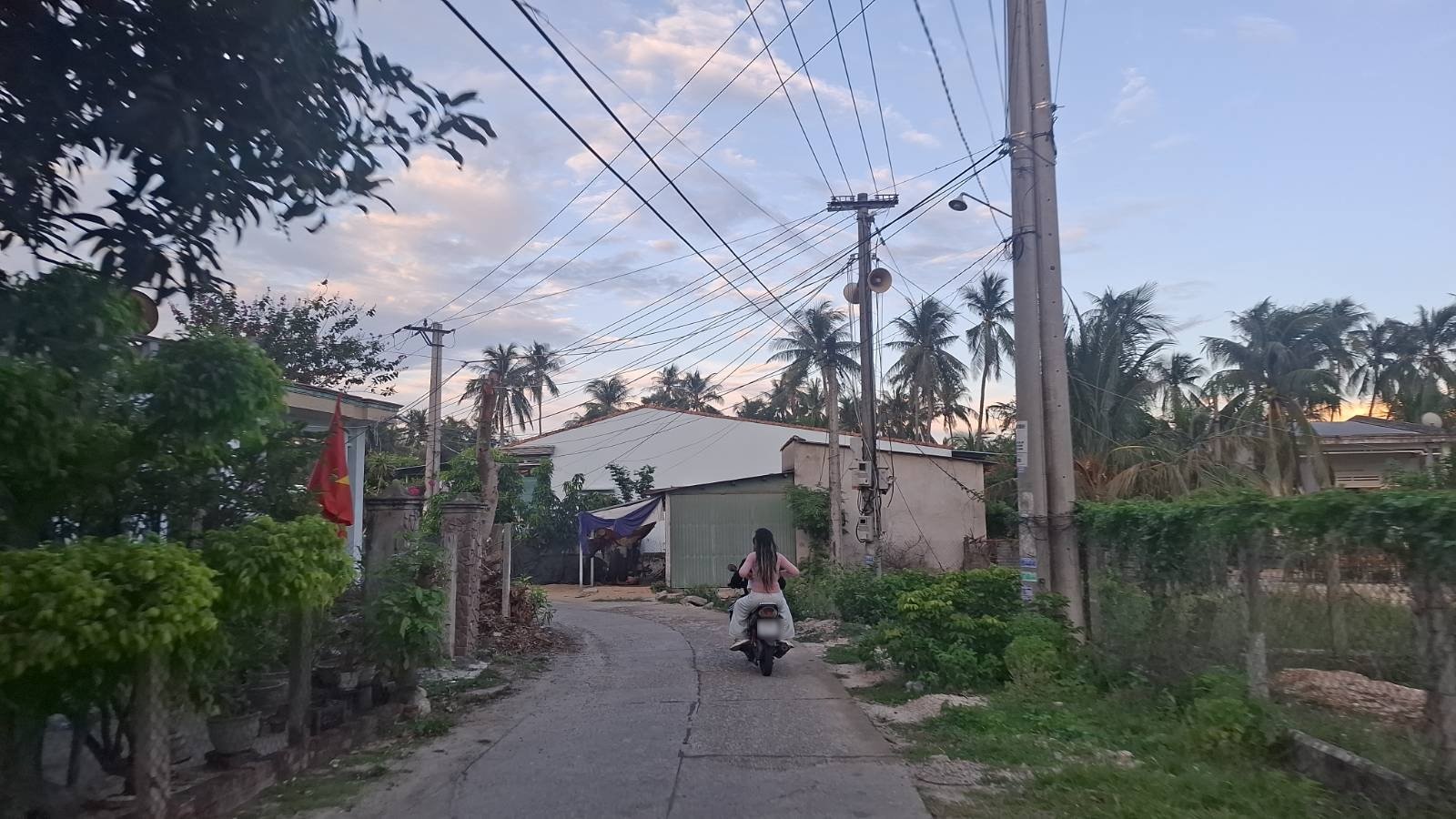
In the last several years, H.’s parents decided to turn their spacious yard into a restaurant, hoping to impress with their steamed chicken and trout soups but attracting few visitors in their quiet seaside village in Central Vietnam.
H. has his own vision. He wants to turn their land into a mushroom farm, which can earn pretty sizable returns on their investment, while opening a new, uncommon market in his neighborhood. He just needs the income to start.
H. and his wife T. have always been thinking ahead, even through the worst year of their lives.
The gig abroad that was meant to give H. and his family the money they needed to start their dreams instead sent him into a network of human trafficking and online scams, like uncountable other Vietnamese nationals. H. and T. are now clawing their way back into a life of normalcy, after H.’s unintentional trip to Myanmar — and the social pressures after — nearly ended his life.
As T. puts it: “Because we have survived such turbulent times, we can survive anything together.”
Human trafficking has changed shape in Vietnam in the last few years.
The U.S. government’s Trafficking in Persons report on Vietnam from 2025 counted more than 5,000 Vietnamese nationals trafficked into online scamming since 2022, but notes that many potential victims do not report their cases as human trafficking.
The Hà Nội-based children’s rights and anti-trafficking organization Blue Dragon noted a rise in this new type of trafficking throughout the 2020s, which has primarily targeted young men in economically vulnerable or unstable positions.
Though there have been crackdowns ongoing that have returned from Myanmar and Cambodia, the same factors, of economic hardship and limited opportunities, are still drawing people out, said Ngô Minh Hiếu, a cybersecurity professional whose work has led him to both investigate and assist enslaved workers in the scam industry.
“A lot of scam compounds are building up over there, it’s crazy. Scary too, they’re very brutal,” he said, flipping through chats he maintains with other Vietnamese workers still stuck in Myanmar. “They got lured by fake job advertisements on Tiktok and Facebook reels, they trick them that they will get a good salary job in Thailand and they lure them to Myanmar.”
And even when they return, workers say they struggle to find peace.
Not enough to survive, thrive
Blue Dragon did not refer journalists to the people the nonprofit aided, but instead shared the story of Hung, a 27-year-old from northern Vietnam who had worked cleaning and construction gigs. He followed an innocuous job offer, feeling he could never earn enough in Vietnam to get his family beyond a survival level, according to the nonprofit. Instead, he was trafficked in Myanmar’s Shan state and forced to scam other people online.
The nonprofit said he had endured human trafficking, beating, detention and torture with electric prods in multiple compounds, saying he was sold several times in the three months he was there. He managed to escape with a group of other Vietnamese victims, and not all made it out. Blue Dragon said he had contacted the organization but still did not trust them at first; they eventually gained his confidence and were able to help him and a few peers return to Vietnam and help provide information to authorities.
H. too said he answered a similar urge. Commitments to his family and peers began to pile up, and he wanted to earn additional money as his son started to go to school. He had successfully worked in online gambling in Cambodia for two months in the past, earning around $900 each month before returning to his family. One of his former peers from Cambodia was the one who recruited him to an alleged job “in Thailand” — that led him across the border into Myawaddy, Myanmar.
In forced criminality, the victims are now predominantly male and Kinh, Vietnam’s majority ethnic group, different from previous trends in human trafficking, of young women being trapped into becoming brides or sex workers in China and other countries, observed in Vietnam. In trafficking for forced criminality, 60% of traffickers and victims were from ethnic minority groups, of which the Hmong people make up roughly one-third of the reported cases. Workers don’t just come to find jobs in Cambodia, Laos or Myanmar, but they are recruited via acquaintances, family or a network of group chats run by Vietnamese to recruit their peers into risky but seemingly lucrative jobs abroad.
Blue Dragon’s survey of 21 cases involved 43 traffickers, but the organization also noted that about a quarter of those traffickers were also victims of human trafficking, as workers in forced criminality were also forced to recruit.
Blue Dragon was already involved in anti-trafficking efforts when it began working with victims of forced criminality, said Lại Thanh Hằng, program manager at Blue Dragon. But responding to forced criminality cases required “a big shift in their needs”, towards both economic recovery and psychological support for the trauma they endured.
H. detailed some of his memories of endless work and brutal torture inside the compound. But more telling was the newfound numbness he felt. He could see bloodied injuries and acts of violence with no reaction, because he had witnessed so much brutality in the compound.
“I don’t know how to explain it, but it’s like seeing someone slaughter a chicken,” he said. “At first, the blood terrifies you, but after seeing it many times, it feels normal.”
H. said he later used this feeling to join a charity rescue team that provided first-aid to traffic accident victims before the ambulance arrived.
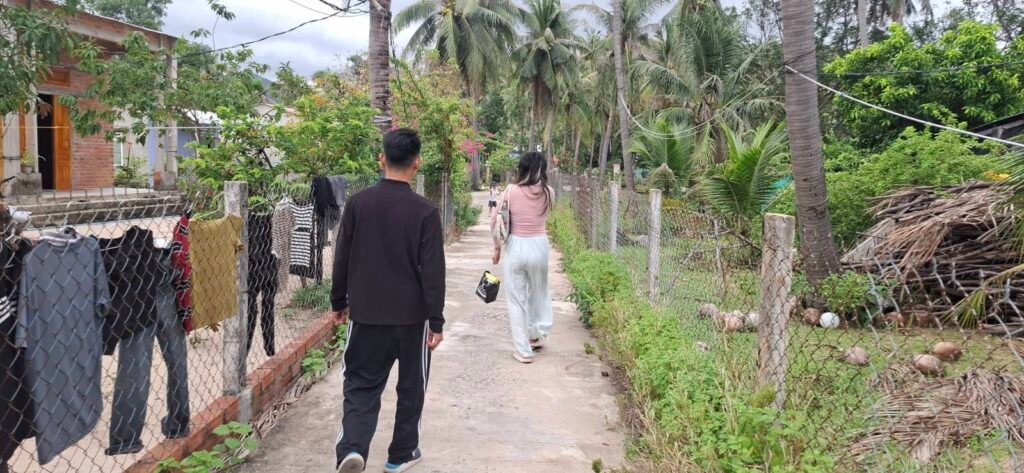
The cost of freedom
In the stories of trafficked scam workers that reporters encountered, mothers and wives were often the frontline fighters who got the survivors back home, and upon returning, back on their feet.
With her husband held captive in Myanmar, T. became his “pillar,” she said.
“I cried for exactly one night after he told me he’d been tricked. Then I pulled myself together, like: That’s it. Now I have to be my child’s anchor. If I’m sad, it’ll affect the child, so I forced myself to stay calm and find some way to get [my husband] home.”
T. had transformed her life to power through the situation. Her days would be spent working 12-hour schedules, supporting her young son by selling fried noodles, intestines and other snacks in any way she could. She could earn 200,000 VND (about $9) per day — it was enough for mother and son to survive. T. had little knowledge of what was happening to her husband, hundreds of kilometers away.
“Just from how he told it, I could sense that you never knew when you might die,” she said. Surviving on her own took a lot of strength too, saying she went to the temple anytime she could to pray for her husband’s return.
Together, they started looking for solutions online. H. found Ngô Minh Hiếu and his nonprofit Chống Lừa Đảo online. T. researched scam rescues and contacted journalists. Finally they got in touch with a famous travel vlogger, Phong Bụi, who became a household name out of negotiating ransoms with scam bosses to free detained Vietnamese workers who wish to leave.
H. ran out of the compound on his own, but Phong Bụi and Ngô Minh Hiếu together helped him manage to travel from Myanmar to Vietnam. H. says the pair paid a total of about $3,000 to help get him back, a number that Ngô Minh Hiếu corroborated. Phong Bụi did not respond to requests for comment.
People like Phong Bụi come in when scam victims and their families fail to seek or receive support from the authorities. When her teenage daughter was lured into scam work in Myanmar, Vy contacted Phong Bụi for help, she told Mekong Independent. Phong Bụi offered to pay for her daughter’s 80 million VND (about $3,000) ransom, and, in return, her family’s story would be a piece of content for his vlog series on rescuing people out of criminal compounds. Rescue efforts are funded by viewers’ donations.
Former scam workers who spoke to Mekong Independent said they made a small amount of income in forced criminality, but it was never the amount promised, debited for expenses and spurious “fees,” or not paid at all. So most, including H., said they returned to debts higher than when they left.
H.’s story was also posted on Phong Bụi’s social media channels, and thus seen by relatives, friends and neighbors who learned of the family’s experience. They did not view it with understanding, the couple said, sending the young man deep into a dark spiral.
A long-term recovery
For survivors, the immediate concern is economic recovery, but advocates and family say survivors cannot hide the depth of their trauma from forced criminality.
When Lại Thanh Hằng and Blue Dragon’s case workers first start working with a survivor, they usually find they immediately pour themselves into the search for job opportunities and vocational training courses.
As Lại Thanh Hằng explained, resolving this economic tension requires observing the survivor’s circumstances, creatively using regional resources and, when possible, involving families.
For example, Blue Dragon might help find ways to improve a survivor’s family farm or help them find jobs or vocational training that are popular in their region. Survivors are often focused on trying to recover their funds quickly.
“For this type of survivor … we can’t really offer them a long-term vocational training course,” she said. “They say they don’t want to study for too long because they need to earn money.”
However, the trauma usually starts to surface after some time.
Since her teenage daughter’s return from Cambodia, Vy, the mother of a scam compound survivor, described her child as becoming “unstable”: She would startle easily, and couldn’t sleep peacefully at night. She refused to return to school, so they sent her to a government-subsidized trade school to learn hairdressing, but she eventually found work at a factory in the regional industrial zone via family friend’s reference.
“Even after finishing the training, working here wasn’t stable for her — she couldn’t open her own shop, she didn’t have the means to. So she went to work [at the factory] instead, because [hairdressing] didn’t pay much, and it was only part-time,” Vy shared.
In order to try to break through the barriers that prevent people from seeking help, especially their loss of trust, Lại Thanh Hằng said Blue Dragon case workers approached survivors carefully, never imposing the need for mental health support onto the person they were helping.
“Instead, we ask if you have problems with your sleep or do you dream about your past experiences, or when you have any anger or disputes, if you feel uncontrolled when you get angry,” Lại Thanh Hằng said. By starting the conversation there, the social worker can offer constructive solutions like dietary assistance or anger management that may help the survivor begin to approach the deeper trauma they hold, she explained.
But not all survivors have the luxury of supportive families, and according to Lại Thanh Hằng, family can be one of the key factors that prevent survivors from falling into deeper issues.
She remembered that in one case, the father of a survivor came to resent his son for the amount of money the family had to pay, making negative comments to Blue Dragon and others.
“When we see that, when the father doesn’t support nor have sympathy, the social worker spends a lot of time and also effort to work with the father,” Lại Thanh Hằng said.
T. was the one who realized how badly her husband H. was struggling. When he first got home he was “OK, but thin.” But when they realized that H.’s escape from Myanmar had been published on social media, the young man became depressed.
“Regarding mental health, even though I made it home safely, the words, the stares, and the constant whispering caused me much greater stress,” H. said.
T. said she watched her husband become listless and morose.
“He was always in a state of dark, brooding thoughts. Partly because he’d just come home and hadn’t found stable work. … His morale just dropped sharply.”
One night, he disappeared. T. recalled that she took their 5-year-old out and they went around their hometown, calling out for him. She later learned he sat on the ledge of a bridge for hours, contemplating jumping off of it.
Ngô Minh Hiếu, the cybersecurity expert who kept tabs on H., said he started to worry about the young man and others who return from forced criminality. He sees parallels from his own experience, after returning from incarceration in the U.S. for hacking and selling personal data from U.S. citizens. When he returned to Vietnam after more than six years in detention and prison, Ngô Minh Hiếu said he wouldn’t have been able to rehabilitate without care from his family.
“I got lucky,” he explained. “I had good family support, but other people, they don’t know, or maybe their family doesn’t know. Maybe they have family support but they don’t know.”
He saw the relationship between H., T. and their young son to be the root of H.’s survival.
Unexpected achievements
H. always wanted a challenge. It’s how he found tourism as a career at first. He enjoyed the creativity he could employ by listening to travelers’ requests and coming up with the right solution to give them the experience they wanted.
“By nature, I don’t like feeling tied down,” he told a reporter, almost a year after he had returned from Myanmar. “So when it comes to work, if I’m being truly honest, I like jobs that offer challenges and variety. I don’t want to do a job that repeats itself day after day.”
The staff of Blue Dragon identified a similar strength of self, courage and creativity in Hung, the man who had escaped from Laos and is now rebuilding his life in Vietnam with support from his family and the nonprofit.
“When recalling the difficult experiences he went through, Hung faced them very openly,” his social worker shared in a message. “He did not treat them as something to fear or avoid but rather accepted them as part of his story and used them as motivation to care for his family and work toward a better life. Above all, Hung carries a sense of positivity and hope for the future, believing in his ability to move forward and refusing to let fears of the past define him.”
Almost a year out from his return to Vietnam, H. said he was close to repaying his debts, and the family should be able to stabilize their finances by the Tết new year holiday.
His experience in Myanmar was not the opportunity he set out for, and in the end set his family deeper into debt. However the love from T., their son and his parents was enough to keep him from sinking into depression.
“I view it simply as an experience from which I learned many things. I gained knowledge and drew lessons for myself,” he said. “It was a life lesson, so I don’t dwell on it much anymore.”
Ngô Minh Hiếu sees more impact from H.’s experience.
The cybersecurity expert shared a report to Mekong Independent of information that he was able to obtain from H.’s time in KK Park, the notorious Myawaddy scam compound that has been known for taking brutal actions against workers forced into criminality. After successfully unlocking the work phone that H. swiped from the compound, Ngô Minh Hiếu recovered dozens of cryptocurrency wallets, as well as website addresses, Telegram usernames and other information he can investigate to try to unravel more information about these complex, opaque operations.
KK Park is a well-known scam compound that was reportedly raided and destroyed by the Myanmar junta in early 2025. Ngô Minh Hiếu has said that the information that H. passed on would be challenging to get without his cooperation. The five months H. spent in Myanmar, from June to November 2025, corroborated by location pins that he sent to the cybersecurity expert, also raises questions about the Myanmar government’s narrative that it had holistically raided KK Park at that time.
Ngô Minh Hiếu said most of his work with victims advances his understanding of the scam industry and its operations. But part of the reason he engages with victims is because they have few other motivational voices amid a dark time in their lives.
“I try to encourage them, but when you talk like that it’s good for that moment, but I don’t know the next moment because they have family, they have kids so it’s sometimes very difficult for them.”
He told Mekong Independent that he worries about the future of the victims of forced criminality, noting that people still accept suspicious jobs abroad, while scam compounds grow more hidden, brutal and thus harder to escape. Earlier this year, he got a short message from one of the men that the cybersecurity expert had previously helped escape scam work.
Ngô Minh Hiếu translated the text out loud: “Sorry, guilty, Cambodia.” The man that he helped return to Vietnam allegedly went abroad again in search of another scam or online gambling job.
“I feel the pain,” Ngô Minh Hiếu said. “They need a job, they need to do something but it ends up they can’t do something [at home], so they try to run away from there and they try to do illegal stuff. Some of them are willing to do scams, to do illegal stuff. After [their experiences], they don’t mind.”
T. said that this was among the lessons she realized from H.’s experience abroad. She found unparalleled strength in herself to reunite their family, and keep them together as her husband was quietly suffering. But from her own side, she had learned from this trafficking experience how easy it was to strive for more, and take oneself too far.
“Because of money pressure, people all go,” T. said. “Now we can warn or tell them to be careful and so on, but they’ve already reached the end of their rope. When people want to make money, they all go.”
This article is published as Creative Commons.