
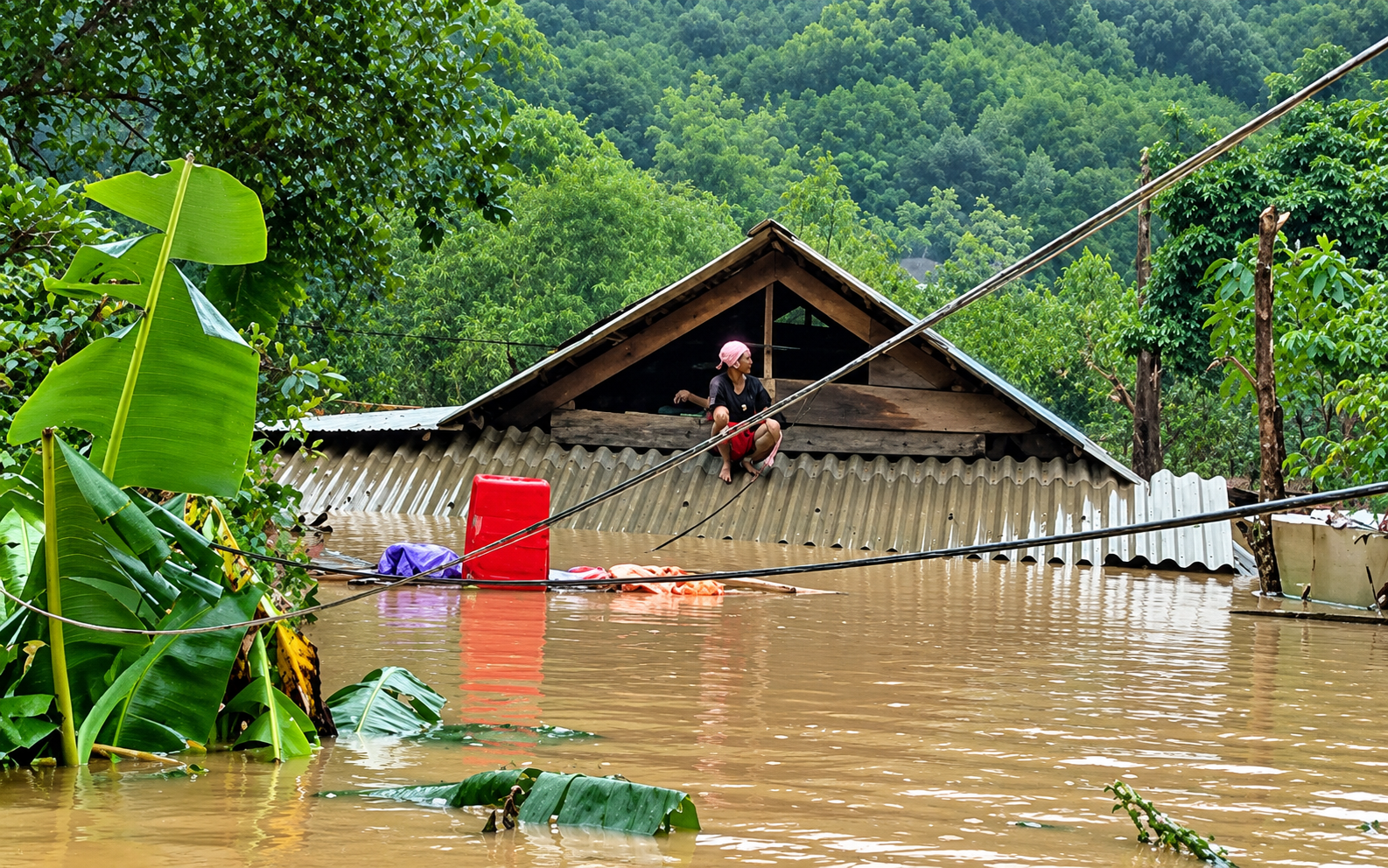
Even though the 2021 coup in Myanmar put his media house — founded just a few years earlier — in jeopardy, Naing had not thought of leaving the country. A seasoned video journalist, he felt compelled to stay on the ground to continue reporting.
Yet things came to a head in 2023 when his close friend and colleague Sai Zaw Thaike, a well-known photojournalist, who was working for the independent outlet Myanmar Now, was sentenced to 20 years in prison with hard labor for treason, defamation, disinformation and agitation against public officials, the longest prison sentence handed down to a journalist since the coup. His crime: covering Cyclone Mocha in Rakhine State in May 2023.
“When journalists expose news that the military doesn’t want revealed, they are prosecuted under the Official Secrets Act and charged with state treason,” says Naing, who spoke under a pseudonym for safety reasons.
According to Naing and several other Myanmar journalists interviewed for the article, Sai Zaw Thaike’s coverage exposed the junta’s inaction during the cyclone that affected 800,000 people.
“The military did not provide proper assistance to the locals suffering from the Cyclone,” says Naing. “They also withheld information about the cyclone from the public, and due to internet blackouts in those areas, many of the locals died because of the cyclone.”
Naing says Sai Zaw Thaike was so tortured in prison that he blurted out names of colleagues who contributed to the reporting of the cyclone, including Naing. Sai Zaw Thaike was not allowed to have a lawyer. His newsroom had to be relocated to Australia.
When Naing returned home from a trip abroad in 2023, he realized that his phone number was blocked and his bank account was frozen. His hunch told him the government was taking action against him. After bribing someone to access the government’s warrant list, he discovered his wife was also wanted. He made a swift decision: Flee the country to avoid arrest. His wife, seven months pregnant, would join him in Thailand later.
“I am not upset because he had revealed my name,” says Naing. “I only care about his health.”
Despite Sai Zaw Thaike’s deteriorating health, prison authorities have denied him adequate medical care.
As of 2026, the Lower Mekong region, home to 200 million people, is among the world’s most climate-vulnerable regions. According to the 2025 WorldRiskIndex, Myanmar (ranked 6th), Vietnam (13th) and Thailand (24th) are among the highest-risk nations.
The index, compiled by the German development alliance Bündnis Entwicklung Hilft in cooperation with the Institute for International Law of Peace and Armed Conflict at the Ruhr University Bochum, measures exposure to natural hazards — particularly floods — and climate vulnerability in terms of ability to cope and adapt across 193 countries.
A surge in disaster frequency and severity coincides with declining media freedom. The Lower Mekong region remains one of the world’s most restrictive environments for journalism, with Vietnam and Myanmar being among the world’s largest jailers of journalists. Journalists, especially freelancers covering natural disasters, face various types of legal threats, including criminalization.
Dr. Mon Mon Myat, a lecturer in the Department of Peace Studies at the International College, Payap University in Chiang Mai, Thailand, says that the weaponization of repressive laws against journalists existed even before the Myanmar coup, but that this practice has accelerated since 2021.
“The only link between treason and reporting about the cyclone is injustice,” says Dr. Mon Mon Myat. “The authorities hate journalists who seek the truth and report about it.”
In addition to sedition and similar charges, vaguely worded laws on fake news have been leveled against journalists across the Mekong region who cover environmental disasters.
Amid shrinking press freedom and the rising power of authoritarian leaders, lawyers in these countries reportedly have significantly less space to defend journalists. Cases of lawyers facing legal harassment — or even imprisonment, both domestically and internationally — for defending public interest journalists have been recorded in Myanmar, Vietnam and Thailand.
Vietnam and Laos
Tâm, a former Hanoi-based journalist who quit journalism in 2024, says her former small state-affiliated newsroom faced a tricky situation when covering natural disasters. “Smaller newsrooms are more likely to self-censor because it would be costly to pay for ‘mistakes,’” says Tâm, who also spoke under a pseudonym. She cites major outlets being penalized for what the authorities unilaterally deem to be untruthful information or content beyond the outlets’ authorized remit.
In affected areas in times of disasters, a press card is often needed to contact local authorities — a credential that eludes even many state-affiliated journalists, let alone independent journalists. Certain information about disasters can only be made public once approved by authorities, namely the Central Committee of Propaganda in charge of censorship.
“The unwritten law is that they cannot feature a lot of work by NGOs that have different opinions than those of governments,” says Tâm.
Nguyễn Tuấn Khanh, an independent journalist based in Ho Chi Minh city, says describing charitable activities by non-state actors requires careful and cautious language, since such coverage threatens to underscore the state’s slow and weak response.
“The writer risks being summoned by police for interrogation over presenting images that tarnish the state’s image, while not fully understanding or acknowledging the state’s efforts,” says Khanh.
Several independent journalists who venture out to cover environmental stories that trouble authorities have been charged with anti-state propaganda. Notable journalists such as Nguyễn Văn Hoá and Hoàng Đức Bình are now in exile or in prison on such charges. Last August, the Hanoi People’s Court tried journalist Đoàn Bảo Châu in absentia and sentenced him to seven years. Among the evidence used to convict him was an interview with BBC Vietnamese about the 2016 floods in central Vietnam, in which he allegedly defamed the party and the state, disseminated fabricated information and incited public panic. He is now in exile in Canada.
Citizen journalists have also paid a price for posting information on natural disasters. Recently, a number of Facebook users in Lào Cai, Đắk Lắk and Cà Mau provinces have been fined between 7.5 million and 20 million (about $290 to $770 USD) for posting information about flooding that was deemed to be untrue, even though it was not clear what specifically was untruthful.
In the same vein, in 2019, Laotian social media influencer Muay Littlepig was sentenced to five years in prison and a fine of 20 million kip (about $900) for sharing posts criticizing the government’s poor response to flooding in southern Laos. The charges against her — “spreading propaganda against the Lao People’s Democratic Republic” and “attempting to overthrow the Party, state, and government” — fell under Article 117 of the Penal Code.
Like Vietnam, Laos is a single-party state where independent journalism is virtually nonexistent. Laos’s 2008 Press Law stipulates that the media must serve as the voice of the party and the state. Venturing into remote areas and representing oneself as an independent journalist is not an easy task, says Lamsay, a freelance Lao journalist who spoke under a pseudonym.
“Nobody wants to give you information, unless the problem is apparent and everyone knows it,” says Lamsay.
Fake news warnings
In times of natural disasters, the government often issues warnings on fake news circulated by overseas independent news outlets and Vietnamese language channels of international outlets.
For example, an article titled “Be vigilant against conspiracies that exploit natural disasters and floods to distort information and incite sabotage” published in 2025 on the website of the Ministry of Trade and Industry reads:
“Some of the most prominent pages known for spreading distorted information include Việt Tân, Chân trời mới, and RFA Tiếng Việt. Through various social media platforms such as Facebook, YouTube, and TikTok, they accuse the Party and the State of Vietnam of neglecting disaster-preparedness and failing to care for people during typhoons and floods — leaving the public to fend for themselves. These narratives not only distort the truth but also sow confusion, creating a sense of regional discrimination by claiming that people in some areas receive priority in rescue efforts while people in other areas are not prioritized and are effectively “abandoned.” More dangerously, these pages also publish false information that incites public panic — such as claims that dikes or dams have burst in this place or that place — in order to make people panic and thereby hinder rescue and relief operations.”
Thailand and Cambodia
In late November 2017, while on the ground investigating the floods in southern Thailand, Hathairat Phaholtap, then a staff reporter for Thai PBS, noticed signs posted along the roadside expressing different opinions, both for and against the Thepha Coal Power Plant in Songkhla province. As she began to probe further into the flood aftermath and the restoration of livelihoods, she couldn’t help but read up on the debate on the project. It didn’t take long before a former community leader who supported the coal plant’s construction warned her not to come to the area again, otherwise, “you’ll find yourself in serious trouble.”
Going into the field in an area where enforced disappearances were not uncommon and local authorities have failed to bring justice to those family members has taken a severe toll on her mental well-being. She says entering the conflict zone sometimes required government escorts for safety.
Hathairat Phaholtap, now a Thai-language editor at the Isaan Record in Khon Kaen, says that those who cover conflict zones must be either senior journalists or people who have received training and know how to work in sensitive areas.
“Any journalist who attempts to work in disaster areas needs to have a guideline of working in a disaster as well, otherwise you will be a disaster victim or a burden in the situation,” says Hathairat Phaholtap.
Nasihah Maso, a journalist at Wartani, an independent news and media outlet focusing on Thailand’s Deep South, says it is difficult to separate disaster reporting from the broader reality of working as a journalist in a conflict region.
“The risks become more visible when journalists cover issues related to security, human rights, natural resources, and government development projects that may have long-term environmental and community impacts.”
In neighboring Cambodia, a Phnom Penh-based journalist says he has always taken precautions when deciding to cover environmental issues — not only because of the documented increasing risks in environmental journalism in Cambodia, but also because he has witnessed his colleague, an indigenous journalist, face constant legal harassment, physical attacks and mental health deterioration for doing the job.
Sovann Sreypich, a freelance journalist based in Phnom Penh, covers disasters. In addition to the challenges of obtaining government data, journalists may also need to navigate sensitive issues that arise “when we try to establish the truth behind an incident — such as who was responsible, whether it was caused by human error, and what technical or financial support should be provided to victims”.
“In disaster-affected areas, when I request information or access, I typically often present my press card to local authorities,” says Sreypich. “In some cases, additional introductions or official requests are required, depending on the location and the sensitivity of the issue.”
Myanmar
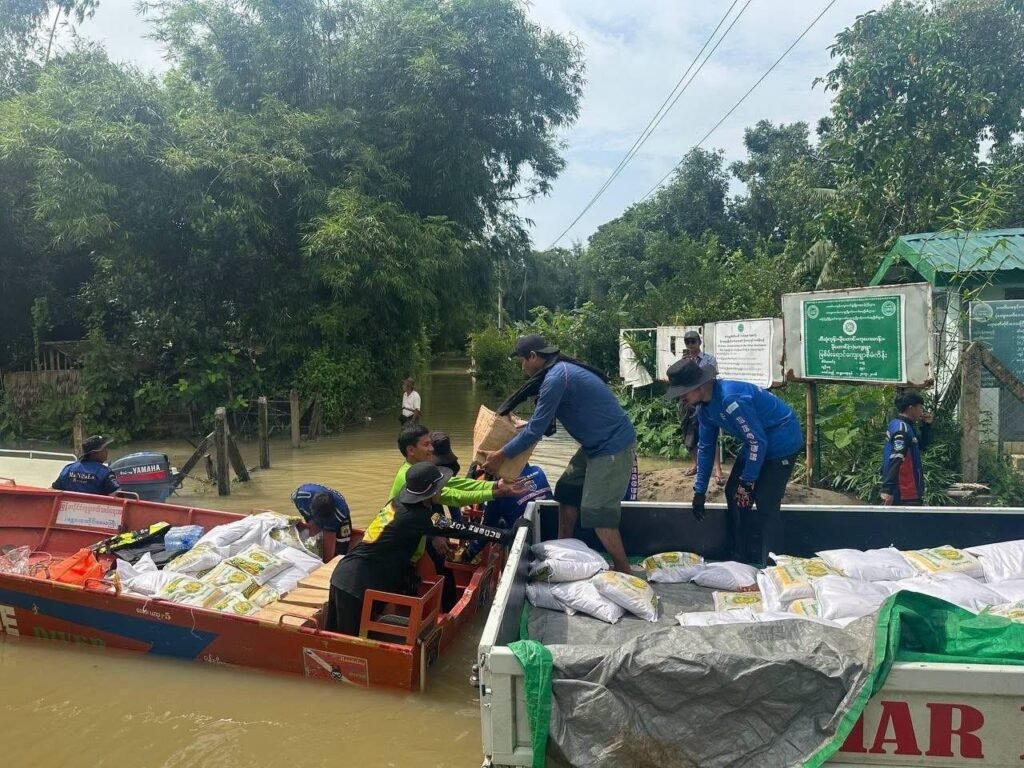
Coverage of natural disasters reveal structural shortcomings that authorities seek to conceal.
“The most risky thing is not the disasters and its aftermath,” says Esther, an independent journalist based in Magway in north central part of Myanmar. “We have to be very careful about the surveillance and arrests of the junta regime.”
“The military regime wants to hide their mismanagement, corruption and lack of capacity to tackle the problem.”
A 2025 situation report by the United Nations about Myanmar’s earthquake stresses challenges in data collection, verification and processing and underreporting, making it difficult to grasp the full scale of a disaster in the country mired in conflicts. Multiple armed groups beyond the junta hamstring reporting on natural disasters.
Aung, a humanitarian worker based in Mandalay, says his organization tries to stay under the radar to avoid harassment by the military regime so that it can continue its work. “We have to avoid unnecessary problems so we can help people from anywhere in the country,” he says using a pseudonym.
He urges that journalists need to be careful when featuring charitable activities by domestic non-state actors.
Yangon-based journalist Josephine Kyi says journalists face different challenges depending on which authorities control the area.
“Because much of Myanmar remains affected by armed conflict, journalists inevitably have to navigate relationships with authorities and other power holders. This makes even seemingly straightforward disaster reporting more complicated and time-consuming.”
She says in territory controlled by the junta, the most obvious concern is security. Low-profile reporting is essential, as using a camera in public can be highly risky. It is also difficult for journalists to identify themselves openly and work publicly as members of the media. In areas controlled by resistance groups, field reporting often requires references or introductions from trusted networks.
“I covered an earthquake last year and am covering flooding this year. Last year, the earthquake-affected areas were mostly under the control of the junta regime, so I had to navigate the challenges of reporting in junta-controlled territory,” says Josephine Kyi. “This year, for the flooding, I am dealing with different challenges in areas controlled by resistance groups.”
To reduce the risks, Josephine Kyi says that some media outlets that she has been contributing to do not mention the real names of the authors in publication. “I think using pseudonyms is a good strategy,” she says. “Mentioning credits or not doesn’t that matter.”
“There is no formal legal protection for journalists, while local rules, regulations and revolutionary ideologies can shape how reporting is conducted,” says Josephine Kyi. “Journalists often have to rely on broader networks to establish contact with local sources and gain access to affected areas.”
Exile in Thailand
The arrests of several other colleagues after Sai Zaw Thaike’s imprisonment took a toll on Naing’s mental health. His newsroom was closed, and he became jobless. A few months after he reached the Thai border, the military ransacked his parents’ house.
“I had to leave behind everything I had built, and now I am living in Thailand, trying to start a new life,” says Naing.
While feeling somewhat safer in Thailand, where he holds a pink card, a Thai identification document issued to non-Thai residents that doesn’t permit him to travel internationally, Naing faces the common struggle of many exiled Myanmar journalists: staying financially afloat while remaining professionally active in the host country. He has to make risky trips back home by land from time to time. Initially, Naing would pay for his own reporting trips back home out of his pocket and pitch stories to international outlets. Now, he has declined offers from several outlets to return, as the threat of conscription and legal consequences outweigh any journalistic opportunity.
“It is increasingly difficult to get quality footage and reliable information from local people in those places [in Myanmar],” says Naing.
Joy, a mental health counselor working on the Thailand-Myanmar border, says the fear of being criminalized, jailed and killed by the military government for doing their job is extremely common among journalists in Myanmar, based on her experiences providing mental health support for exiled Myanmar journalists.
On the one hand, many journalists fled the country because they were unable to do their jobs. On the other, even after relocating to a host country, they often feel helpless because they cannot do their work properly from afar — such as calling sources and verifying information.
She says her exiled journalist clients express anxiety about their legal precarity.
“Fear of being deported often comes up in conversations [with clients], like ‘What if we were detained in Thailand? In that case, we’d have to assume they would deport us back to our country, and then we would be in jail,’” says Joy, speaking under a pseudonym.
Communicating with exiled journalists in safer locations — where they can help share information — is another solution, though it doesn’t always guarantee complete safety, says Vũ Huy Hoàng, an activist based in Thailand. He has been helping journalists inside the country post clips of public interest that are dangerous to share in Vietnam.
Dark clouds
As threats increase, journalists have been forced to adapt, and many are simply being pushed farther away.
Esther, the independent journalist based in north central Myanmar, chose to cover the 2025 earthquake in Myanmar from across the border in Thailand. She made a short stay in refuge, believing she and her family would be safer.
In Vietnam, the restrictions are tightening. The Press Law was amended this year, and journalists are now required to disclose their sources at the request of the Ministry of Public Security if the information is deemed detrimental to national security.
On September 25, the Vietnamese government further issued a decree on penalties in journalism, which took effect the next day. Article 14, vaguely worded, stipulates fines of 300 million to 400 million dong (about $11,500-$15,500) for the act of “publishing or broadcasting information that negatively affects the standing, reputation, or image of Vietnam; or that harms foreign relations and international cooperation between the Socialist Republic of Vietnam and other countries and partners.”
The challenges mount as extreme weather increases. Floods in Northern Vietnam last year broke records while causing 409 deaths and disappearances and 337,000 damaged or collapsed houses. In Thailand the same year, flooding killed at least 162 people as officials acknowledged failures in its management.
This year, as of late September, large swaths of Bangkok were underwater.
The International Press Institute issued a report in 2024 documenting the rising threats against journalists covering climate incidents just as their work became more pressing.
Many states fail to let journalists report the issues freely, forcing them to “adopt resource-intensive strategies to reduce the risk,” the report says.
It encourages more support for local newsrooms, and more collaborations as a way to give them — and the attacks against them — greater visibility.
IPI executive director Frane Maroević said these were “appalling risks.” “This is a call to action to all of us who care about independent journalism, press freedom and the global climate and environmental crisis. Today we need accurate, independent, and accessible journalism more than ever.”
This article is published as Creative Commons.