
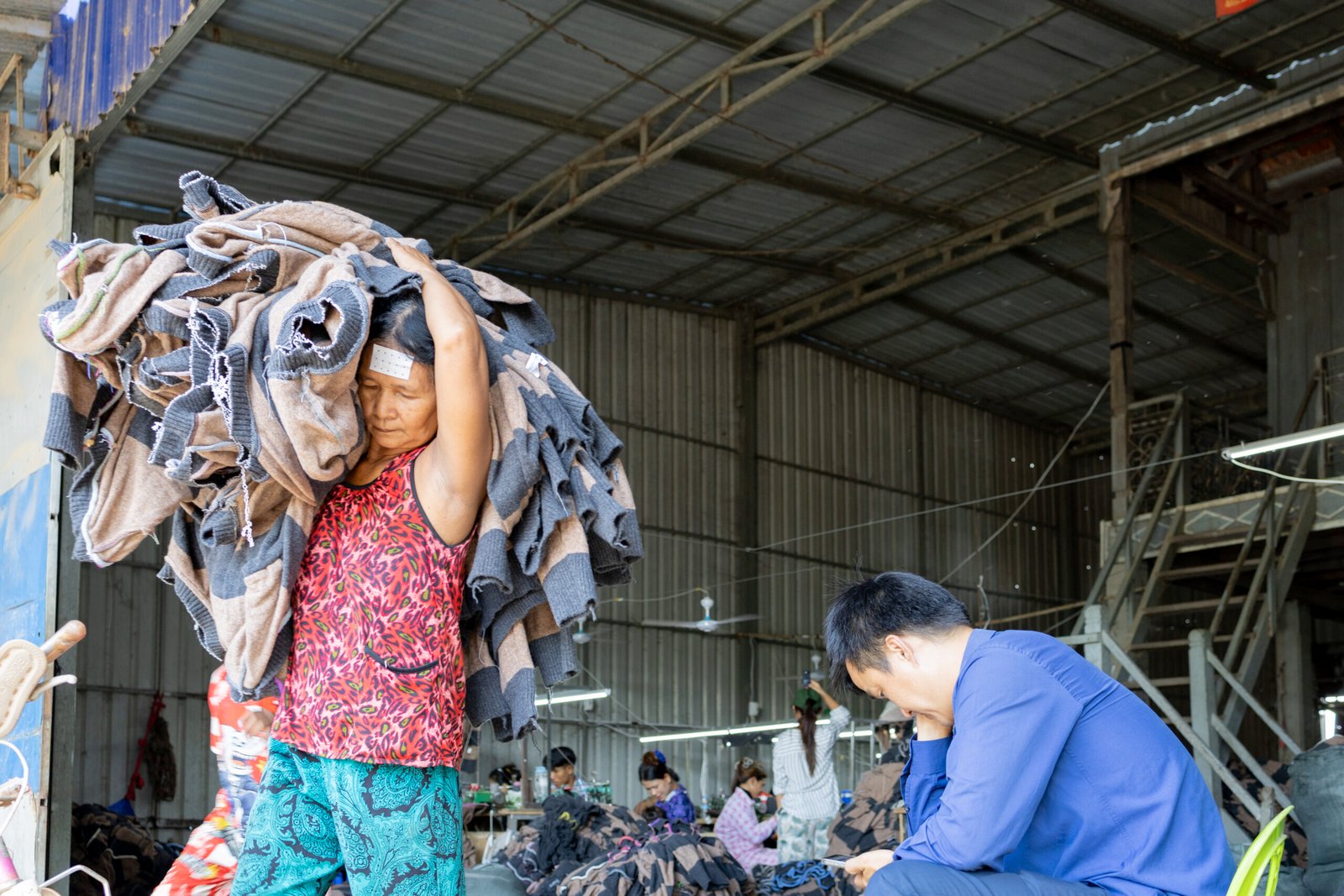
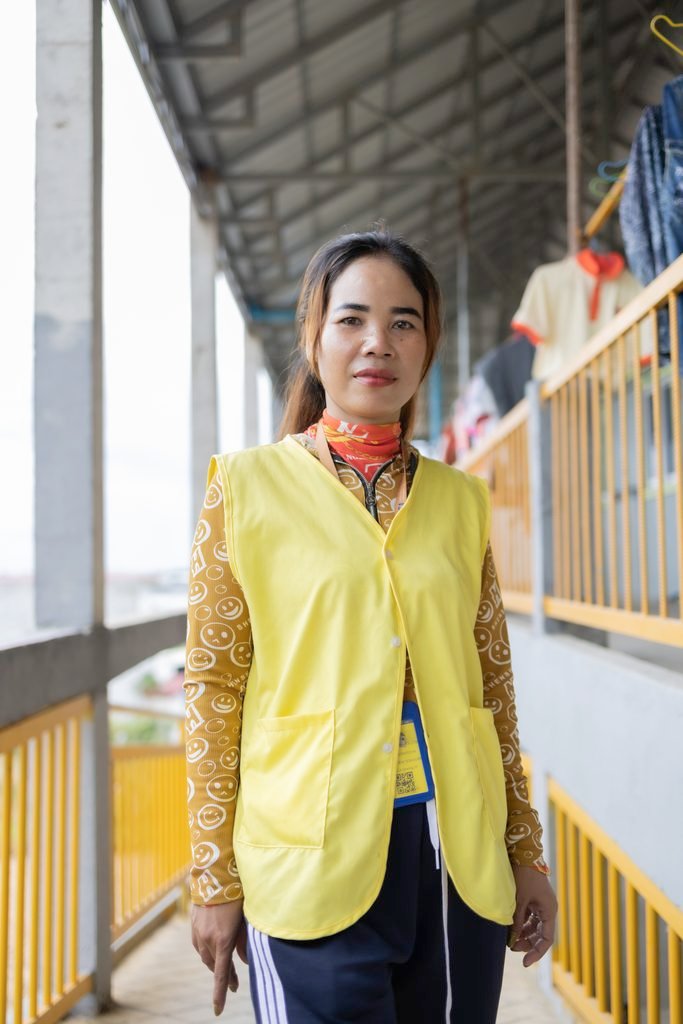
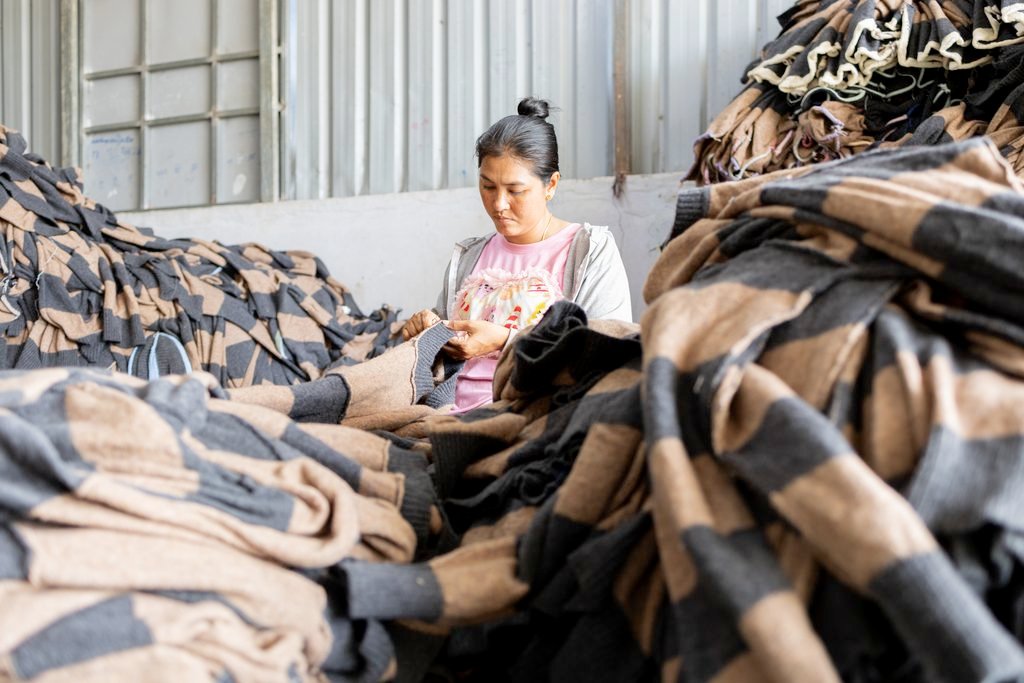
For the six days a week that Chol Sreymom shows up to work, she says she tries to do her best both for the company and her peers in the factory.
In SWJ and many other garment factories in Cambodia, the work is cooperative: Each team needs to produce roughly 60 to 80 pieces in each hour. At 46 years old and about 26 years in the garment industry, Sreymom is a veteran.
“I’m a good staff member,” she told Mekong Independent. “I try to help the younger workers, I encourage them and I try to make sure they take care of themselves when they’re exhausted or sick.”
But as the days went on, Sreymom said, this was becoming a challenge, physically and mentally.
“It’s hard to accept, when I enter the factory I don’t feel happy because it’s hot and the boss is not friendly to us,” she said.
The heat and humidity inside factories is already making strenuous work more challenging in Cambodia, and garment workers are on the frontlines of the country’s evolving issues of higher temperatures and other climate change impacts. As the only sector with a set minimum wage in Cambodia and additional pressure from buyers and brands, the garment sector is leading conversations about solutions to heat stress. But workers say they feel their stress goes deeper than more thermometers and evaporative air coolers can reach.
Dangerous temperature and humidity conditions are now a reality in Cambodia. The annual number of days at 35 C or higher in Phnom Penh increased from 35 days in the late 2000s to 112 days in the years between 2020 and 2024, according to a July report, Mitigating Heat Stress in the Garment, Footwear and Travel Goods Sector, published by Deutsche Gesellschaft für Internationale Zusammenarbeit (GIZ).
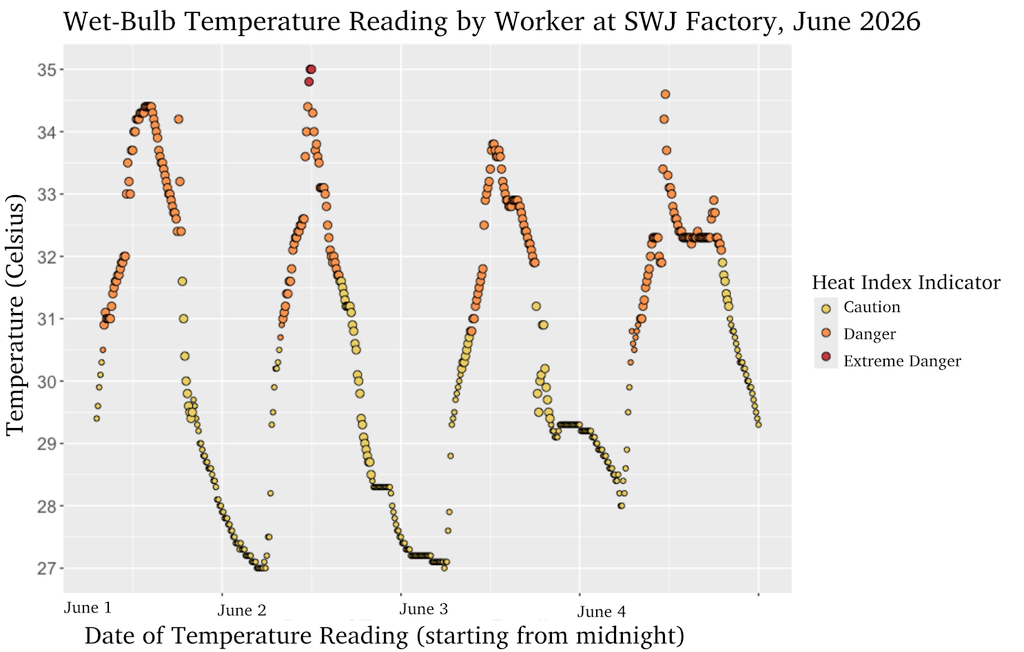
Sreymom found that she spends more than half of her day in a dangerous heat environment, after taking temperatures with a thermometer inside the factory. At least 30 minutes of her day, even when factoring in Cambodia’s monsoon season, register as “extremely dangerous” on the heat index.
According to data captured across four days of her work schedule at SWJ in early June, Sreymom spent 45% of her time in dangerous heat, including hours outside work. Of the roughly 2,880 minutes that she spent working in the factory, 80% of that time registered at a “dangerous” or “extremely dangerous” heat index.
The thermometer she used captures temperature and humidity every 10 minutes. Across those four days, the heat index registered in a dangerous zone for 2,390 minutes, or 40 hours of the total 89 hours that reporters measured the temperature.
Though Sreymom hadn’t measured the temperature before, she said she was aware that it was getting hotter. She is also a farmer, growing rice as well as fruit and vegetables at her small piece of land in Kampong Speu province. Whether she was in the fields or at the factory, Sreymom noticed that before, she wouldn’t start to feel hot until at least 10 a.m., but she said increasingly she notices the heat of the sun from 8 a.m.
But while she’s taken more measures to stay cool during her farming activities, she wished the factory would do more to acknowledge the increasing heat, as well as workers’ conditions in general. Sreymom knows the consequences can be deadly.
“I saw online on Facebook the story about the worker who died at her work station,” she said, referencing the March death of 32-year-old Yim Rin at Cambo Unisoll factory in Kandal province. The Ministry of Labor and Vocational Training said that there was no evidence Yim Rin died because of unsafe working conditions, but the case still made Sreymom think about the compounding pressures of heat, workload and other personal pressures on workers.
“I don’t want that. Some people can die [from the stress or pressure] when they go home too.”
Capturing the feeling
Heat is measured in different ways, and different measurements give insights into different risks that workers face. A thermometer on its own measures what’s called a “dry bulb temperature,” reading only the temperature as it’s freely exposed to the air. Meanwhile a “wet bulb temperature” also reads humidity, as the content of water vapor in the air impacts how people can handle the heat. The combined reading of temperature and humidity is called the heat index, a calculation popularized in the late 20th century that better takes into account multiple factors of people’s perception of heat. For that it’s sometimes referred to as the “real feeling” of heat.
High temperatures have been persistent in factories. Authors of a new extensive report on heat stress used 10 years of “dry bulb” temperature data from inside garment factories, which doesn’t take humidity into account. Though the overall trend of temperatures went down across the 10-year period, the data still showed that 82% of Cambodian factories analyzed had indoor temperatures over 32 C, the maximum temperature recommended by the garment industry monitoring organization Better Work.
For this project, some workers measured dry bulb temperatures, just bringing a simple thermometer with them into their workplace and home, while others had a wet bulb thermometer, which read relative humidity too and could be used to calculate the heat index.
Sreytoch, a worker at a factory called Bowker Garment Factory in Phnom Penh, said she was aware the factory had thermometers, but it was rare that she checked it. She was surprised to take the basic thermometer into the factory and see the number climb upward each day.
At the maximum, she saw the temperature reach over 38 C, and that was in May, when monsoon season is supposed to set in and cool temperatures.
“I’m thinking about the near future, in the next few years, the temperature is just going to rise higher, and a lot more in the future after that.”
Sreytoch is right to worry about her situation.
When workers spend their time at “extremely dangerous” heat index readings, with a calculated score of 50 or higher, they are advised to delay their work until cooler times of the day. Even at “dangerous” readings — which make up most of workers’ working hour temperature readings — workers are recommended by heat index advisories to take a break for four minutes for every hour of activity, and have access to cooling stations.
| Reading | Celsius | Fahrenheit |
|---|---|---|
| Caution | 30-39 | 91-103 |
| Danger | 40-49 | 104-124 |
| Extreme Danger | 50+ | 125+ |
When subject to heat stress for too long, workers can experience exhaustion, dehydration, rashes and even longer term health issues like kidney injury or respiratory and cardiovascular impacts.
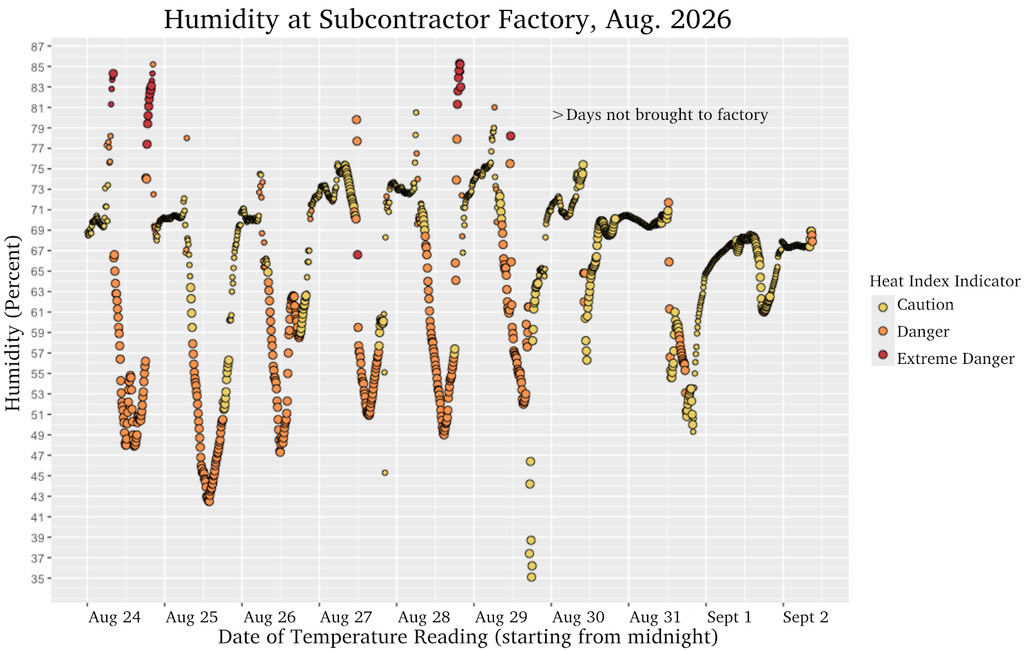
With the basic thermometer, Sreytoch could read temperature, but she wasn’t aware of the humidity within Bowker. However, readings from the advanced thermometers showed that the most extreme heat index readings during their days came from higher humidity readings, rather than extreme temperatures.
For Sreymom, for example, almost all of the dangerous — and all extremely dangerous — heat index readings occurred while she was in the garment factory in early June. Sreymom spent a total 30 minutes of the five days she used the thermometer in extreme danger readings, but none of the times it occurred were at the highest temperature that day, but rather the greatest percent of humidity.
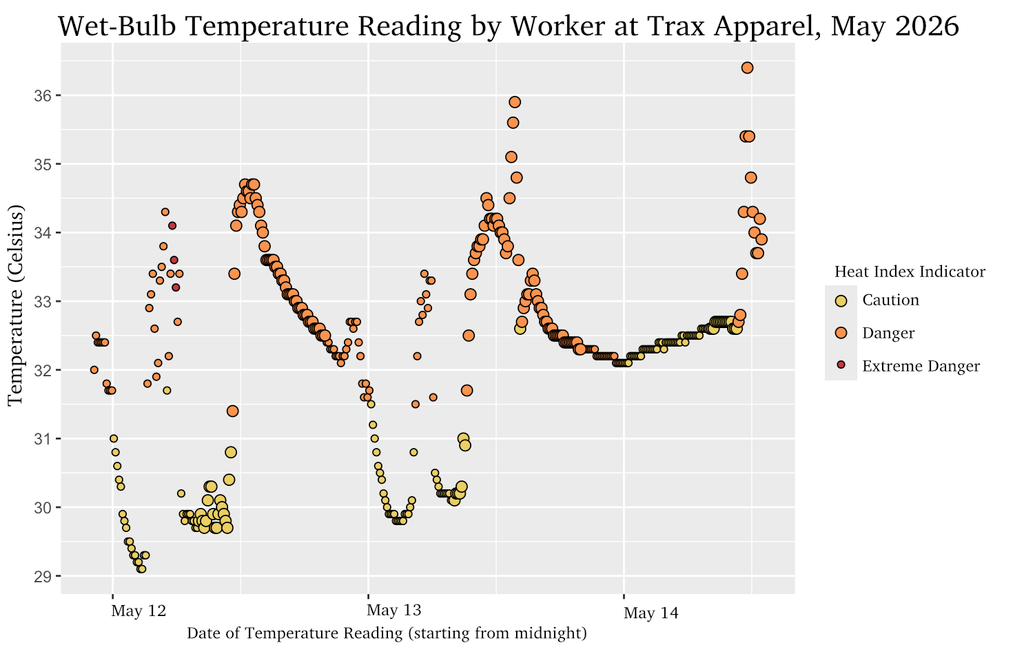
At Trax Apparel, one sewing staff member who took the thermometer in mid-May found that the temperatures were manageable in the mornings at Trax, but increased dramatically from her lunch break onward.
She went around different locations within Trax across May 12 and 13, and checked what the thermometer said at each one.
Where the workers were ironing labels onto clothes, she read 34.0 C.
At a section of storage, where workers packed, stored and moved garments, she also read 34.0 C.
The thermometer read 34.1 C when she spent a little time in the cutting section, where workers piece together clothes at the supplier for Adidas athletic wear.
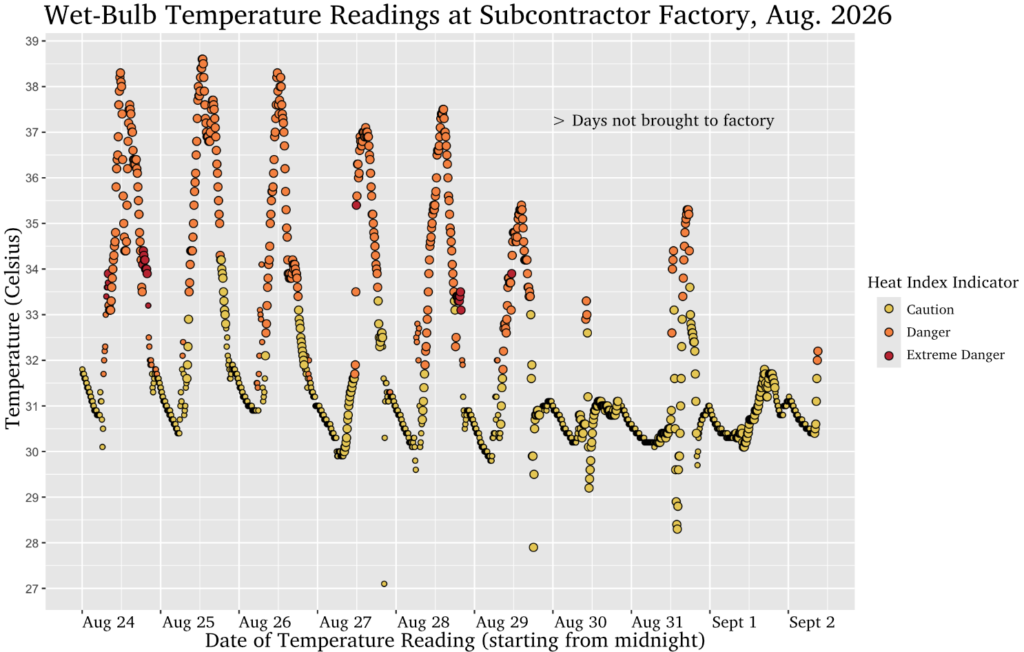
A worker at a subcontracted factory also took the wet-bulb thermometer to her workplace, which makes fleece and sweats for brands such as Champion, and received the most extreme readings of the group. The temperature exceeded 38 C three out of her five days of work in late August, and humidity levels over 80% pushed several of her work hours into “extreme danger” zones.
May 12: It’s 11:30 a.m. Srey Ya has just taken her lunch break. Just before she finished her shift ironing labels onto clothes for Adidas brand, she measured the temperature in Trax Apparel. It is 34 C.
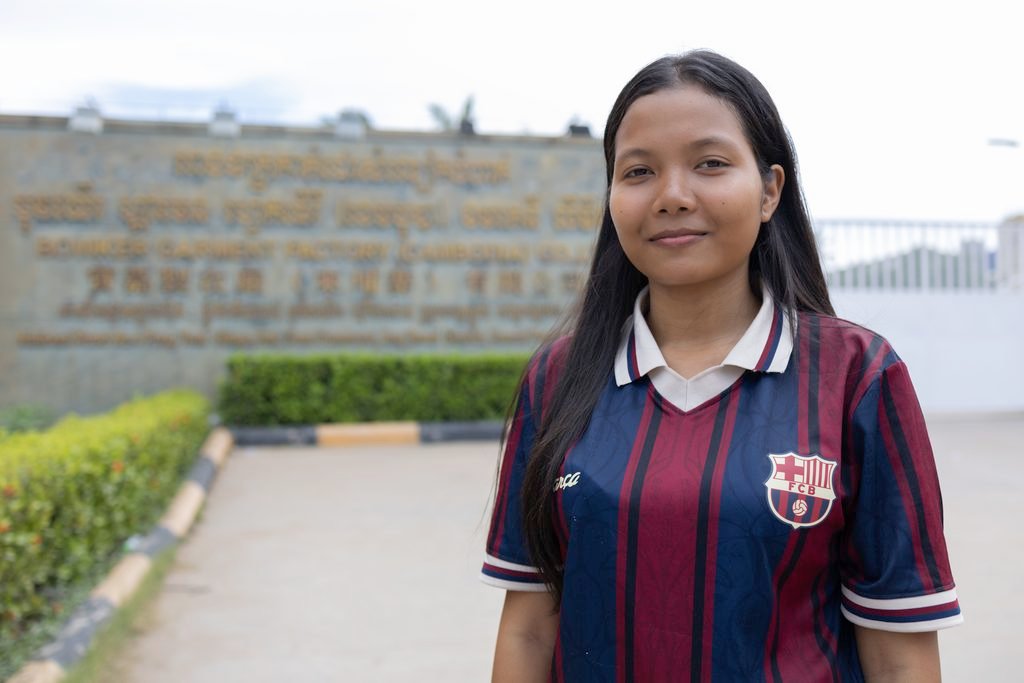
May 13, about 2 p.m.: Sreytoch feels hot while she’s working on the production line at Bowker Garment Factory. She checks her personal thermometer and reads that the average temperature is 35.8 C, with a maximum range of 38.3 C.
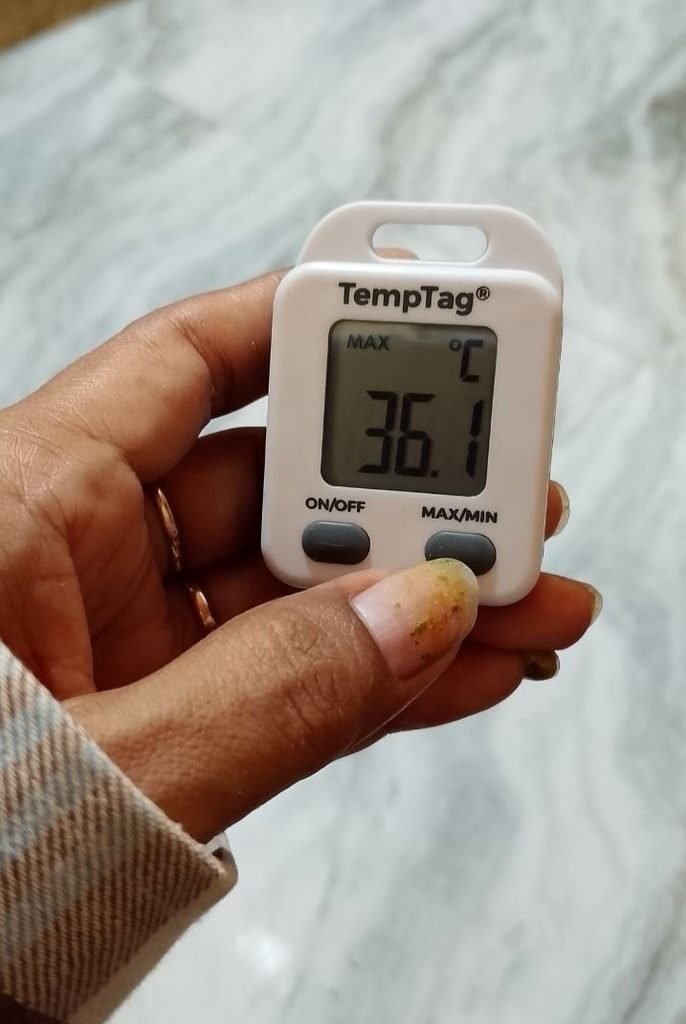
May 13, 6:30 p.m.: Sokhorn comes back home from her 12-hour shift at Caswell Factory and starts making dinner for herself. She quickly looks at the thermometer in her rented room. It reads 34.5 C, with a high of 36.1 C.
Why is it still so hot?
Though the climate is warming, the conversation about heat stress in factories has been going on for nearly as long as Cambodia produced garments and footwear for export.
The Cambodian government passed a sub-decree in 2002 urging factories to keep the climate at an “acceptable” or “suitable” temperature, with thermometers within the building to monitor temperature. But that regulation never set any specific degree or standard for the “acceptable” temperatures or requirements to measure heat in factories, nor any penalty for factories who consistently fail such tests.
Meanwhile Vietnam in 2016 set a range of acceptable workplace temperatures across industries, varying based on humidity and the intensity of work. Workplaces should maintain a temperature of less than 30 C for almost all conditions of medium and high-intensity work, or if impossible increase the number of breaks so workers can recuperate, the regulations say. Thailand first set such regulations in 1976, revising its occupational health and safety standards in 2016.
Cambodia’s Labor Ministry is reportedly working on new regulations to set a maximum workplace temperature, at least for the textile, footwear and travel goods sector. However, Mekong Independent could not obtain a copy of the draft law before publication.
Ken Loo, secretary general of the Textile, Apparel, Footwear and Travel Goods Association of Cambodia (TAFTAC), noted that the government was working on setting the regulations, without providing any further information. But, he added, TAFTAC has been trying to raise awareness about climate risks in factories.
“We have conducted numerous workshops and trainings to ensure that our members take care and concern on this issue. Preventive measures have also been introduced and explained to members so that they can take the necessary actions to ensure ventilation and lower temperatures at the workplace,” he wrote in a message.
But Loo added that implementation “depends on the financial ability of the factory and other factors.”
The brand Adidas, one of the major labels represented in Cambodian factories, says it has taken heat issues seriously for years, including it in the 1,200 factory audits they conduct, said Stefan Pursche, spokesperson for Adidas.
Adidas, a company that generated a record revenue of more than $28 billion (€24.8 billion) last year and $1.5 billion (€1.377) in net income, buys orders from Trax Apparel and Bowker, among other factories.
Pursche said the brand required factories to have “adequate ventilation systems” and had adopted specific heat-related guidance for factories since 2023. He also described a new set of guidelines, called the “Heat Stress Management and Prevention Framework,” which he said was being developed by Adidas and international organizations in the sector like the American Apparel & Footwear Association, International Labor Organization, Better Work and others.
“This new guidance will best support suppliers in protecting its workers from the effect of heat in the workplace and will be published in the coming weeks,” he wrote in an email.
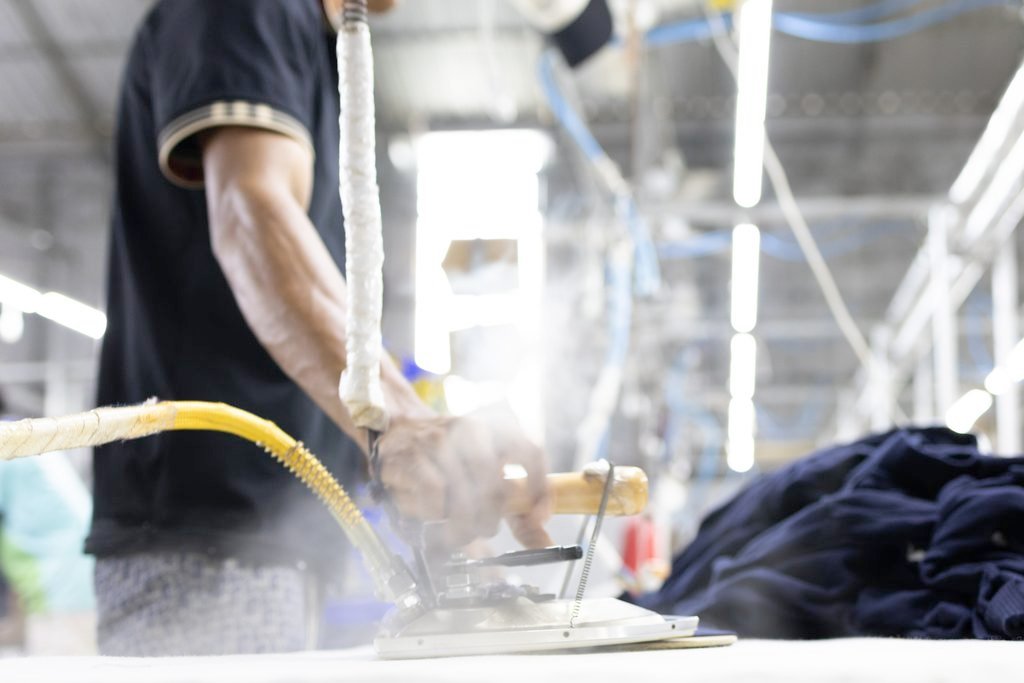
However, compliance requires monitoring. Major factories like Bowker Garment Factory and Trax Apparel are more likely to be monitored for temperature and held accountable if workers endure too much heat stress. But many workers now are employed by subcontracted factories like Kejer, which indirectly supply the export industry by supplying other factories within Cambodia, and therefore are more hidden in the supply chain. Subcontracted factories are often not part of monitoring bodies like TAFTAC and Better Factories Cambodia, and workers generally lack most of the benefits that the garment industry touts.
One worker’s temperature measurements indicate that workers in the Kejer subcontracted factory experience higher temperatures and humidity than their peers at more monitored factories. In the first five days of the chart below, workers brought the thermometer to the factory. The remaining days were provided to show ambient temperatures at their rented rooms.
The data shows that in the roughly 3,600 minutes they carried the thermometer, they experienced “danger” or “extreme danger” levels of the heat index for 83% of their workday.
The workers themselves say they believe there are other ways to make their workspaces cooler.
Sreytoch, the worker from Bowker, said she had friends in another factory inside the Royal Group Phnom Penh Special Economic Zone in the western district of the capital, and they had described specialized cooling systems that they felt effectively decreased the hot feeling inside a warehouse.
“In that SEZ they can do this because they are big, well known, and they don’t want trouble,” she observed.
Workers also suggested having more breaks and being allowed to bring individual motorized fans for their stations.
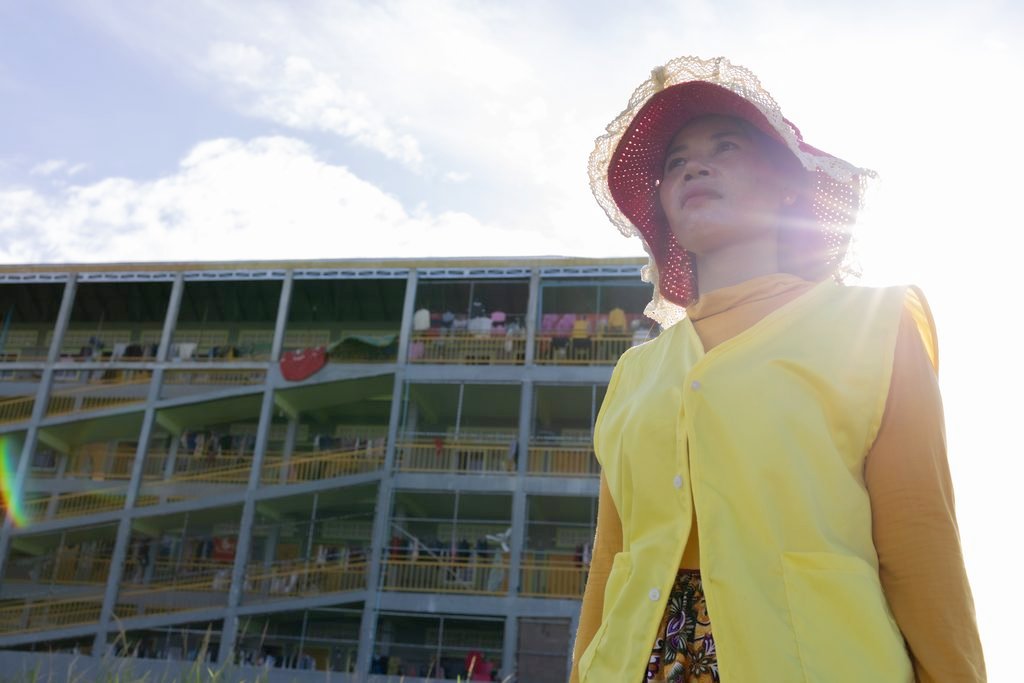
Sreymom noticed that her factory, SWJ in Kampong Speu, had a very high ceiling, and that appeared to be affecting the heat. As a result, the cooling systems that they have — fans and a few water distribution systems — didn’t touch or affect many of the workers.
Workers say that factories sometimes measure temperature and humidity, but they didn’t check the data or know what to do with it.
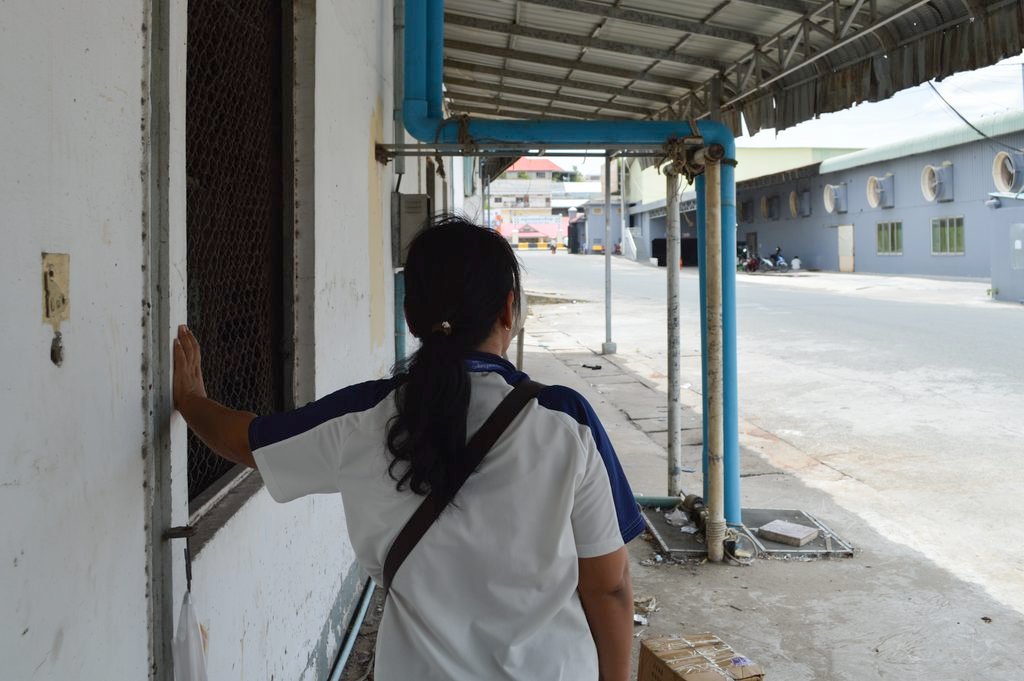
Sreymom says the heat sits on her mind, as other aspects of the factory are dangerous too. When reporters met Sreymom in June, she described how the passageway at the front of the factory — where they enter, exit and pass to go to the toilet — is narrow and sometimes crowded with clothes or materials. She felt the factory layout “wasn’t standard” to occupational health and safety regulations she learned in the past.
“Sometimes I worry about a fire, what would happen to us. I’m really worried, and I think about what happened at Koh Pich,” she said, referring to a crowd crush that happened more than 15 years ago during a national holiday celebration in Phnom Penh.
Cambodian factories were not built to support workers through this level of heat, observed Laurie Parsons, reader in Human Geography at Royal Holloway, University of London who has heavily investigated the impacts of climate change and labor issues on the garment industry.
“The problem is every factory fails unless you measure [wet bulb temperatures] in January or February,” the coolest months in Cambodia, he said.
Parsons said that there was little data about average and extreme temperatures in garment factories, which made it challenging to set standard temperatures and thus understand what would actually improve workers’ conditions across different sections of the factory floor. But he also observed that brands, factories and regulators tend to shift the blame, because reducing the level of heat stress would be another cost for manufacturers and brands.
“Factories are in warehouses, they’re not really built to maintain a reasonable environment for a human population,” he told Mekong Independent.
The Ministry of Environment posted a report in 2021 estimating costs of different cooling systems, based on work by the U.N. Industrial Development Organization. Investments like replacing air conditioning units for a factory was estimated at $15,000, while redesigning the ventilation system could cost $100,000, according to the document.
Phirom Morm, a human resources manager at Bowker Garment Factory, said that the company was aware of the increasing number of days at 35 C and above, and was investing in infrastructure in the factory, which supplies Adidas among other brands.
He said the factory’s target workplace temperature is 30-31 C, and they start monitoring closely for heat stress indicators at 32 C and above.
“Bowker is implementing additional measures including upgrading local exhaust ventilation systems in high-heat process areas, applying reflective heat-isolation roof coatings, enforcing mandatory 30-minute task rotations, and reassigning vulnerable workers to air-conditioned spaces during peak heat periods,” he said.
Morm didn’t specify how much budget the factory’s cooling systems require, but he noted that the factory monitors the systems and conducts preventative maintenance programs. He also noted the factory’s participation in government, NGO and brand-connected programs about heat stress.
Parsons, the academic at the University of London, said he felt motivated about the issue because of the amount of engagement across all garment sector stakeholders, even among brands. He noted that European Union countries like Germany and France had been more mindful of the human rights and labor issues in their supply chains, and thus tackling issues like heat stress had gotten increased traction. He said he thinks the projected loss in productivity also speaks to brands and manufacturers.
“One thing that’s really positive about all this is everyone’s talking about it and everyone recognizes it’s a problem,” he said. “Heat has real potential for at least the willingness to engage in it.”
Not just an ambient environment
When the heat is too much, workers say they feel they have no choice but to bear it.
Sokhorn, a worker at Caswell Apparel, said she feels she is making unhealthy choices amid the heat in order to continue her work. She has a water bottle provided by the factory, but she tries her best not to use it, in order to keep up with the fast pace of the work.
“Even when I work under the heat, and I’m exhausted and don’t have enough energy, I try to avoid drinking enough water, because I force myself to go to the toilet just two times a day, one around 9 a.m. and another time around 3 p.m.,” she explained. “To make sure that I don’t go to the toilet so often, in a whole day of work I only drink about 750 mL of water.”
The long-term damage will not only be to health, as workers reportedly lose productivity, motivation and even comprehension ability when experiencing heat stress. Researchers from the U.S.-based Cornell University’s Global Labor Institute and a London-based investment firm estimate that Cambodia’s garment industry could lose 18% of its potential export earnings if they don’t adapt to climate change.
Sokhorn said she was aware of many potential health issues: Unlike many of her peers, she refuses to drink any energy drinks, because she knows the extreme sugar and caffeine levels will damage her health. However, she still forces herself to drink less water and hold off bathroom breaks because she doesn’t want to cause problems for her peers.
Sokhorn and other workers explained that their production goals were collective, and her group was given a certain number of targets to complete within an hour or a day, depending on the order. Sometimes the goal is feasible, but sometimes they feel the need to rush to keep up.
Regardless of the pace of the deadline, this means Sokhorn would be held accountable by her peers, she said. For Caswell Apparel, she’s literally pushed along by what they call a float, or moving hangers that transport garments between work stations.
“If I don’t complete my part, the floating garment rack will stop and get stuck at my place,” she said. “The other workers will have nothing to do until I finish my part.”
Workers in the subcontracted factory — which is called Kejer but does not appear to be in TAFTAC or Commerce Ministry business registration databases — said they were well aware of what rights they should receive, because they used to have them in their previous workplace.
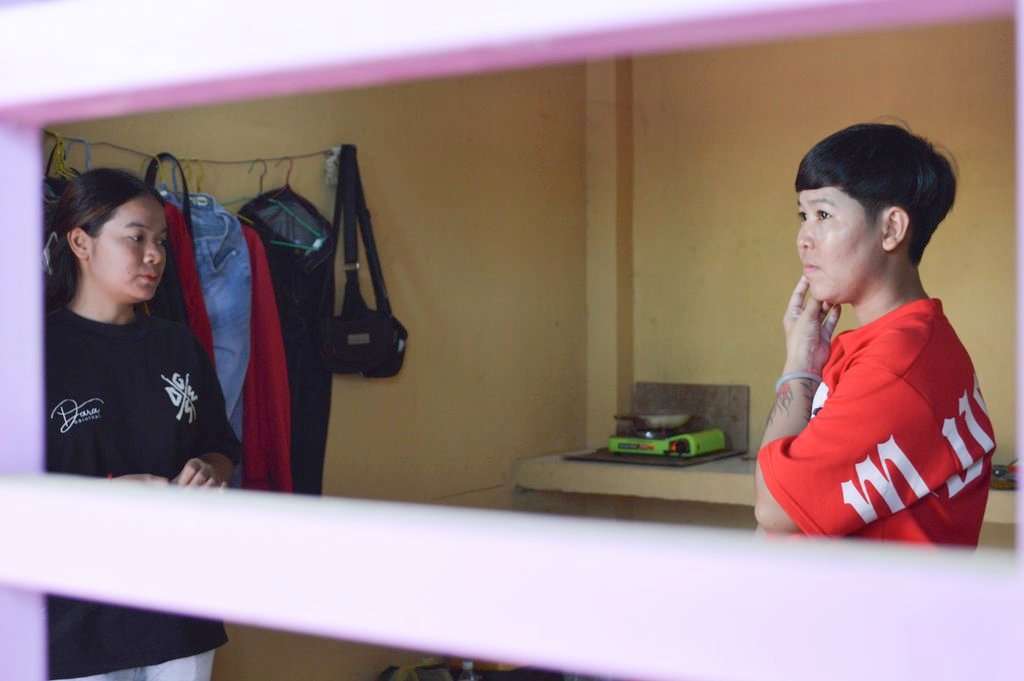
Sreytouch, one of the newly subcontracted workers, said that she and her colleagues came to the Phnom Penh metropolitan area from Poipet, where they used to work at ML Intimates. She was let go with around 700 others as the factory closed in May due to a lack of orders and the continued closure of the land border with Thailand post-conflict.
Sreytouch and the others told Mekong Independent that they had lost their seniority pay, social security from the factory and other health incentives like maternity leave. Now they work longer hours and on Sundays, and get paid a weekly but much smaller package.
On top of lacking benefits, Sreytouch said she was aware of the occupational health and safety issues at Kejer, like the lack of airflow and consolidation of debris from the soft fleecy fabric that they all cut and sew into sweatshirts for Champion and other brands. She said she and her peers were exhausted, struggled to breath and sometimes got rashes.
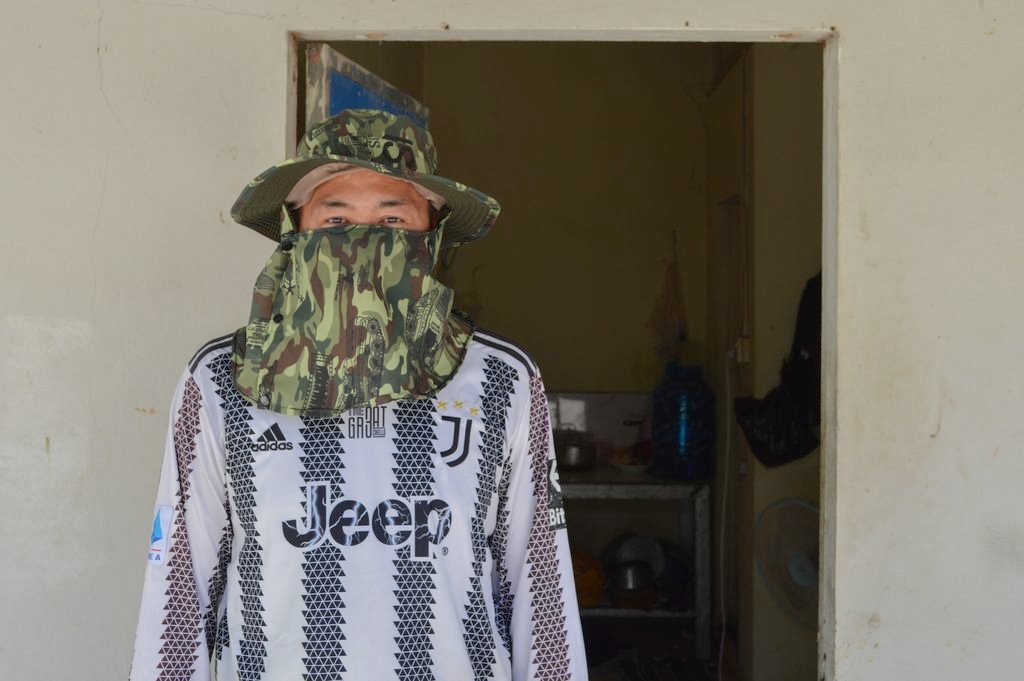
“Everyone tries to cover up, even with the heat, wearing masks and extra layers to prevent the dust from irritating our skin, [but] it gives us extra heat,” Sreytouch said.
When asked about their communication channels for workers, the factory and brand that responded to Mekong Independent said there were many ways to express their concerns.
Phirom Morm, the human resources manager for Bowker, told Mekong Independent in an email that the factory had several digital platforms to communicate with workers, from general channels like conversations with supervisors, to online options like a special digital platform and a Telegram HR group chat.
“Management regularly reviews reported issues with worker representatives and monitors the implementation of agreed actions. Bowker is committed to ensuring that workers have accessible channels through which they can raise concerns and receive timely follow-up,” he said in a statement.
Morm said the factory had made short-term and long-term changes to their cooling systems based on worker feedback, including adding fans in areas where workers felt too hot as a temporary measure and more extensive changes when they could.
The 39,945 square meter factory of 3,344 staff now has 322 industrial evaporative air coolers, 188 wall-mounted fans, 91 additional fans, roof heat insulation, UV films on windows, designated cooling and rest areas, and accessible drinking-water facilities.
He acknowledged that it was hard to keep factories cool by nature.
“At the same time, managing heat in our operating environment presents practical challenges, including high outdoor humidity, large metal-roofed buildings and dense production layouts, all of which can affect the effectiveness of evaporative cooling and natural ventilation. We recognize these challenges do not remove the need for continued improvement,” Morm wrote in an email.
Sreytoch, the worker from Bowker, is a supervisor, and said she was able to work with the factory managers and HR to make sure workers in her section are heard when they complain about the heat and other issues. But she sometimes feels frustrated with structural issues in the factory; for example, when Bowker managers rearrange workers’ sections after they’ve gotten accustomed to a certain task and feel they’re performing well.
“They don’t seem to care about sticking workers in the spot where they do well,” she said.
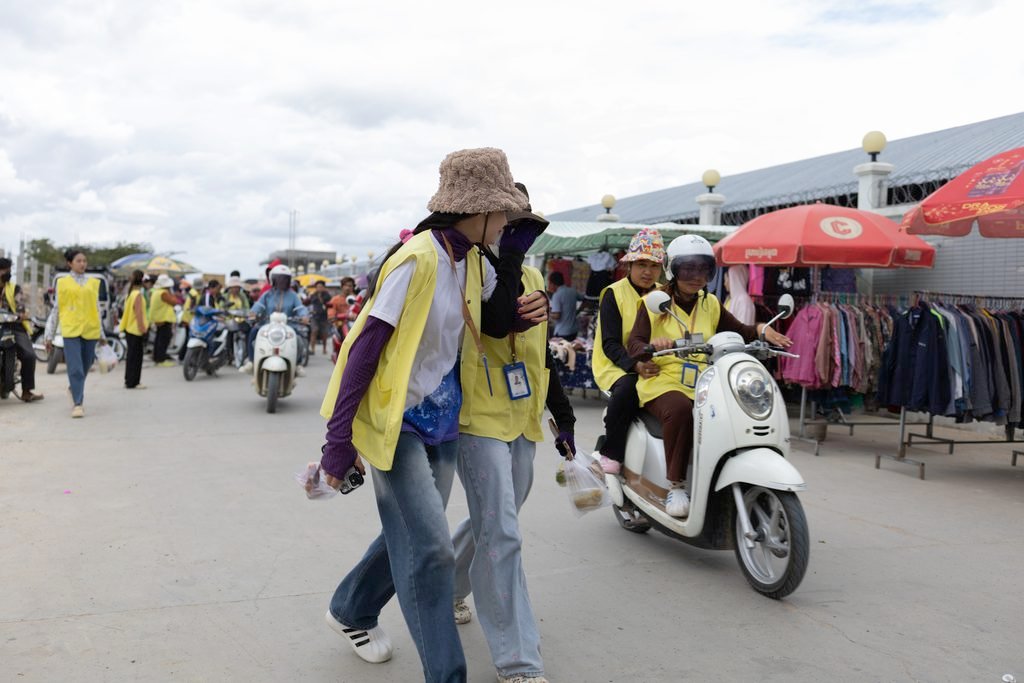
The heat adds to these general strains of working in a factory, she said. She knows it’s getting hotter everywhere, and it is hard to fight heat in a manufacturing setting. But at 23 years old, she feels the general exhaustion that working in the garment industry causes has already taken a lot out of her life.
“When I first started my first boss said I had a good memory, but that’s no more, as I’ve changed from one job to another,” Sreytoch said. “I don’t know the reason, but I didn’t realize [as it happened] but day by day” she saw the decline in her memory, and her general health too.
For Sreymom, she doesn’t see the heat as the problem in itself — it’s other challenges that worry her. She and other workers were once able to lobby their boss at SWJ to install more fans, but there was no follow-up after, and workers weren’t all able to feel the effect of the fan.
Sreymom said she doesn’t feel acknowledged by the factory, especially her direct manager who sometimes makes insulting comments to Sreymom. She said they weren’t able to form a new independent union because of fear from the workers and pressure she felt from factory management. Still she says they try to make the situation better, but it requires persistence.
“It’s still not enough, and I raised before that it doesn’t actually reach everyone,” she said. “We should be able to work with the boss to make it better, get a better cooling system.”
This story was supported by the Pulitzer Center.