
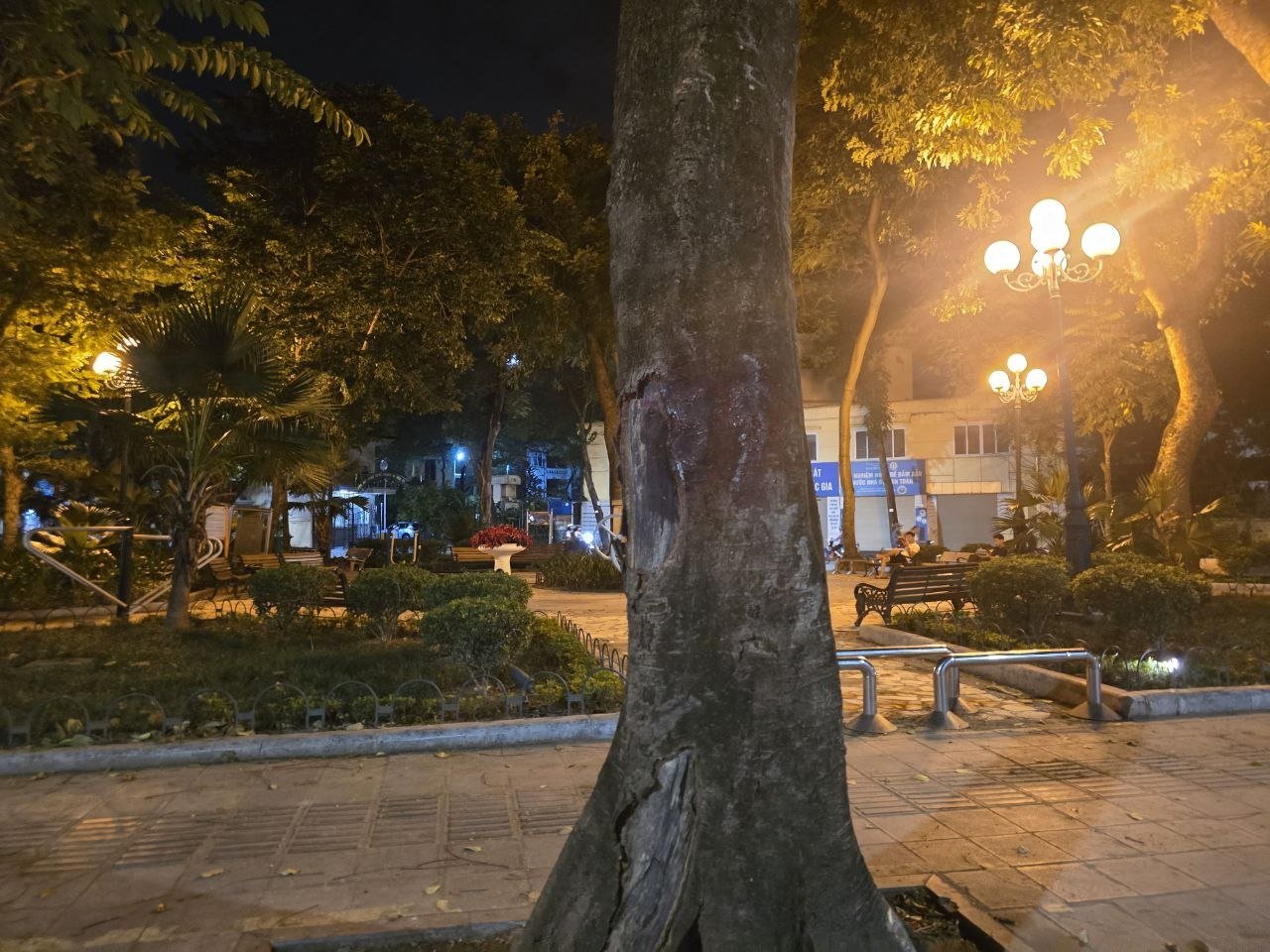
One day in the middle of August, the sidewalk in front of a public garden in Hà Nội, where locals often take a morning coffee, became the center of attention online. The tree at that location soon started attracting piles of bouquets, and became a symbol of a subtle but growing trend in Vietnam.
Tree No. 55 on the sidewalk of Nguyễn Huy Tự Street in Hà Nội, also known as the Justice Tree, where bouquets brought over by masked passersby kept piling up in commemoration of Đỗ Ngọc Phương Thùy.
This was where, on May 30, 2025, Thùy and her father were hit by a BMW coming in the opposite direction and swerving into their lane. The crash threw them to the ground, severed Thùy’s right leg, and seriously damaged her organs. She died 10 days later at the age of 18, days before her high school graduation exam.
More than a year after the actual accident happened, the case took on new gravity on Threads, a platform where Gen Z Vietnamese have found new space to express their frustrations with the inequities they see everyday — and consider what they may do to reshape their futures.
“Like many, I was distraught when I first heard of the accident. Her life was cut so short when there was so much ahead of her,” said Linh, a 24-year-old Vietnamese woman working in the UK after finishing studies there, who spoke using a pseudonym out of fear of repercussions in Vietnam.
The local press initially identified the driver by the initials N.S.C., a 64-year-old man living in Hanoi, but rumors started circulating that the driver was actually Nguyễn Sỹ Cương, a former Vietnam National Assembly deputy and husband of a high-ranking party official.
People hoping for prosecution of the deputy were soon disappointed. After the case was said to have been transferred to the police for further investigation, no further updates followed. “Was the case disappeared already, pals?” asked a user in an online forum where people watched the case back in June 2025. Months later, it seemed like it was.
However, 15 months later, after a wave of Gen Z outcry identifying the tree as a symbol on Threads, National Television ran a documentary that confirmed that Nguyễn Sỹ Cương was the driver, but showed the investigation’s conclusion that he was not prosecuted at the family’s request. The father of the victim was featured, filmed with his back to the camera, urging the public to stop pursuing the incident. Toward the end, the audience was warned to stay calm and not be instigated by “terrorist organizations.” Nguyễn Sỹ Cương was not presented in the segment.
The television report — which was later reposted with the document that dismissed the prosecution blurred — sowed further suspicion and frustration. Many responded with disgust, seeing this as another attempt to smear critics with legitimate concerns in blatant defense of the former National Assembly deputy.
“How cruel are you to bring a father who lost his only daughter to explain on the offender’s behalf?” said one anonymous comment.
“Terrorists in the past bore guns, terrorists today bear flowers,” noted another.
By the time of this reporting, the wave of online dissidence subsided, and as of September 1, the tree’s number appeared covered with spray paint. However the symbols stay alive on the internet: photos of white ribbons attached to backpacks in Thùy’s memory, the photo of the flowers thrown in a dumpster and sketches and artwork of the Justice Tree.
“People may not see it this way, but it was, for me, like a silent protest. And the police’s response was out of proportion,” Linh noted.
On the other side, men with the look of plainclothes authorities can still be seen stationed around the Justice Tree.
In a country where civil society has remained repressed and the youth are often derided by many, including state media, as “apathetic” and “selfish,” the event offered a glimpse into a new wave of political commentary and activity among young Vietnamese whose beliefs and orientations are still not adequately appreciated.
Simmering discontent
Thùy’s death and the lack of investigation around it echoed another incident of unjust traffic fatalities that resurfaced a month before the crash in Hà Nội.
In September 2024, 14-year-old girl identified with her initials, N.N.B.Tr., was riding an electric bicycle on Provincial Road 901 in Trà Ôn, Vĩnh Long, when she collided with another electric bicycle rider. She fell into the path of an oncoming truck and was run over and killed. Authorities initially declined to prosecute, alleging that it was the deceased teenage girl who “committed the socially dangerous act.”
Her father, identified as Mr. Phúc, repeatedly challenged that decision to no avail. One year later, on August 28, 2025, he shot the truck driver involved before committing suicide. Mr. Phúc died while the driver was seriously injured. Later, it was confirmed that the truck driver’s family had connections with one Deputy Head of the Investigation Agency of Trà Vinh’s police.
The two cases exemplify what many have long felt to be the cruel reality in Vietnam, where “people do not have any faith in the law anymore, because the people they believe will protect them don’t protect them,” said Linh, the Vietnamese student participating in online discourse while in the UK. The flowers laid around the Justice Tree became for many the last resort at calling for accountability and pleading the authorities to salvage that faith.
Nam, a pseudonymous 27-year-old who went to Canada to study business and who came to use Threads actively to raise awareness on political issues, also got to take part in this public ritual. He asked a friend in Hà Nội to place a bouquet at the Tree of Justice in commemoration of Thùy.
“It was very heartwarming to see people stand together and raise their voices against injustice. Turns out, humanity is still alive,” said Nam.
For young people, this perceived unfairness is compounded by economic inequality and the environmental degradation that they feel around them — something which deviates wildly from the promises of a socialist country they were taught about in school and society, where the environment is well taken care of and workers are treated with dignity.
Just a few weeks before netizens turned their focus toward Thùy’s death and impunity of Nguyễn Sỹ Cương, Threads users were discussing the Hải Vân Pass, a famous 21-kilometer mountain pass in central Vietnam, where a large swath of natural grove was felled to make way for Vinhomes Làng Vân, a resort project by the politically-connected conglomerate Vingroup.
While netizens criticized the project, they witnessed no critical coverage of it in state media, except for a few articles covering the importance of relic sites within the area reserved for the resort.
In a video that went viral on Instagram by a Vietnamese artist, she said: “They vacuumed up public coastlines and ecosystems, converting them into lifeless ghost towns. And we Vietnamese have no structural way to push back.”
Linh, the Threads user, described the shock she felt coming back to Vietnam earlier this year after studying in the UK for two years, noting that civilians are noticing the decline in nature and even urban living.
“It was like a slap in the face,” she said. “The environment was so polluted that for the first two days I couldn’t breathe.”
For over 10 years, Vietnam has experienced serious air-pollution problems, especially from fine particulate matter (PM2.5), often known colloquially as “fine dust,” a kind of particle that can enter deep into human lungs and bloodstreams. Long-term exposure to this is often associated with increased risks of heart disease, stroke, lung cancer, and respiratory problems. Currently, Vietnam’s estimated annual PM2.5 exposure of 26 µg/m³ is roughly five times the World Health Organization guideline of 5 µg/m³. In big cities like Hà Nội and Hồ Chí Minh City, fine dust and smog are inescapable aspects of urban life and development.
While some contend that environmental degradation is a price to pay on the country’s path to prosperity, others see that the benefits have not been equally distributed — something that exemplifies the capitalistic nature of its economy.
“There is no way the Vietnamese Communist Party can be called Marxist. Rhetorically, perhaps. But the way Vietnam is organized economically is purely capitalist,” said Susann Pham, a researcher on social movements in Vietnam and the author of Vietnam’s Dissidents.
In Vietnam, where a worker makes on average 9 million VND per month (roughly $340 a month), the housing price is roughly 128 million VND per sqm in Hà Nội. So to own a 30 m² new apartment at the average Hà Nội price, a person of average income will have to spend roughly 100% of their income over 35 years. This is the case even for those with a university degree.
Gia, a 26-year-old graduate from a top university, confessed that she only makes VND 10 million a month ($400) teaching English in a northern province.
“When I was teaching in Hà Nội, my salary was about VND 20 million [$767 per month], but the costs of living are so high that it was not nearly enough,” she said. Gia said that she didn’t intend to buy a house, but for her friends who need to buy one, the current situation makes them extremely stressed.
For Gen Z individuals like Gia, they are concerned that inequality and affordability are not just sources of personal grievances, but also prevent Vietnam from improving the future of its people.
The intergenerational gap
These issues didn’t arise among Gen Z only, but they sprung up anytime a new forum became available for people to mull on their concerns. Since 2006, when Vietnam officially joined the World Trade Organization, new dissident movements emerged throughout the country, pushing for democracy, land and labor rights activism and environmental protection and preservation.
This plethora of dissent was enabled partly by the proliferation of social platforms available to anyone with an Internet connection — Yahoo 360, WordPress, YouTube and most notably Facebook — which provided the information to challenge the Vietnamese Communist Party’s propaganda and the infrastructure for mobilization. This grassroots democracy resulted in waves of protests throughout the years, culminating in the massive protest in 2018 against a draft proposal for the establishment of a special economic zone that would allow land leases of 99 years to foreign entities, feared to undermine the country’s sovereignty, and the passing of a cybersecurity law that many saw as encroaching on freedom of speech.
Meta, the parent company behind Facebook, Instagram and Threads, has become known to censor posts and take down accounts at the government’s request. At the same time, the Vietnam Communist Party has deployed its 10,000-strong military cyber troops, also known as Force 47, to fight off “wrongful information and anti-state propaganda.” Coupled with that is the wave of repression and arrests that intensified after Tô Lâm, the country’s former minister of public security, became general secretary of the Communist Party of Vietnam and president in 2024.
That repression has proved too effective at silencing questions and concerns that could raise up online, to the point that “the former democracy movement doesn’t exist anymore,” according to Susann Pham, the researcher.
“The people from the older generation are either in prison or in exile,” said Susann Pham. “Once these dissidents leave Vietnam, it is hard for them to transfer their strategies and knowledge to the next generation.”
The Gen Z generation that is now active online says they had no exposure to this history of dissent, as it had been wiped away and hidden before they could understand. Instead, they were exposed to international movements, particularly the genocide against Palestinians and their fight for self-sovereignty.
Daughter to an upper-middle-class family, Linh said she had the privilege of going to study at a university in the UK in 2021, and while there, got her first taste of activism, seeing for the first time huge strikes by workers from many fields.
“It was inspiring to see how they care about their welfare and human rights and are willing to fight for it,” Linh recalled. But Linh said her interest pivoted toward activism after she, and other young Vietnamese online, started learning about Israel’s genocide in Gaza.
“I read many articles on the genocide and they made me more involved in politics. The Palestinian question made me more focused and helped me connect the issues together. There was, like, an intersectionality of different oppressions.”
Linh started learning more about the history of labor movements worldwide, which eventually brought her back towards Marxism and Vietnamese revolutionaries like Tạ Thu Thâu, a Marxist censured in Vietnam’s official history as a “Trotskyist”. The term, alluding to a key Russian communist revolution, is used in Vietnam as a common slur against leftists who disagree with the official line of the VCP and its predecessors.
“This philosophy aligns with the values I’ve long strived for: fairness and equality for everyone. I want everyone to be happy,” said Linh.
This trajectory is also shared by Gia, the English teacher now living in Vietnam. She first used Threads in 2024, initially to advertise her English classes, without knowing much about politics.
Her first taste of politics was when she got scolded by some leftist users after she posted a photo of Jordan Peterson, a right-wing influencer from Canada, with a caption praising his “daddy’s vibe.” Other social media users informed her that she was sharing photos of a person who discriminated against the LGBTQ+ community, which left an impression on Gia.
“I didn’t know who the guy was, but after I learned more about him, I found that they were actually right,” Gia confessed.
Gia then intentionally sought out, and was fed through the algorithms, content related to Palestine and leftist politics.
“It was like a crash course in leftist politics, and I learned very fast,” said Gia. “Safe to say that Threads is the nesting ground for leftists.”
Now identifying as a Marxist, Gia says she spends more time reading classic texts by Rosa Luxemburg, Vladimir Lenin and other revolutionaries.
“It might not be clear by now, but I want to live a life committed to the class struggle,” said Gia.
For a small but increasingly visible group of young Vietnamese activists, this marks a major departure from the past movements.
“Back then, it was impossible to call certain ideas ‘left’ in the Vietnamese context,” said Susann Pham. “What left means, at its core, is being anti-capitalist and being a little bit Marxist.”
She noted that this generation’s embrace of Marxist philosophy is a contrast from previous online movements, which took a strong anti-communist approach in its critiques of Vietnam’s social, labor and environmental conditions.
“Because the older generation was very radical in its anti-communism, it might not really respond to how the young generation strategizes its activism,” Susann Pham concluded.
With this understanding, Linh, Nam and Gia arrived at a conclusion different from that of the past dissidents. The problem with Vietnam is not that it is communist, but because it is only communist “in name.” The new left, though lacking in resources, organization, and civic liberty, is committed to bringing about a brighter future, which they say could be both communist and democratic in reality.
“Regardless of what kind of state it is, people should at least have the right to protest so they can properly express their political will. The VCP has failed to provide even that, meaning it doesn’t give people even the basic democratic rights found in a bourgeois state, let alone a communist one,” Gia said.
For Nam, he got a glimpse of the future he wants to build in the circle of flowers people laid under the Justice Tree.
“It shows us that what we want is not that far away. We might begin with something simple: you see the pain of others in your pain, and then have a political direction to solve both your problems and others’ problems,” said Nam.
“Isn’t that unity what is captured in the last line of The Communist Manifesto: ‘Workers of the world, unite?’”
This article is published as Creative Commons.