
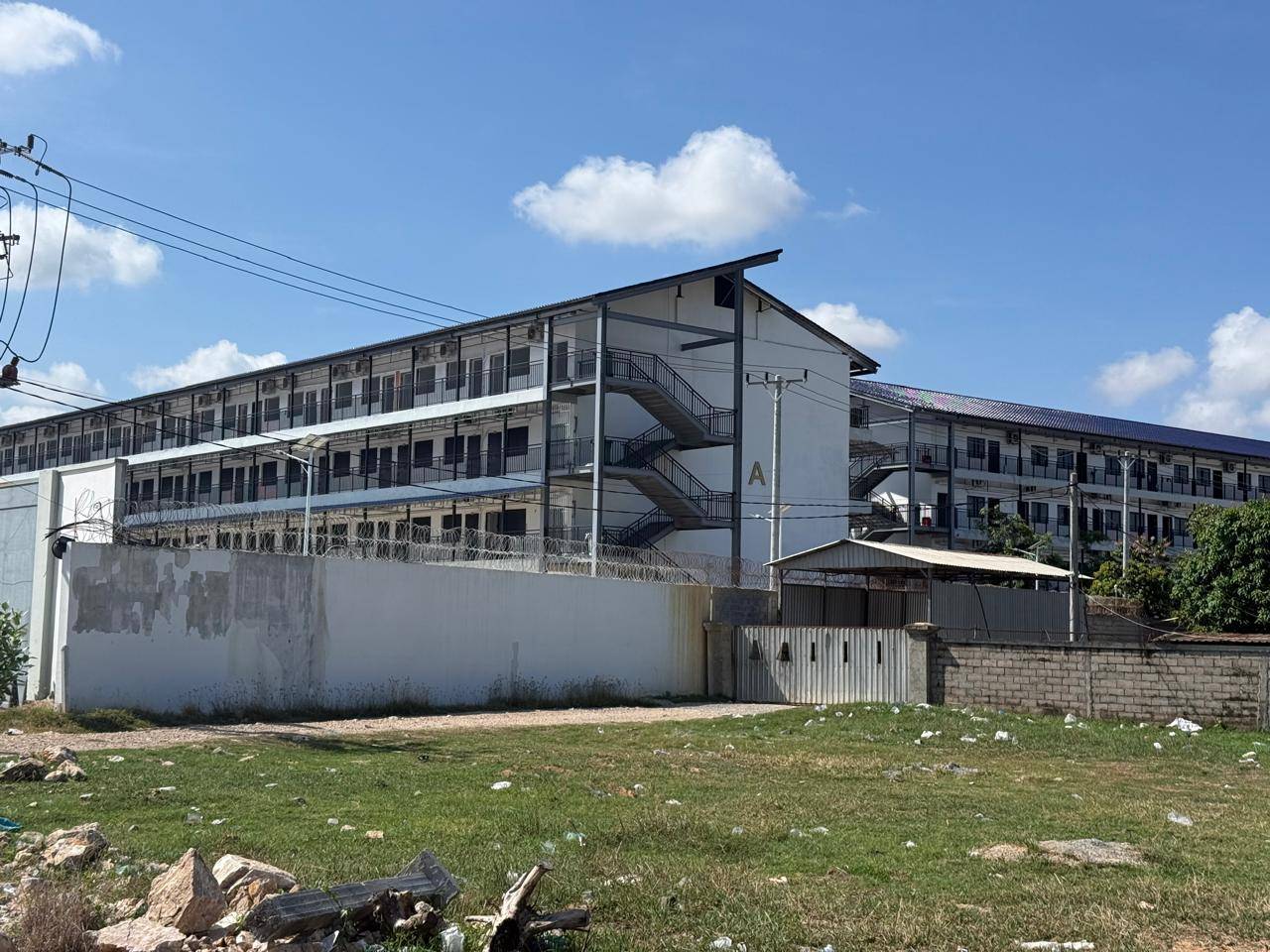
Kenzo left Lesotho for a job in Cambodia in December — and when he got to Kampot province’s Wo Casino, he had no choice but to scam, he said.
“It’s either we did and did it well or we would be tortured,” he said.
Months after he was able to escape, he said he similarly had no choice but to sleep outside the gates of an NGO called Caritas, where he had waited and slept for four nights and five days.
For those five days, staff and guards of Caritas said they could not help. “Our help is limited,” he recalled. Kenzo told a reporter via text that he would have even appreciated it if he could sleep on the ground inside the gates in safety rather than outside.
“Indeed when they said ‘good intentions and reality never go together,’ they told the truth, we came there running seeking help, only to be taken into custody,” Kenzo said over text messages with a reporter.
On June 2, Kandal police detained 18 foreigners who had been sleeping outside the gates of the NGO after they had escaped trafficking networks and forced work in Cambodia. The people who were detained, and other foreigners who say they escaped scam operations, say the situation is growing more dangerous for those who can’t yet afford a plane ticket out of Cambodia. Some have been raped while sleeping on streets.
Phon Likou, Takdol commune police chief confirmed to Mekong Independent that local authorities in Kandal province had detained 18 African people including two women. He said that the NGO Caritas had reported to them that they did not have enough documents and they came to the shelter gates without being referred by another person.
“We are not arresting them, [but] the technical team brought them in for questioning by the provincial police commissioner,” he told Mekong Independent. “They are not involved with any crimes because they are foreigners and they come to ask for shelter from the NGO, because the NGOs accept the people who lose passports or have no shelter or no destination.”
Phon Likou did not provide any details about the people who were detained, saying the matter was in the hands of higher authorities.
“The center does not dare to accept them because they do not have sufficient documents and they come by themselves without anyone’s order sending them [to the shelter], so they dare not to accept, and inform authorities so that we bring them in for questioning in compliance with procedure.”
Some of the workers sent a live location pin on June 10, a day after they told a reporter they had been transferred. The location pin that they sent overlaps with a former scam compound in Takeo province called Mango 2.
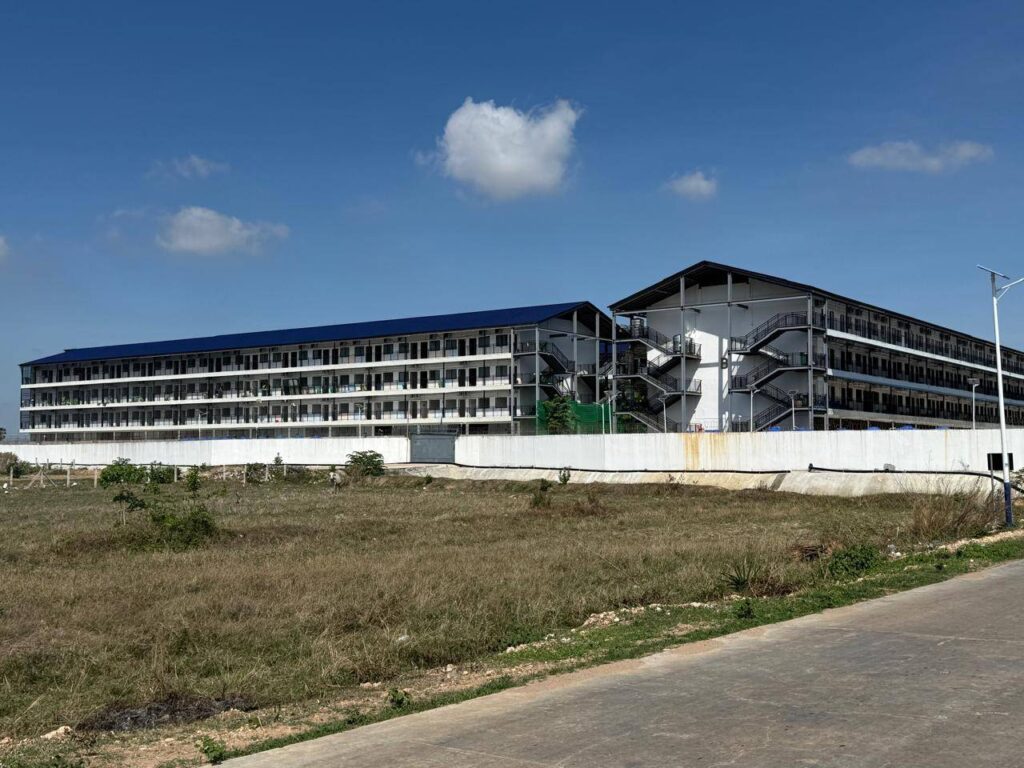
Ling Li, a cofounder at the nonprofit EOS Collective that has been providing aid to trafficked scam workers, said that a former scam compound in Takeo province colloquially called Mango 2 had been converted to an immigration detention center. People in the center had told her that the conditions were unhygienic and people were not given sufficient food and water.
“There are embassies reporting to us that there are skin diseases spreading in detention centers,” she said. “It’s unacceptable that the Cambodian government changed the Mango 2 scam compound into an immigration detention center and some of the people were trapped before in Mango 2, so it’s definitely retraumatizing for them.”

The people in Mango 2 were scared to give their names out of concerns of retaliation, but they could speak to a reporter directly via WhatsApp messages and in a group chat. They said they were only offered water for free at limited times, and were forced to order their food by delivery, increasing costs. Provided food consisted of rice and a small piece of chicken, they said.
A spokesperson for the U.N. International Organization for Migration’s Cambodia office responded to questions from Mekong Independent with a general statement saying they were working with the Cambodian government and other partners on victims’ cases. “Given current resource constraints, IOM is working with partners to provide limited, prioritized support,” they said.
Caritas Cambodia did not respond to a request for comment.
A 41-year-old Ghanaian man texted a reporter from the center, saying that he had been told by the U.N.’s IOM office in Phnom Penh to go to the Caritas NGO shelter, where he too waited for five days before being arrested.
He had come into Cambodia on a flight ticket paid by the company recruiting him, which he initially believed was a teaching job he found in TikTok ads. He ended up in a compound in Prey Veng province that’s often called “Park 8.”
Now in the center, he said he was getting sick, with severe pain in his abdomen.
“I need your help please, the condition under which we are kept at the police custody is so inhumane,” he said. “I feel seriously sick for the past few days due to the smell together with cigarette smoke. … I need your help to get out please, my life is in a limbo.”
One Ugandan man said he had been detained after he already bought a plane ticket back to Nairobi via a family sponsor, sending a picture of the ticket to a reporter. Before his flight, he was concerned that the officers at the detention center would not take him to the airport, saying they wouldn’t talk to him or look at the ticket copy on his phone.
“They handcuffed me from behind,” he said. “[The] worst part is the police guy is still with me as if I will run away.”
He made it back to Uganda on Sunday, he said in a message.
Indonesians going home
The Indonesian Embassy in Phnom Penh has been sending regular updates to the still-thousands of citizens who came to work in online gambling and scams via its Facebook page, waiving overstay costs and directing people who need to leave to buy certain flights approved for overstays.
The embassy previously claimed that none of the Indonesians leaving had been victims of human trafficking but rather illicit online workers.
Dozens of Indonesians waited outside the embassy on June 15, saying they were seeking consular services — crowds like this have been outside the embassy most weekdays. One man squatted and played on his phone outside a rented room nearby that he shared with a half-dozen other Indonesians. He showed reporters his plane ticket to Jakarta and said he was excited to leave.
He said his experience was mostly positive in Cambodia, earning a salary of $607 monthly in an online gambling business in Kandal province’s Sampov Poun city. But he said he was “not coming back.”
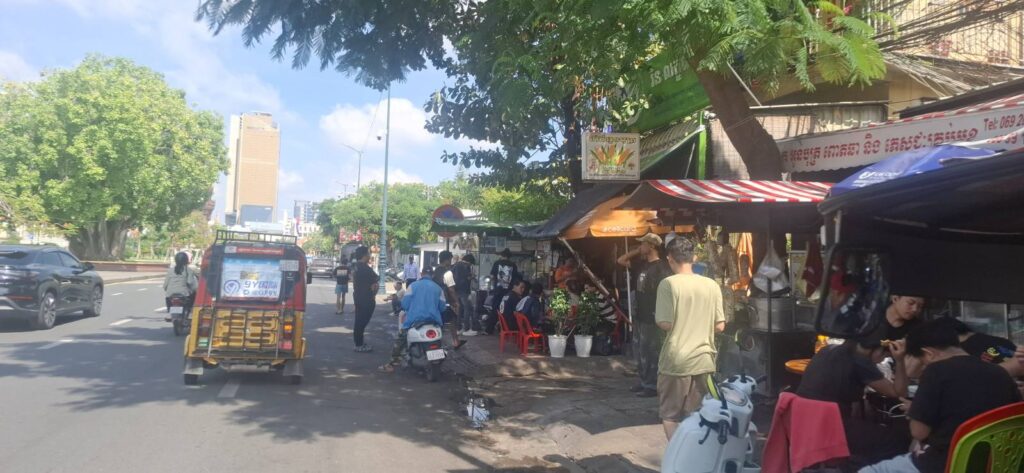
Adi, an Indonesian who had been living in Poipet for three years, said he ended up overstaying his visa for the past six months because he had lost money on an investment.
“Before I had two choices, and I [only] had $1,000, so I could make a visa or I open resto new … so I think if I open resto new for one month I can make a visa [after],” Adi said.
He opened the Indonesian restaurant in Poipet in November, but by December the border conflict between Thailand and Cambodia reignited for almost three weeks, and most of Poipet closed down. Adi had to close the restaurant.
“Resto closes, and now I have a visa overstay,” he said.
His wife, Les Hasnah, a Cambodian woman from Preah Sihanouk province, said that they had been trying to support 20 other Indonesians who lost their jobs in the conflict and later the ongoing crackdown, but the couple lost even more of their savings when Adi’s wallet was recently stolen.
They came to Phnom Penh about a week ago, Adi said, so that he might be able to go home and fix his passport. They are also selling meals of rice, egg and bakwan sayur, Indonesian vegetable fritters, for $1.25. Adi said he wanted to keep the price affordable so other waiting workers could buy it.
Hasnah said her current life was challenging, but she felt especially bad for the Indonesians trying to leave Cambodia.
“Some Indonesians become so desperate because they become starving, and [they] decide to steal phones and get caught [by authorities],” she said.
Danger on the streets
Nancy, a 25-year-old Kenyan citizen, said throughout her year in Cambodia, May had been the most dangerous and precarious month.
She had been recruited to Cambodia into what she believed to be a general call center job, but she was forced to perform task scams in Wo Casino in Kampot province, escaping in January during the mass raids. She lived by sleeping in crowded rooms in the few guesthouses that didn’t check her visa status, as her recruiter had brought her into Cambodia with a tourist visa, now long overstayed.
Nancy told Mekong Independent that she didn’t have enough money for a plane ticket back to Nairobi, and her younger cousin had also been recruited to Cambodia, and so she struggled to provide for her too.
“I told my uncle if you manage to get money for at least one plane ticket it will be easier even for me, because I don’t have money and I’m struggling to get money to get food for two people, at least if they manage to take her back home,” she said. In order to try to raise funds, Nancy tried to work for one month in March at a scam compound in Poipet that was still recruiting, but she left again after a raid, gaining temporary shelter and food but never any income.
Back in Phnom Penh, she spent a few nights in rented rooms shared by escaped scam workers from African countries, but sometimes she had to sleep on the street under a road bridge. Usually she would stay in groups, but one night when she was alone, she was raped by two men. They only stopped when a passing tuk-tuk driver intervened and helped her.
Nancy says she got donations of plane tickets for herself and her cousin from the EOS organization even before she was raped, but she didn’t have stable shelter because of overcrowding. She also received medical support from IOM Cambodia after informing them of the rape, but that was after she texted them over the three prior months, asking for food and shelter.
Li of EOS said both escaped workers and embassies don’t know clearly what to do in the circumstance where they can’t afford to buy their own ticket home and their embassies aren’t in Cambodia, a common situation for many African workers.
Li said she also worried that the Cambodian government’s decision to waive overstay fees for escaped scam workers might not last long enough to get all of them out, leaving people stuck with another fee they wouldn’t be able to repay. Last month a letter, which had been proved as a falsified government document, claimed that the waiver would be removed by the end of May and African citizens without proper papers could face jail time.
The primary problem barring foreign victims from getting help — with shelter, food and plane tickets out — is that the Cambodian government has not screened any foreign workers for identification as victims of human trafficking.
“We know there are many good anti-human trafficking organizations in Cambodia, they have been doing a great job for the Cambodian citizens. But why this time everybody is silent? Because there’s no victim. This is the main problem,” she said, referring to official designations.
This also means that victims’ home countries won’t have sufficient evidence to identify them as trafficking victims and will struggle to recuperate from debts and their traumatic experiences, Li continued.
“Many of those victims, they sold their property, they quit their job in the dream of having a better life, and now they went back to a situation that is even worse than they left,” she said. “I’m afraid that we are pushing those people with scam skills to go back to the industry.”
Danielle Keeton-Olsen joined the co-founding board of EOS Collective but she does not collect a salary from the organization and does not work on trafficking victim support.
This article is published as Creative Commons.