
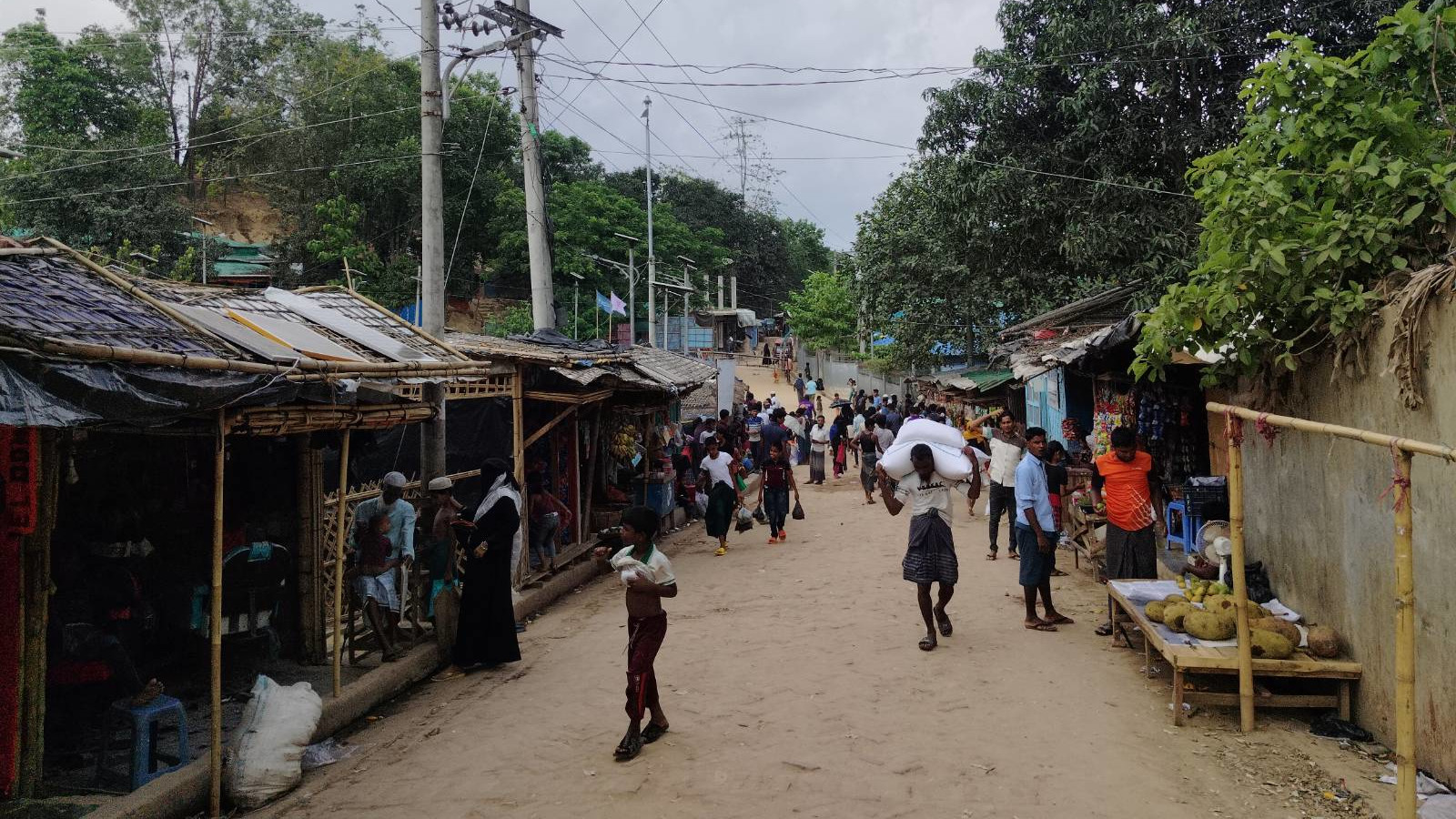
Abdu Shukkur’s monthly supply of rice, lentils and eggs ran out after only 18 days. Only half a liter of oil remained, and some garlic for a Sunday meal for his eight children. There were no edible goods remaining except an empty container.
Inside the crowded Rohingya refugee camps of Cox’s Bazar in Bangladesh, hunger does not arrive all at once. It comes slowly, meal by meal, item by item, until families begin calculating how many days remain before the next food distribution.
“The children ask for food many times,” Abdu Shukkur said, sitting inside his bamboo shelter as rain dripped through the poor plastic roofing above him. “Sometimes we tell them to sleep early so they do not feel hungry.”
Like more than 1.2 million Rohingya refugees living in Bangladesh, Abdu Shukkur fled genocidal violence and mass displacement in Myanmar. Most families survive entirely through humanitarian assistance.
In April, the World Food Programme (WFP) introduced a new three-tier assistance system based on household vulnerability. Under the system, around 17 percent of refugees receive food assistance worth $7 per person per month, while others receive either $10 or $12. Prior to the change, all the families received $12. According to WFP, “male-headed households with able-bodied men” are placed in the $7 tier, with the implicit assumption being that people who can do physical work need lesser aid. However, refugees inside the camps are restricted from formal employment and have no opportunities to earn income legally.
Abdu Shukkur’s family was placed in the lowest category as he has two adult boys.
To collect the month’s rations from the WFP office, he walked for nearly 22 minutes through a hilly road. At the camp distribution center, he learned what his family would receive for the month: 80 kilograms of rice, five bottles of oil, 15 eggs, one kilogram of onions, half a kilogram of garlic, and one kilogram of dried chili.
At first, he believed the supplies might somehow last. But they were gone after only 18 days. With meals consisting almost entirely of rice, even 80 kg goes fast.
After that, Abdu Shukkur borrowed 4,000 Bangladeshi taka (about $33) from his uncle, Roshid, and secretly went outside the camp through a hole of barbed wire to the market, where he bought another 30 kilograms of rice, three kilograms of lentils, and a few vegetables.
Leaving the camp carries risks. Movement restrictions, police checkpoints, and insecurity make travel difficult for refugees.
But Abdu Shukkur said he had no choice.
“If I stay inside the camp, my children will sleep hungry,” he said. “I know going outside is dangerous, but what can a father do?”
At night, his children now eat smaller meals so the rice can last longer. Sometimes breakfast is skipped completely.
One of his daughters recently asked when they would eat eggs again.
“I could not answer her,” he said.
Deepening hardship across the camps
Across the camps of Cox’s Bazar, families describe similar scenes unfolding inside their shelters.
Parents who once managed to survive on previous food assistance levels say they are now reducing meals, borrowing money, and pulling children out of learning centers to help support households.
Ahmed, a 57-year-old refugee, said his two sons recently stopped attending their learning center and now spend their days selling ice cream inside the camp.
“They wanted to continue studying,” he said. “But when there is not enough food in the house, children begin thinking about survival instead of education.”
Ahmed, like most interviewees, asked to withhold his full name out of fear of retaliation from the police or camp authorities.
In Camp 19, Rozina, a mother of five, said she had cried after learning her family was placed in the lowest assistance category.
“There is nobody working in our family,” she said. “How can we survive with $7?”
She said her children had become weaker in recent months because the family could no longer afford vegetables, fish, or protein-rich food beyond the limited ration supplies.
“Before, we somehow managed for the whole month,” she said. “Now the food finishes early, and the children remain hungry.”
At a monthly public coordination meeting for the camps in May, a Doctors Without Borders representative said the effects of worsening nutrition were becoming visible in the Rohingya refugee camps.
Roshid, a father of seven children, described how several of his children had recently become sick with fever and skin infections at the same time.
“First one child became sick, then the others,” he said. “We waited half of a day at the AWARD hospital because there were too many patients in line.”
The family received basic medicine, but he said he could not afford nutritious food to help his children recover.
“When children are hungry all the time, their bodies become weak,” he said. “As a parent, it is painful to watch.”
The worsening hardship is also deepening fear inside the camps.
After sunset, many refugees avoid walking alone through the narrow pathways between shelters. Residents describe frequent reports of armed violence, kidnappings, extortion, and intimidation.
Jamila Begum, a mother living near one of the camp roads, said she no longer allowed her daughters outside after dark.
“We hear shouting and sometimes gunshots during the night,” she said. “People are already hungry and desperate. Now they are also afraid.”
Some refugees say the growing desperation is pushing people toward dangerous decisions.
Khairul, a 28-year-old refugee, said more people were discussing risky sea journeys to Malaysia as conditions worsened inside the camps.
“People know the sea can kill them,” he said. “But many believe staying here without food, work, or safety is also destroying their future.”
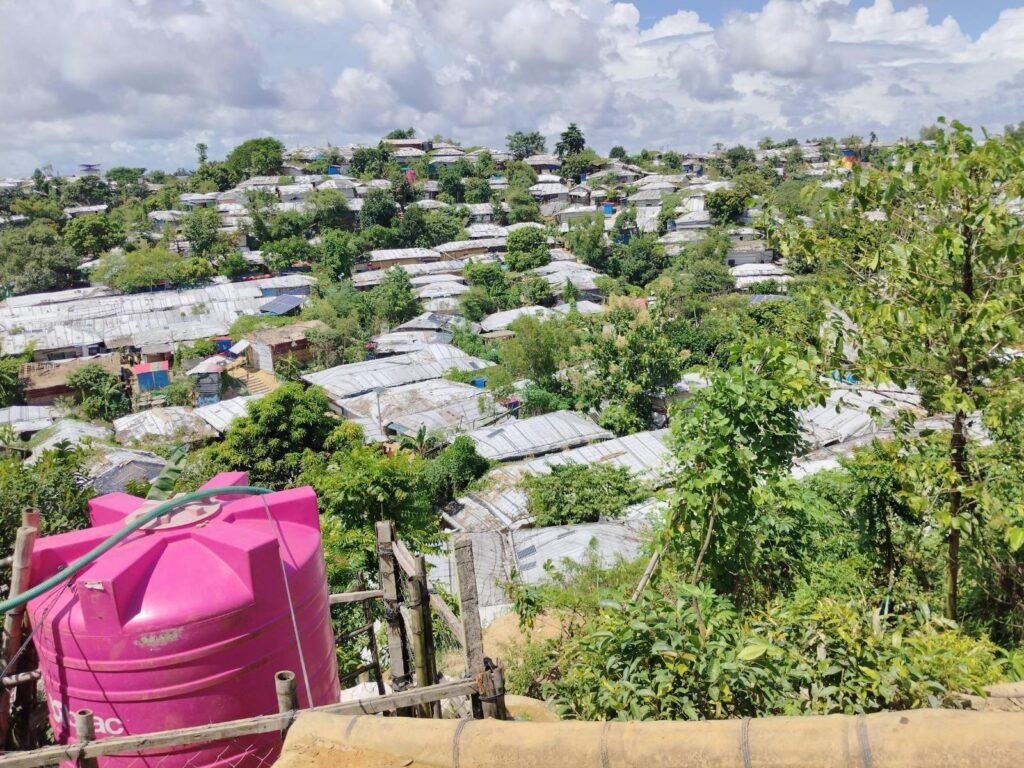
Aid reductions push Rohingya families into deeper crisis
When the new assistance system was introduced on April 1, WFP spokesperson Kun Li said in a CNN interview that the changes should not be described as “ration cuts,” arguing that assistance levels still met minimum emergency nutritional standards.
The agency stated in a Facebook statement that a true ration cut would mean assistance dropping below 2,100 calories per person per day. According to the WFP, even refugees receiving support worth $7 per month could still meet that minimum level.
The agency said the new system was introduced as humanitarian funding continued to face major global pressure, and aimed to prioritize households considered the most vulnerable.
Kun Li did not provide answers to further questions from Mekong Independent.
But many refugees strongly rejected the argument that conditions remained manageable.
“For us, this is clearly a ration cut,” said Munaf, “People cannot survive properly when prices continue increasing and we are not allowed to work.”
Families must also buy soap, medicine, vegetables, clothes, and other daily necessities using whatever limited resources they have. For larger households, the assistance no longer stretches through the month.
Trapped between hunger and hope
As evening approaches, smoke rises from cooking fires across the camp while children run barefoot through muddy alleyways between shelters.
Inside his shelter, Abdu Shukkur carefully measures the remaining rice in a large plastic container.
Only a small amount remains. He says he does not know how his family will survive until the next distribution arrives.
The money he borrowed has almost finished, and he worries about repaying the debt.
Around him, the camp continues moving through another difficult day, aid trucks arriving, children carrying water pots from the bottom of the high hill, mothers standing in ration lines, fathers searching for ways to feed their families.
For Abdu Shukkur, the future feels trapped between survival and uncertainty.
“We escaped from violence in Myanmar hoping our children would live safely,” he said. “Now every day we worry about hunger instead.”
Still, he says he has not completely lost hope. Like many Rohingya refugees, he wants the chance to return home one day with citizenship, rights, freedom, and security guaranteed in Myanmar. Until then, he hopes humanitarian support will not continue shrinking for families who have nowhere else to turn.
“We are refugees,” he said. “We cannot survive without assistance.”
This article is published as Creative Commons.