
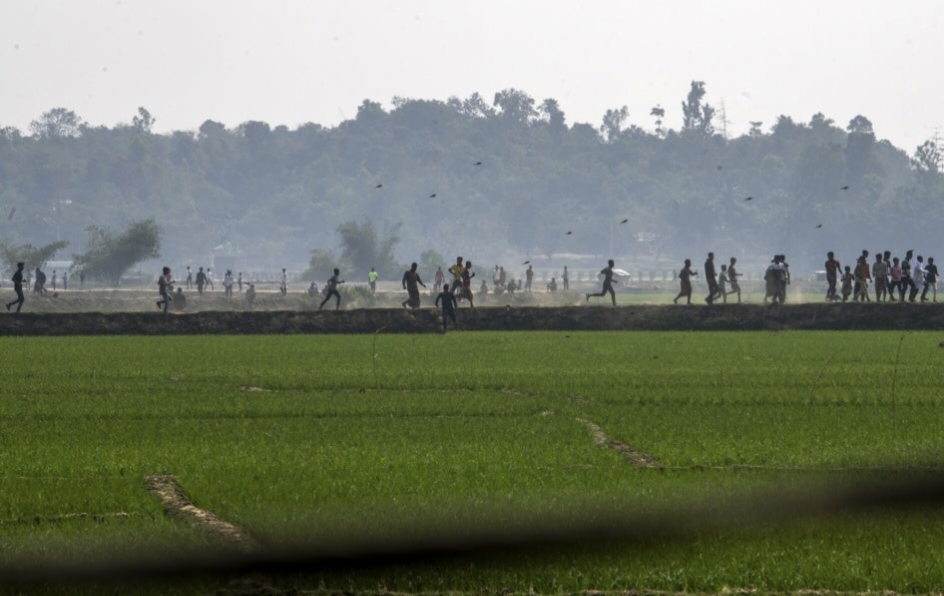
In western Myanmar, family members and neighbors tried to intervene in the arrest of seven young men and women who were seized by members of a local ethnic armed organization, the Arakan Army.
“They came suddenly, heavily armed, and took them away,” said Abdul Karim, who said he witnessed the abductions in Buthidaung township’s Lea Wet Daung Pyin Shey village.
“First they were locked with a chain. When a man asked why they were being locked up, he was kicked by an armed soldier without any response,” he said. “I don’t know where they were brought later.”
Abductions have become one more problem for communities in Rakhine state to face as both the Arakan Army, or AA, and Myanmar military vie for control through widespread clashes. Families displaced by fighting have been sequestered to camps where food and medicine are scarce, further hampered by blockades, travel bans and few opportunities.
The Arakan Army, which controls 14 of the state’s 17 townships, has yet to fully capture Buthidaung township near the Bangladesh border. Northern Rakhine is home to tens of thousands of Muslim-minority Rohingya displaced in a genocide that began in 2017 and continues in the form of attacks and clearance operations by Myanmar’s military.
Relatives identified two of the victims as 17-year-old Mohammed Hares and 20-year-old Jani Alom, both men from Kyaw Hla Pyin village, while the remaining five individuals from Dun Chaung village remain unnamed. All were internally displaced people sheltering temporarily in Lea Wet Daung Pyin Shey.
Members of the AA and local administrators, including a village chairman, returned to Lea Wet Daung Pyin Shey days later, relatives of several abductees told the Mekong Independent. They demanded a ransom of one million Myanmar kyat (US $235) per person, a huge sum for most families.
“We are struggling just to survive. Even buying food is difficult — how can we raise this kind of money?” said Noor Begum, the aunt of the abducted Jani Alom. “We are helpless. We just want them back alive.”
Two other relatives said they worried the AA could retaliate if they failed to make the payment.
Last year, the AA were reportedly set to begin conscription for residents over 18, according to Radio Free Asia.
Requests for comment from the AA were not answered by the time of publication.
Shifting power dynamics
The Rohingya, a predominantly Muslim ethnic minority in Myanmar, have faced decades of systemic discrimination under the Myanmar military’s policies, including restrictions on citizenship, movement and access to basic services.
In 2017, more than 700,000 Rohingya fled Myanmar following a military crackdown widely documented by international organizations and media. Investigations described widespread killings, sexual violence and the burning of villages during operations carried out under the government led by now-deposed State Counsellor Aung San Suu Kyi.
In the years following the 2021 coup, allegations of attacks, raids and abductions have plagued both the AA and the Arakan Rohingya Salvation Army, as well as the Myanmar military.
Accusations against the AA began to mount with increasing frequency alongside its rapid military successes in 2024, Rakhine residents said.
“These incidents are no longer isolated,” said Aman Ullah, a community leader in the town of Maungdaw. “People are living in constant fear.”
In 2024, the AA were accused of murdering more than 600 civilians during an assault on Buthidaung township’s majority-Rohingya village of Htan Shauk Khan.
The AA denied these allegations, stating its soldiers had only killed junta troops following a three-day battle.
However, family members of the deceased claim their relatives were killed in a discriminatory attack when the AA fired into crowds of civilians fleeing a battle.
“A group of Arakan Army soldiers intentionally opened fire towards us and killed many of us, including four of my siblings,” said a teacher asking to be identified as Asmot, who lost five family members total. “I escaped by lying beside one of my brothers, pretending to be dead.”
One victim, asking to be identified as Sokina, said she was shot in the arm four times before her seven children and husband were also killed in the attack.
“My husband asked me for forgiveness and a last drink of water before he took his final breath,” said another woman asking to be identified as Setera. “I saw my children’s bodies lying on the ground and then thrown into the pond, where they struggled for several hours before dying.”
Abduction allegations
While the Myanmar military remains a central actor in the country’s ongoing conflict, the rise of the Arakan Army as a dominant force in parts of Rakhine State has introduced new dynamics. However, Rohingya residents and observers say that despite the shift in control, they continue to face insecurity and rights violations.
“The authorities may be different, but our situation has not changed,” said Eman Hossain, a religious leader from Maungdaw township. “We are still living without protection.”
In a 2025 report, Myanmar-focused investigation organization Fortify Rights documented repeated incidents of torture, abduction and murder by the AA against Rohingya throughout 2024 and 2025.
Officials reportedly kept victims in AA detention centers on accusations of affiliations with Rohingya armed groups, or for refusal to join the AA. Some were sentenced to hard labor, while others were beheaded.
While the AA denied 2024 arson attacks on Rohingya homes, it did admit to the 2025 torture and execution of two prisoners of war.
Men fleeing into Bangladesh are also frequently fired upon by the AA, witnesses said.
AA soldiers shot at a group of four men, killing two named Mohamed Farooq and Ziau Rahman on March 31, said a former worker for Médecins Sans Frontières, asking to be identified only as Sayed.
“When they were seen near the border, the Arakan Army opened fire,” he said. “Two men were immediately killed, while the other two managed to escape.”
Three Rohingya women, one identified as a woman named Minara, were reportedly abducted on Feb. 18 from Buthidaung township’s WaYa Chaung village, according to an activist asking to be identified as Toyub. They were taken from their homes and are believed to be held at an Arakan Army base in Kwan Daung village for military training.
Minara was married just two days prior to being abducted from her father-in-law’s house, said her cousin Rofiqe, who witnessed the abduction.
“The AA forces them to wear shorts during training and subjects them to other uncomfortable practices,” he said. “There are also rumors that the girls are being sexually abused.”
Media outlet Arakan Now reported that nearly two weeks before the abductions from Lea Wet Daung Pyin Shey village, AA officials took Maulana Mohamed Kawbir from Kyet Yoe Pyin village in Maungdaw township on April 17.
For the seven individuals abducted on April 30, their whereabouts remain unknown, relatives told the Mekong Independent. Families are attempting to gather funds, but living under severe financial hardship, they fear they may not succeed.
“The situation for civilians remains extremely fragile,” said a humanitarian worker operating in Buthidaung town, speaking on condition of anonymity due to security concerns.
“Even where control has changed, protection for Rohingya communities has not improved.”
Niyamot Ullah is a researcher and poet based in Bangladesh. This article was completed with additional reporting done by citizen journalists.
This article is published as Creative Commons.