
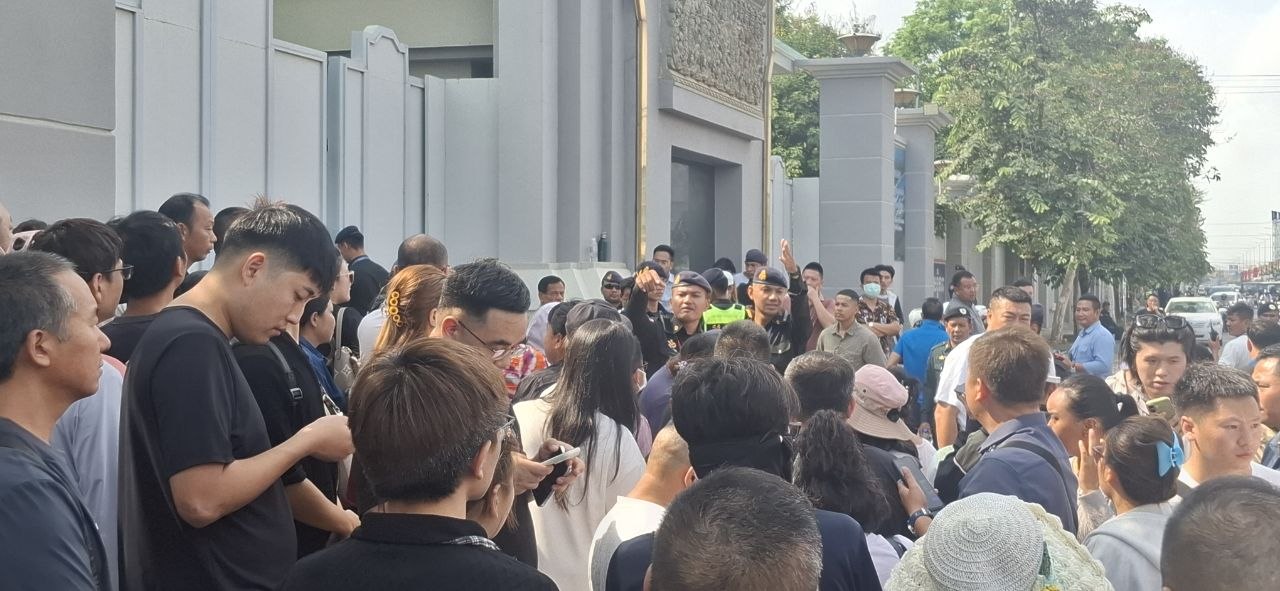
Huione Pay customers protest at Chinese Embassy, NBC
Chinese customers of Huione Pay and HPay spent several hours protesting in front of the Chinese Embassy in Phnom Penh on Wednesday morning, and then at the National Bank of Cambodia on Friday morning, requesting their funds be returned like clients of Panda Bank and Prince Bank.
Protesters told a reporter that police surrounded them on Wednesday and made some people delete their photos. One person claimed that police tried to grab two Chinese men and bring them somewhere, but the protesters pulled them away.
The National Bank previously told clients in a private letter that the bank was not required to intervene, but they could attempt to file a complaint in court.
This week, clients of HPay — which was launched as a rebrand of Huione Pay with offices in the same locations as former Huione branches — were told they should file their claims within 30 days in order to be credited during the company’s liquidation. Customers have raised contentions with the NBC’s attempts to distinguish HPay from Huione Pay, saying they’re functionally the same company.
Clients said they were troubled to see that their account balance in the app turned to a null reading as of this month.
One protester who attended both demonstrations, who only gave his name as Long, told Mekong Independent that a total of 20 people — 10 Chinese customers and 10 Cambodians — were allowed into the NBC building on Friday morning to make their claim. He said they wanted to make a short appeal to explain that they believed had Huione and HPay were legal companies operating properly.
“I think many people don’t want to get a lawyer,” he said, referencing the NBC’s statement suggesting clients bring their case against the company in courts. “If you don’t have money or power here, you can’t get a lawyer.”
In spite of the large number of protesting Chinese clients, Long observed that he had seen little coverage of the Chinese Embassy protest in Chinese news media. He said that he believed that was because Chinese Foreign Minister Wang Yi was in Phnom Penh this week for the “2+2” dialogue between Cambodia and China’s foreign and defense ministers.


Kok An sanctioned
The U.S. Treasury sanctioned tycoon and senator Kok An over his alleged involvement in scams, alongside associate Rithy Raksmei and others.
“Southeast Asian scam operators within this network have stolen millions of dollars from U.S. victims while operating under the protection of Kok An and his political connections,” the U.S. alleged.
Kok An’s company Crown Resorts owns casinos, resorts and other buildings in Poipet, Sihanoukville and Bavet.
The U.S. State Department also announced a $4-million reward for information leading to the arrest of Daren Li, who was allegedly involved in “facilitating the laundering of proceeds for various scam centers in Southeast Asia.”
Immigration, police officials arrested
Ouk Hai Seila, the deputy director of the Interior Ministry’s Immigration department, and Sor Samnang, Phnom Penh deputy police commissioner, were sent to court this week over alleged bribery tied to the online scam ministry. The Anti-Corruption Unit spokesman Soy Chanvichet confirmed the news to CamboJA News on Wednesday but provided few details. Chanvichet added that the case had been under investigation for about 20 days and was sent to court on Wednesday afternoon.
Government news site Fresh News reported that two others, Sor Samnang’s wife and a person named Yat Kosal, were also suspected of taking bribes.
Ouk Hai Seila has long been involved in police actions involving foreigners, including alleged online scam operations run by Chinese nationals dating back to 2017.
Shooting in Poipet
Banteay Meanchey deputy provincial police chief Ram Vireak said that a video shared on social media showing a raid and shooting in the province was real.
“I have not received the report yet and need to wait a little more time and I cannot say anything yet,” he said, adding he was based in the commune office and therefore not present at the raid.
One video shared on Twitter shows a group of officers at a high-rise apartment building. Various items appear to be thrown off balconies. The sound of gunshots can be heard as a group of men run away from the officers toward the building.
The next day, authorities reported arresting more than 400 people during a raid at a hotel in Poipet city’s Kbal Spean 1 village.
‘Scambodia’ headline rankles government, netizens
The Wall Street Journal published an article on April 19 exploring the ways in which the cyberscam industry has infiltrated the Cambodian government and development, which so far has lasted beyond the dramatic deportation of Chen Zhi and ensuing crackdown.
But many readers appeared stuck on the headline: “How cybercrime became a leading industry in ‘Scambodia’”.
Keo Remy, senior minister and president of the Cambodian Human Rights Commission, wrote a letter to WSJ’s editor in chief Emma Tucker, urging the news outlet to change the headline and issue an apology.
Information Ministry spokesman Tep Asnarith called the headline an “intention to incite discrimination” in an article by Phnom Penh Post, channeling the language of the oft-used incitement charges in Cambodia’s Criminal Code.
But others, like Thmey Thmey news editor, Sao Phal Niseiy, expressed his disappointment in a Facebook post but also suggested netizens pay closer attention to the cyberscam phenomenon behind the headline.
“If we turn away from the root of the problem because we are angry, because we are hurt, we will continue to lose!”