
This article was originally published on Prachatai.
When the Rohingya refugee crisis is discussed internationally, global attention usually centres on Bangladesh’s Cox’s Bazar camps, which became emblematic of displacement after Myanmar’s 2017 military crackdown. Less visible is the situation unfolding across Southeast Asia. In Thailand, Rohingya refugees and migrants live in prolonged legal uncertainty frequently detained, rarely recognised, and largely absent from formal protection frameworks.
Thailand is not commonly framed as a destination for Rohingya refugees. It operates no formal Rohingya camps and does not publicly position itself as a protection country. Instead, it functions as a transit corridor, informal labour site, and temporary holding ground. For many Rohingya fleeing violence in Myanmar or deteriorating conditions in Bangladesh, Thailand is neither a final refuge nor a secure stopover, but a space of risk and administrative ambiguity.
Small boats departing Bangladesh or Myanmar’s Rakhine State often aim for Malaysia or Indonesia. Yet sea currents, interception, mechanical failure, or abandonment by smugglers frequently bring passengers to Thai shores. Others cross land borders through forested terrain with the help of brokers.
When boats land along Thailand’s Andaman coastline, including areas near Phuket or Phang Nga, authorities may provide immediate humanitarian assistance: food, water, medical care, and temporary shelter. However, these gestures are discretionary and do not confer legal recognition. After initial screening, many are processed under immigration law.
Thailand is not a signatory to the 1951 Refugee Convention or its 1967 Protocol, and domestic law contains no comprehensive asylum procedure. As a result, Rohingya asylum seekers without documentation are categorised as irregular migrants, regardless of persecution claims. Refugee status has no formal standing in Thai immigration legislation.
Without statutory protection, immigration detention becomes common. Undocumented Rohingya intercepted at sea or arrested inland may be held in Immigration Detention Centres (IDCs). A 2025 Human Rights Watch report documented how Myanmar nationals , including Rohingya , face routine arrest, intimidation, extortion, and detention, with Thai police sometimes using threats of arrest to extract bribes from undocumented people.
Similarly, Fortify Rights has highlighted cases of Rohingya children being detained under Thailand’s immigration laws and urged authorities to provide alternatives to detention and legal protection for refugee children.
The Rohingya’s precarity in Thailand is rooted in statelessness. Myanmar’s 1982 Citizenship Law effectively excluded most Rohingya from recognised national races, denying them citizenship and facilitating decades of movement restrictions and discrimination.
Statelessness does not end at the border. Without recognised nationality, Rohingya entering Thailand lack consular protection or valid documentation. This reinforces their classification as undocumented migrants and heightens vulnerability to exploitation.
Those living outside detention depend largely on informal labour markets. Many work in fisheries, construction, agriculture, and small-scale manufacturing, particularly in southern provinces reliant on migrant labour. Without work permits, they are excluded from formal labour protections. Wages may fall below legal minimums, safety standards may be ignored, and access to legal remedies is limited.
Fear shapes daily life. Police checkpoints and immigration raids restrict mobility. Workers are often reluctant to report abuse, knowing that contact with authorities could lead to detention. In some areas, informal payment arrangements to avoid arrest have been reported, illustrating how legality becomes transactional.
Children face similar uncertainty. Thailand formally guarantees education access regardless of legal status, yet documentation barriers, language gaps, and fear of exposure limit enrolment in practice. Healthcare access varies widely; emergency care may be available, but routine services often require payment beyond families’ means.
Civil society organisations attempt to fill these gaps through legal aid, translation services, and medical support. Yet without formal refugee recognition, durable solutions remain out of reach.
The maritime journeys themselves underscore the desperation driving onward movement. Boats are frequently overcrowded wooden vessels with minimal supplies. Passengers may spend weeks at sea, facing dehydration, illness, or abandonment by smugglers.
Regional coordination on maritime rescue remains inconsistent. States have at times hesitated to assume responsibility for disembarkation, citing jurisdictional ambiguity or fears of encouraging further arrivals. Survival at sea does not guarantee security on land.
This fragmentation reflects broader regional constraints. Within ASEAN, the principle of non-interference limits collective responses to internal crises in member states. Myanmar’s treatment of the Rohingya is rarely addressed through binding regional mechanisms. ASEAN lacks a coordinated refugee protection framework comparable to systems in the European Union or Latin America.
In October 2025, Thailand approved measures allowing certain refugees in long-established border camps to apply for legal work permits. These policies primarily benefit registered refugees from Myanmar along the Thai–Myanmar border rather than Rohingya arriving by sea, yet they signal incremental recognition that displacement management must include economic participation.
The timing was shaped by the wider context of an armed border dispute between Thailand and Cambodia, which disrupted cross-border labour flows and helped pressure the government into implementing work-permit measures amid labour shortages.
Rohingya outside formal camp systems, however, remain excluded from these provisions. Without legal recognition, they cannot access official work permits.
Policy discussions in Thailand have occasionally referenced screening mechanisms to distinguish individuals fleeing conflict from other migrants. Yet implementation remains limited and opaque.
More comprehensive reform would require legislative change. A domestic asylum law establishing refugee status determination procedures, alternatives to detention, and temporary protection categories would align Thailand more closely with international standards. Clearer cooperation frameworks with UN agencies could improve consistency and transparency.
Alternatives to detention, particularly for children, have been repeatedly recommended by rights organisations such as Fortify Rights and Human Rights Watch. Community-based supervision models used in countries such as Sweden or Canada demonstrate that migration management and rights protection need not be mutually exclusive.
At the regional level, stronger ASEAN coordination would require political willingness to reinterpret non-interference in the context of mass displacement. Without shared responsibility mechanisms, frontline states will continue to rely on containment and deterrence.
Thailand’s current approach manages presence without resolving status. Detention, informal tolerance, limited humanitarian gestures, and selective labour integration form a containment strategy rather than a protection framework.
For Rohingya families, legal invisibility shapes every aspect of life: whether a parent can work safely, whether a child can attend school consistently, whether medical care can be sought without fear. Psychological insecurity compounds material precarity.
Thailand is not the origin of persecution, nor the largest host country. Yet as a key transit state, its policies carry significant humanitarian consequences. The persistence of legal grey zones reflects a broader regional reluctance to formalise refugee protection.
Until durable legal pathways are established, nationally and regionally, Rohingya in Thailand will remain suspended between movement and settlement, visibility and denial.
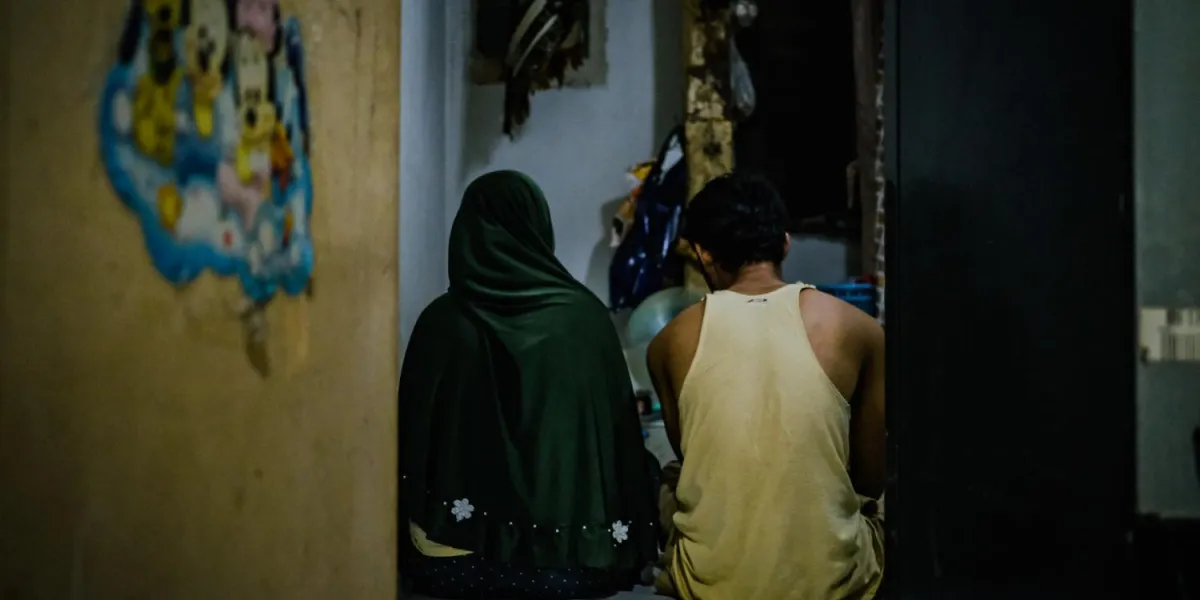
They are present, working, surviving, yet officially unseen.