
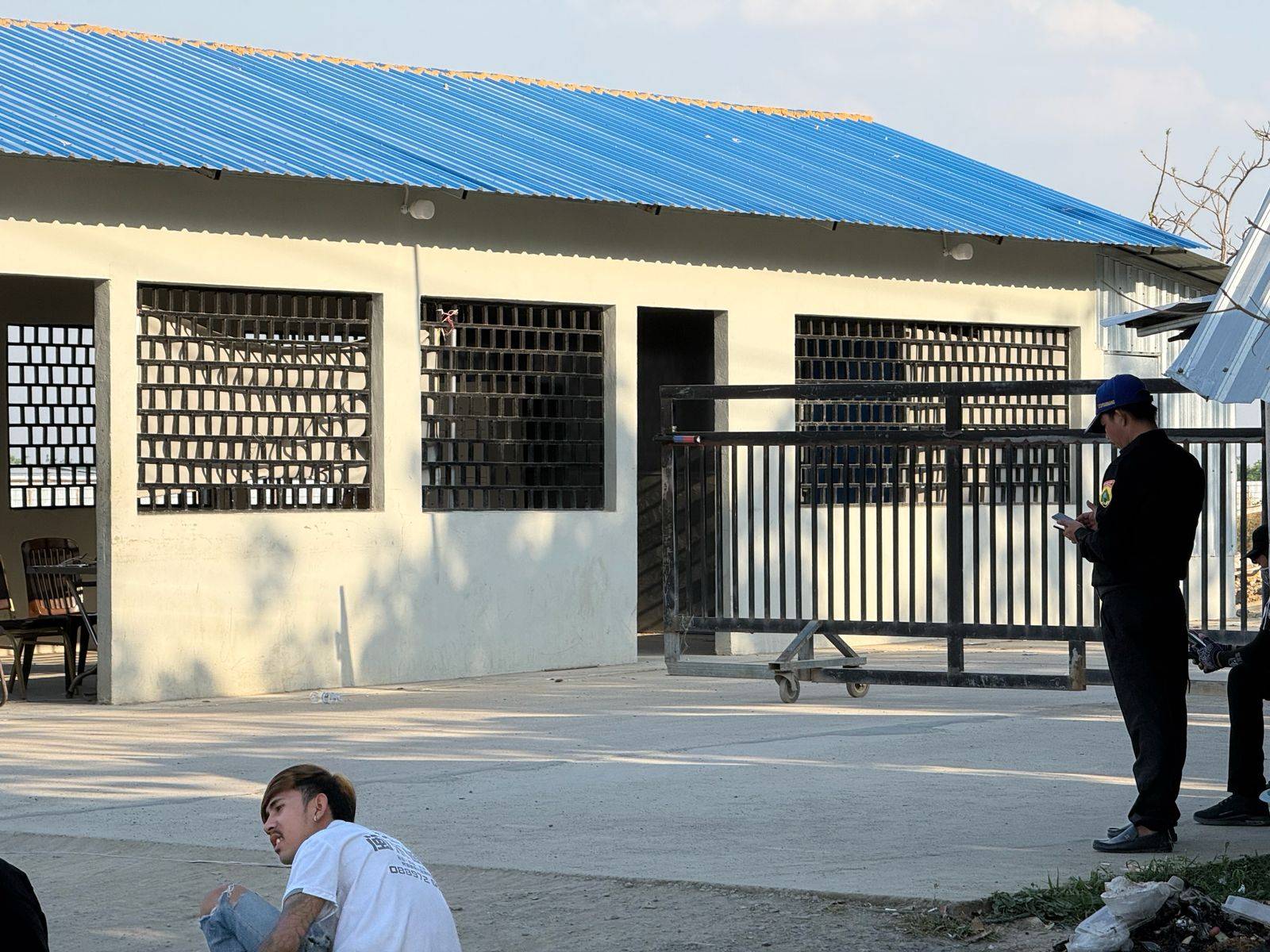
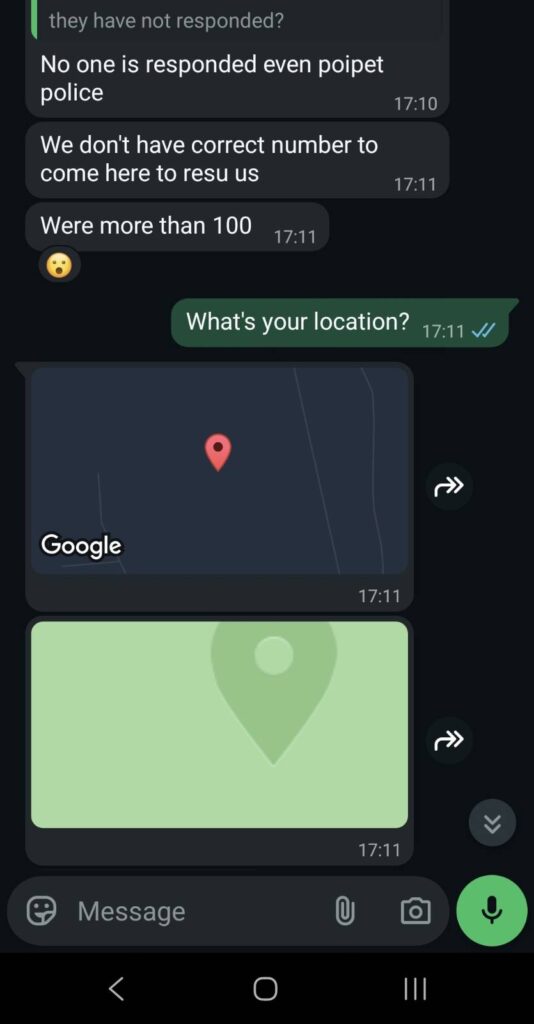
“Hello good evening were ugandans here we need emergency help in poipet,” a man texted a reporter on February 16. As he texted more details, he shared a location that was roughly 30 kilometers outside Cambodia’s border city of Poipet, known for casinos as well as online gambling and alleged scam businesses.
“Were more than 100,” he texted a reporter, asking for assistance to get his passport from “the Chinese” and leave the scam company.
A remote and rural area outside of Poipet city has transformed into a zone that housed scam businesses recently raided in the Cambodian government’s crackdown on the cyberscam industry. But according to older news reports and locals who work near the area, these compounds were previously advertised as upcoming real estate projects with ties to powerful individuals in the Prime Minister’s Bodyguard Unit and the entertainment industry.
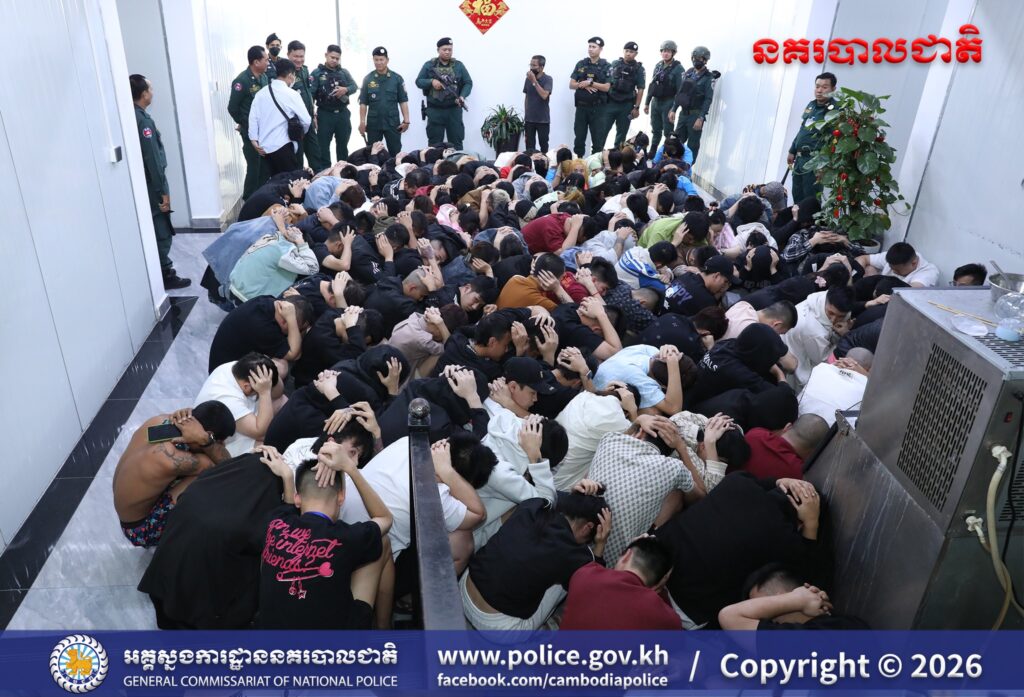
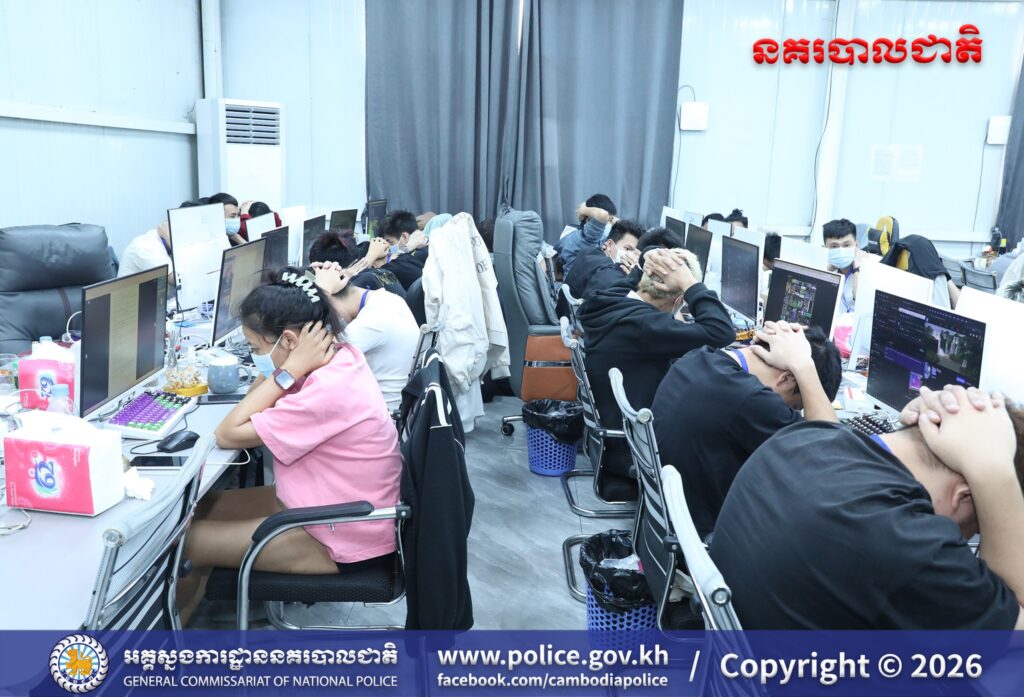
National Police posted dozens of photos from a raid last week at a location they called “Chhay Na Boeung Beng” in Banteay Meanchey’s O’Ampil village in Malai district. Photos showed workers caught in front of their computers as armed police entered the compound, and hundreds of foreigners huddled in a courtyard between multi-storey buildings.
The operation, led by Chhiv Phally and Muong Sothea of the National Police, found 811 people working in the operation, including 776 Vietnamese, 34 Chinese and 1 Malaysian national, according to local media reports. Phally told the government-aligned news channel BTV that the workers were lured to work in Cambodia by responding to social media ads recruiting people to sell their organs. Instead they worked in a romance investment scam, Phally told BTV. The 776 Vietnamese nationals were “expelled” from Cambodia on Tuesday, according to the Interior Ministry’s Immigration Department, but their post did not detail the outcomes for the Chinese and Malaysian foreign nationals.
Neither Phally nor Sothea of the National Police could be reached for comment. Banteay Meanchey provincial governor Oum Reatrey hung up after he was asked for information about the raids.
When a reporter called the Banteay Meanchey provincial police, the respondent said they could not yet share information. “We have not received the calculated report in our hand yet and we are working on the procedure.”
Sdok Lin, chief of Tuol Pongro Commune that includes O’Ampil village, said his office was not involved in the operation, and orders were instead executed “from the top.”
“We went to have a brief look and we saw forces, and cars, and trucks for carrying prisoners, and buses,” he told Mekong Independent over the phone. “We saw a lot of police. We are not clear [how many people involved] but there are many cars. We have seen them with our eyes, and we do not know how and where they are going to crack down.”
He confirmed that the raid happened on March 12 but said he was not clear what was raided, adding that he also recognized the location from social media posts.
“We see the buildings and we do not know what’s inside because we have never been inside. … They have the guards, and we are just small potatoes.”
Before the raids, he had seen many cars going in and out but wasn’t sure what the operations involved.
“The land was owned by Cambodians, but we do not know how they rented it. We do not know about it,” he said, and didn’t specify who owned the land.
Suos Borith, Tuol Pongro Commune police chief, said he did not know about the raids or location.
An upcoming ‘satellite city’
Last week’s raid described scam activity in one only gated compound in O’Ampil village, but residents, online posts and an escaped worker suggest that there were scam compounds in two different gated areas that advertised new housing projects and commercial enterprise.
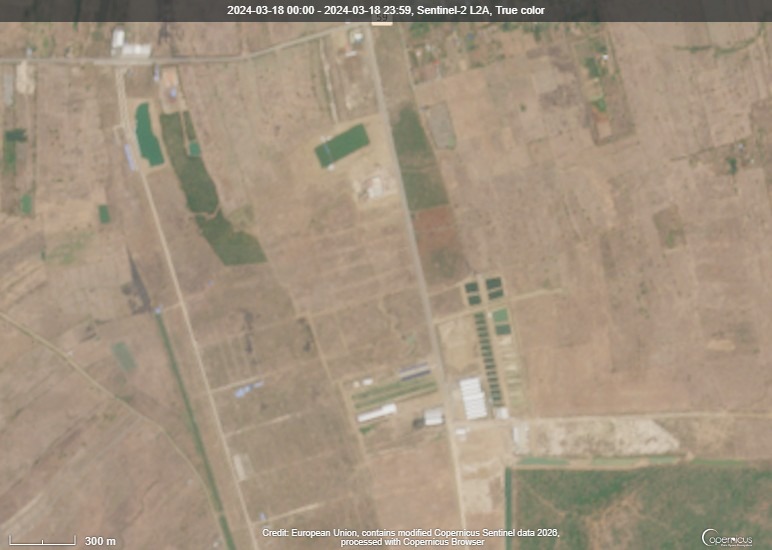
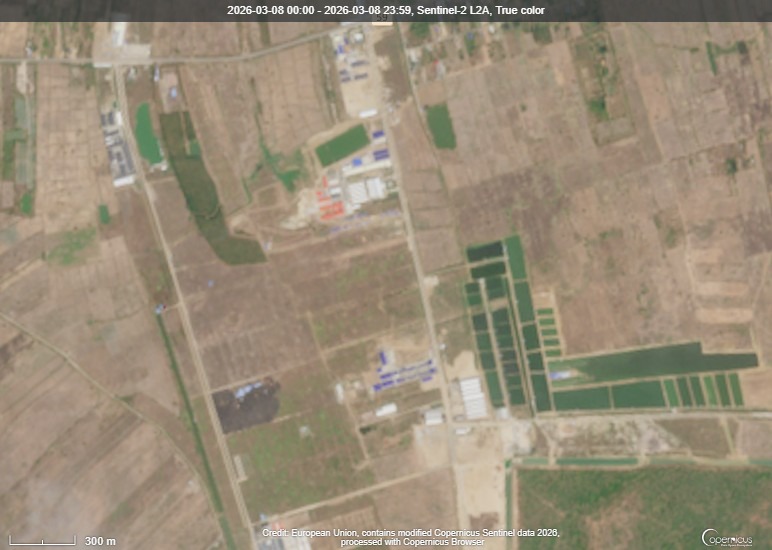
The scam analysis website Cyberscam Monitor shows two suspected compounds directly next to each other in O’Ampil village, branching south from National Road 59, but provides few details of activities. Satellite imagery from the European Union’s Copernicus satellite indicates that these two areas developed within the last two years. Jinbian News, a Chinese language news page, reported on Thursday that workers fled two scam operations in the area, according to “internal information from the Chinese community.”
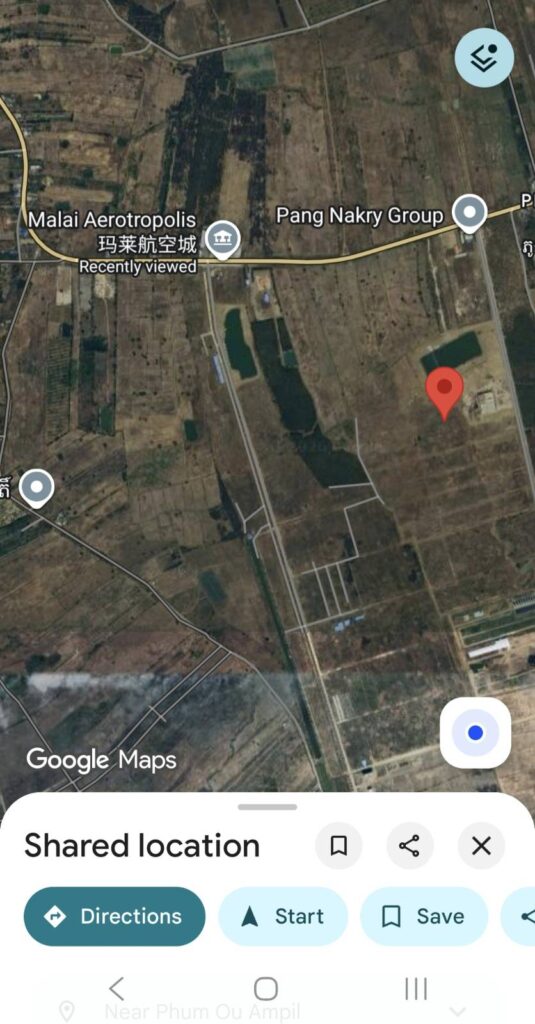
On Google maps, these locations look like empty rice fields, but location pins describe the area as an “Aerotropolis” and hint at other future real estate plans.
The 32-year-old Ugandan man who texted a reporter sent a pin of his location on February 16, showing he was in a building behind the guarded entrance of a development labeled “Pang Nakry Group.”
Though there isn’t a business registered as “Pang Nakry Group,” Pang Nakry Real Estate has been heavily advertising developments in the same location where the Ugandan man said he was detained.
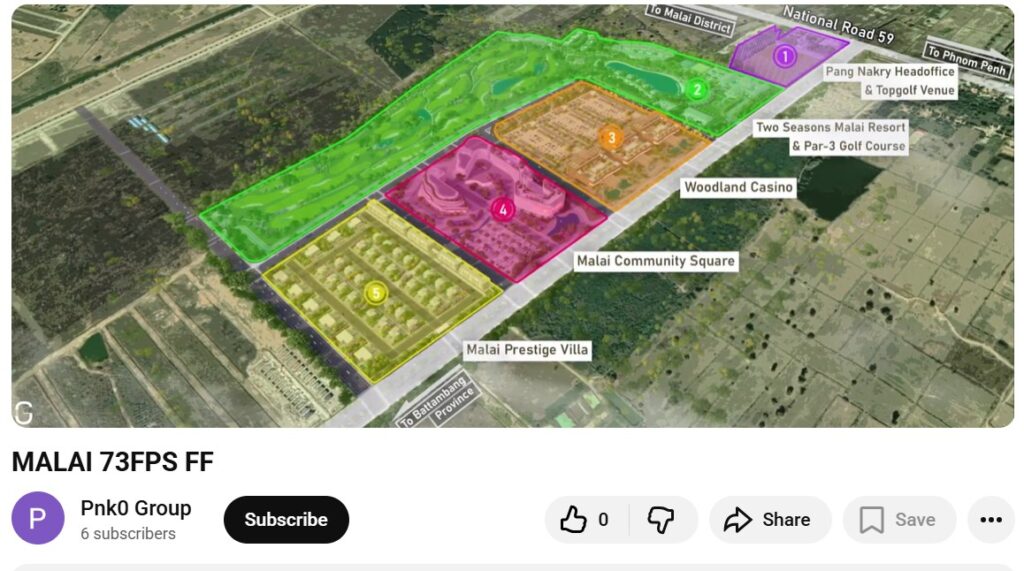
Pang Nakry Real Estate’s website and social media channels advertise opulent plans for the location, which it markets as a “dream new city” with industrial, residential and luxury spaces. YouTube videos from the company detail plans to build a golf driving range, community square, gated housing developments and a casino called “Woodland Vegas.”
The real estate company is directed by a businesswoman called Pang Nakry, who also owns a steel processing plant in Banteay Meanchey that was inaugurated in 2022. Her group website also indicates the company distributes crispy fish snacks, and she was listed as a director for a company called Woodland Vegas Co. Ltd. up until February 2025.
Pang Nakry Real Estate could not be reached through a phone number listed in the Commerce Ministry’s business registry. A phone number on the Pang Nakry Real Estate website was deactivated, according to the voice message, and the associated Telegram account had not been online since last May.
Coverage of the 2022 inauguration of the steel plant also links Tek Bunthoeun as a representative of Pang Nakry Group, quoting him as encouraging development in the border region with Thailand. Tek Bunthoeun, who appears to be Pang Nakry’s husband based on posts on their respective social media pages, is also a member of the Prime Minister’s bodyguard unit.
People who sold snacks and sundries near the compounds said this week that the land in O’Ampil village had been bought while it was cheap by powerful individuals.
A traveling sugarcane vendor — who stopped along National Road 59 and spoke to a reporter without revealing his name — said that civilians who lived in O’Ampil village sold their land to Tek Bunthoeun years before.
“Before this and that used to be the land plot projects,” he said, gesturing to the two contiguous developments. He was referring to a common development scheme in rural areas, where a business owner sells long-term leases on small plots of land within their larger land territory. “Later on, it is no longer a land plot project. It has been over a year. Some people came to check out their land, but they were not allowed inside.”
He and other residents told a reporter that Leng Navatra, a real estate tycoon and entertainment industry owner, and Khemarak Sereymun, a former singer and actor, had worked on a joint venture with Tek Bunthoeun, who is also referred to as “Tol.”



Leng Navatra heavily promoted his development project called “Poipet Satellite City” or “China Poipet Satellite City” in 2020 and 2021, which Tek Bunthoeun had also visited based on one of his Facebook posts. More than 200 construction workers protested conditions at the site in 2021, saying they had gone more than 50 days without pay. Construction workers are usually paid every week or every other week.
Khemarak Sereymun explicitly announced business partnerships with Pang Nakry Real Estate in a 2021 press conference, promoting sales of smaller land plots within a larger development.
A security guard who stopped a reporter from taking photos of the two locations said that the two gated areas were owned by the same person, but didn’t give the owner’s name.
Tek Bunthoeun and Pang Nakry could not be reached for comment via contacts listed on multiple online promotional posts and on their personal accounts, nor via a contact for Pang Nakry listed on the Commerce Ministry website.
The Toul Pongro commune chief Sdok Lin said that Tek Bunthoeun owned some of the land in O’Ampil village, but he did not know the details: “He bought some of the land, and other people bought it, and it is very complicated and at that time I was not commune chief yet.” Eng Samon, head of Malai district’s provincial administration, declined to comment on the raids or ownership.
Escape from Banteay Meanchey
“Adam,” the Ugandan man who asked to speak with a pseudonym, said he was not working at that location in O’Ampil village for a steel company, a fish processing factory or real estate, but for a scam company.
“It was dating, chatting. … I talked to men [online],” he told a reporter. “How can they ask me to chat [with] the men? They ask you to chat and pretend to be a woman.”
Adam said he had been sold to the location in October, after he had been working in “Long Bay” — likely the sprawling Long Bay Dara Sakor compound on a controversial economic land concession in Koh Kong province — for almost a year.
The treatment inside the compound was more brutal than Long Bay, he said, adding that one Ugandan he knew was taken away after trying to contact police.
Adam said he was eventually able to leave in late February, roughly a week after texting a reporter, as the Chinese bosses grew nervous about the anti-scam campaign across the country. He said he started networking with other Ugandans who had left other compounds before him, and they advised him to lobby for his exit and lent him money to buy a bus ticket to Phnom Penh, where he met a reporter. After he left, Adam said there were still “a lot” of Africans there, from Uganda and other countries, but they had been in different buildings and had not managed to negotiate their exit. He left Cambodia days after meeting the reporter, saying his wife borrowed money from another relative.
“The company I was working for, they remove your trousers, your shirt, then … they tie you on the pole,” he said, gesturing that he was kept with his hands tied behind his back. “Then they beat you, they use the shocker, they use plastic chairs beating you.”
Adam said he tried to contact police via the “117” hotline, and by asking other Ugandans who had already escaped to report the detained workers’ situation to Poipet police.
“Even when our friends [outside the compound] went to the police station, they ask if you have a visa,” he said, adding they were told: “If you don’t have a visa you can’t report, you can’t open any [police] case.”
He felt the Chinese bosses of the company were powerful. “They are the same,” he said of the police and the company where he worked. “Unless they change the system.”
This article is published as Creative Commons.