
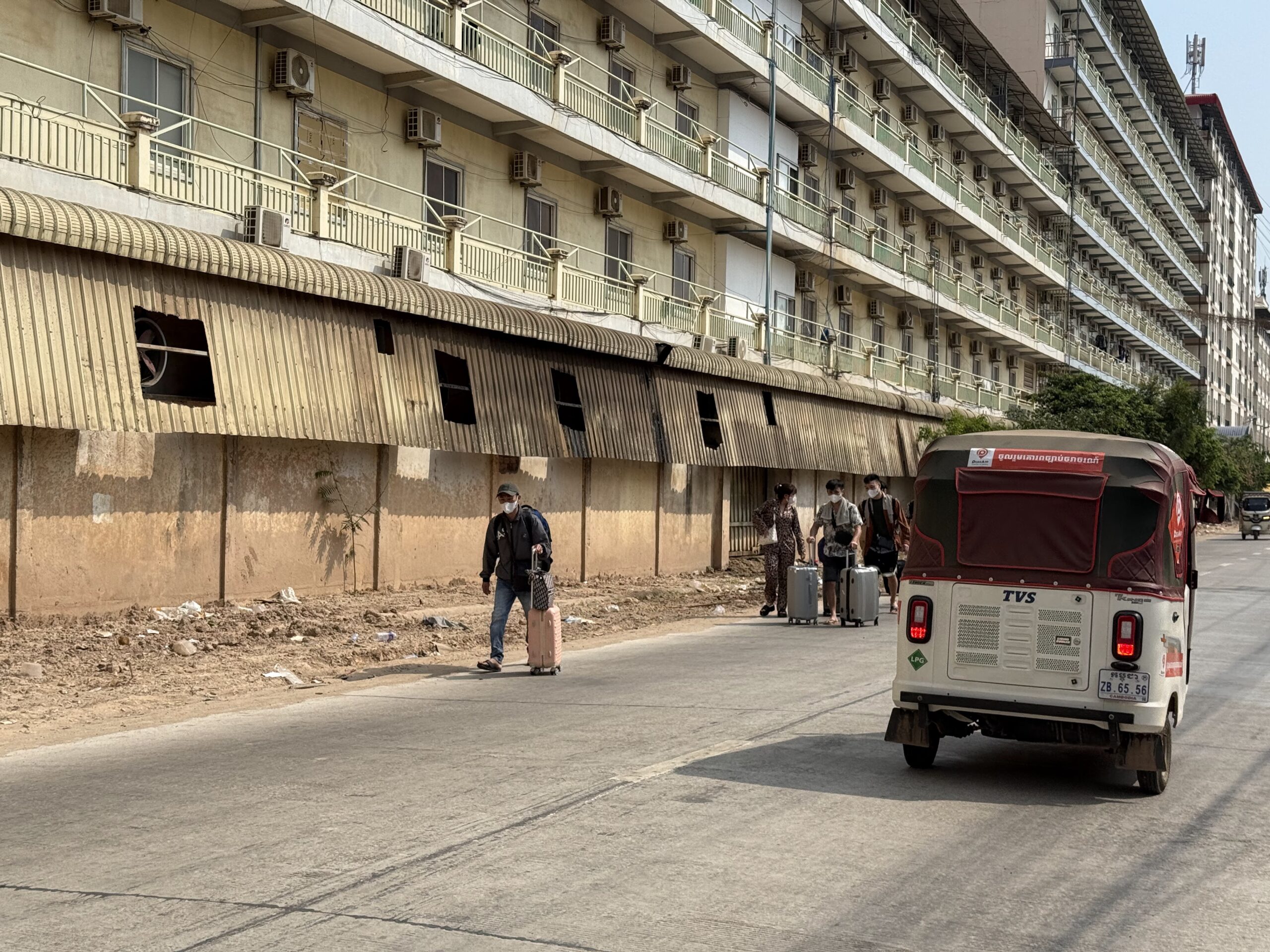
Cambodia’s main international border to Vietnam was choked with traffic as the government’s latest scam crackdown appeared to empty out major complexes in Bavet city.
Bavet, in Cambodia’s Svay Rieng province, had become one of the country’s main scam hubs in the past few years as large complexes of concrete buildings added to existing border casinos that faced ongoing reports of global scam operations and human trafficking.
On January 18, as law enforcement against scam operators widened amid international pressure, the Svay Rieng provincial administration issued a warning that it would take strict action against the owners of casinos, apartments, guesthouses and hotels “to curb online scams until online scams are completely eliminated in Svay Rieng province.”
Government-aligned Fresh News said from January 1 to January 22, Cambodia deported 1,620 foreigners of 21 nationalities, including Vietnamese, Thai, Chinese, Pakistani, Indonesian, South Korean and Burmese. Over the past seven months, Cambodian authorities arrested 5,106 suspects of 23 nationalities and deported 4,534 to their countries of origin, it said.
The Cambodian government has periodically conducted crackdowns against the booming scam industry, but in the past they largely left major scam businesses intact or allowed them to quickly rebuild. This month’s actions so far appear to be broader in scope, though the country’s major tycoons, whose properties have allegedly housed scam operations and who have internationally faced arrest warrants or sanctions, remain untouched.
Svay Rieng deputy police chief Buntha Virak said authorities had inspected 27 locations in the eastern province and arrested about 500 people. More than 100 remained under police custody.
Bavet commune police chief Has Sara said officers were working to ease traffic jams at the international border. Asked for more details about the crowds, he said: “You come check it out yourself. I cannot give you information.”
Crown Casino
The ownership of Crown Casino, one of the major casinos close to the border, is linked to tycoon and Senator Kok An. Kok An has been tied to scam compounds in Sihanoukville and along the Thai border, and recently faced legal action in Thailand.
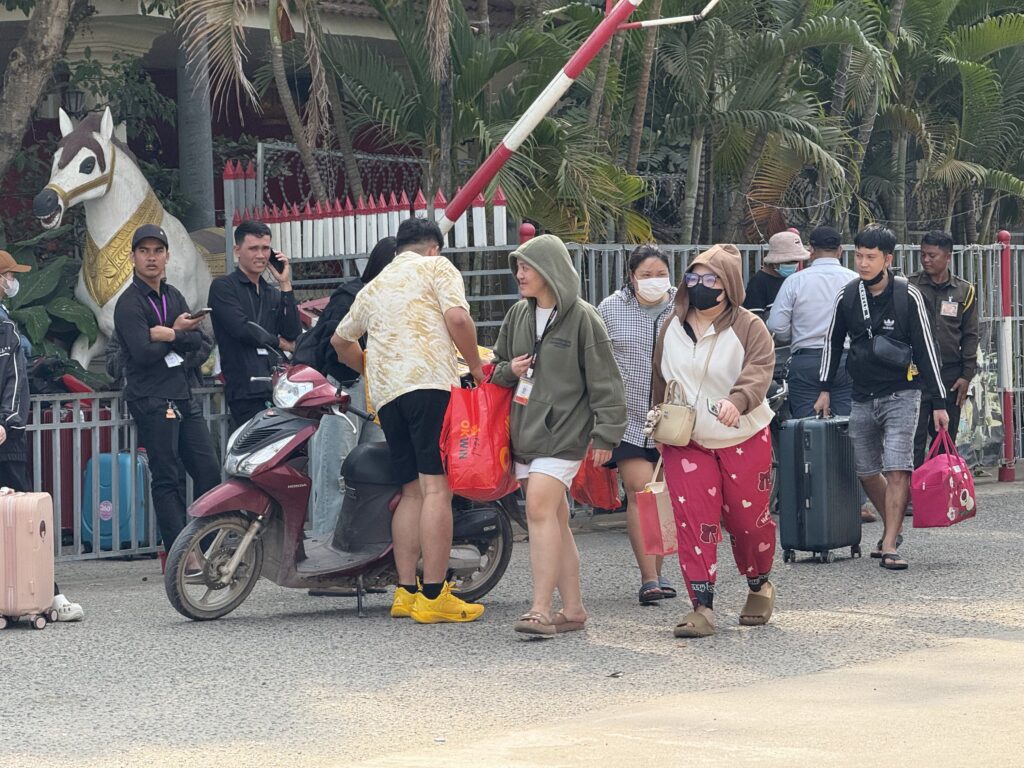
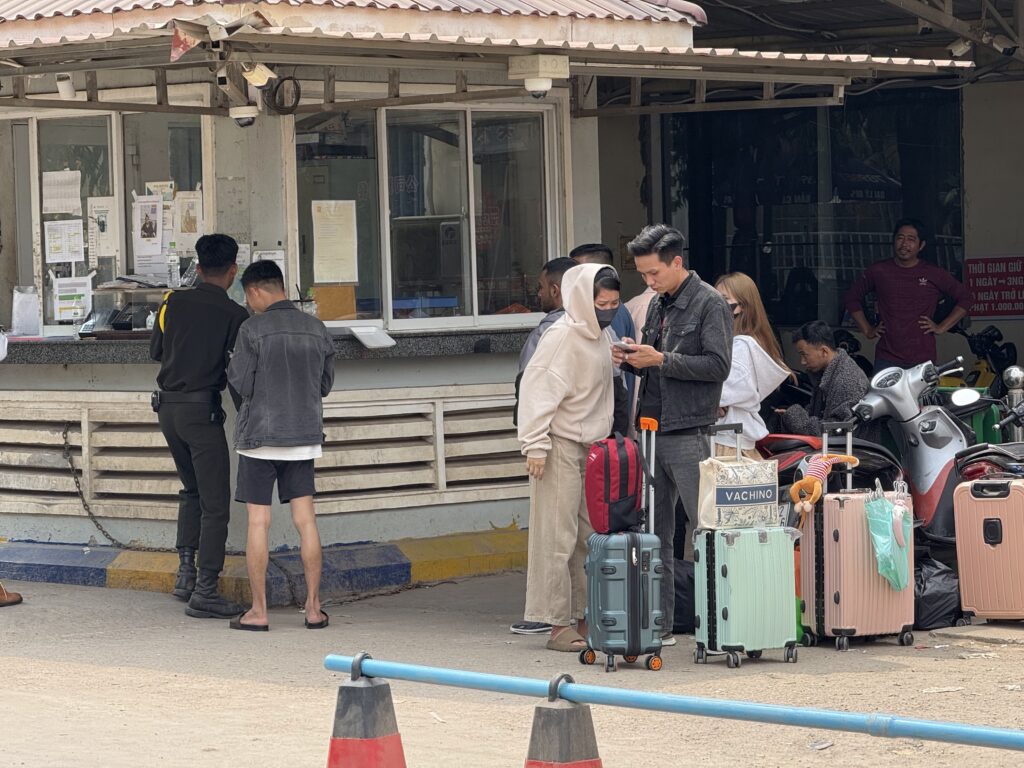
On Sunday, people streamed out of the building with large suitcases. Some dragged two suitcases, some held sun umbrellas with their free hands, and buses waited at the gate to pick them up. It was unclear where they were headed. Many tuk-tuk drivers tried to talk to them and get their business.
The scene was similar at the backdoor of the casino, with crowds of workers, tuk-tuks and taxis.
Barbed wire, which had been strung all along the west side of the property, had been removed. Security guards remained, however, and continued to check people entering and exiting.
On the main road, trucks and trailers pulled by motorbikes transported beds, chairs and construction materials.
Henghe/Diamond Casino
Henghe, a growing complex of rows of concrete buildings, is located down a small road behind Crown Casino.
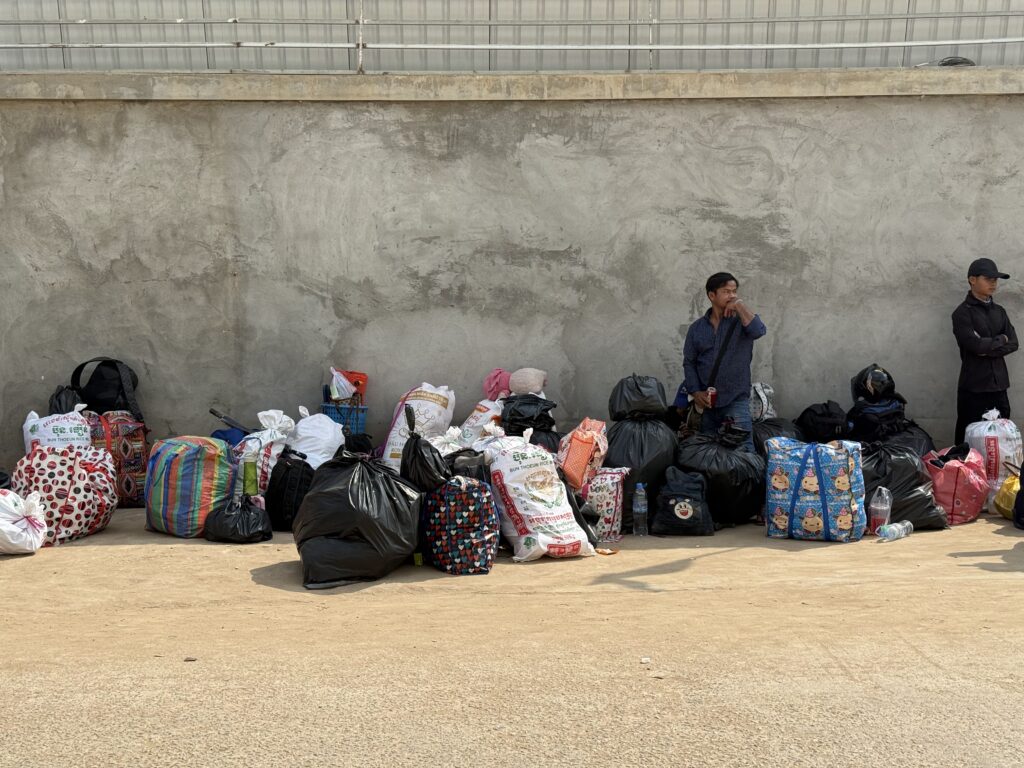
Groups of security guards, cleaners and construction workers sat along the compound’s walls with many bags of belongings, looking ready to leave. Some entrances were no longer guarded, and the grounds and buildings appeared mostly empty. There was no sign of foreign workers remaining inside.
Local residents said they had seen a police inspection of the compound and a mass exodus of foreign workers.
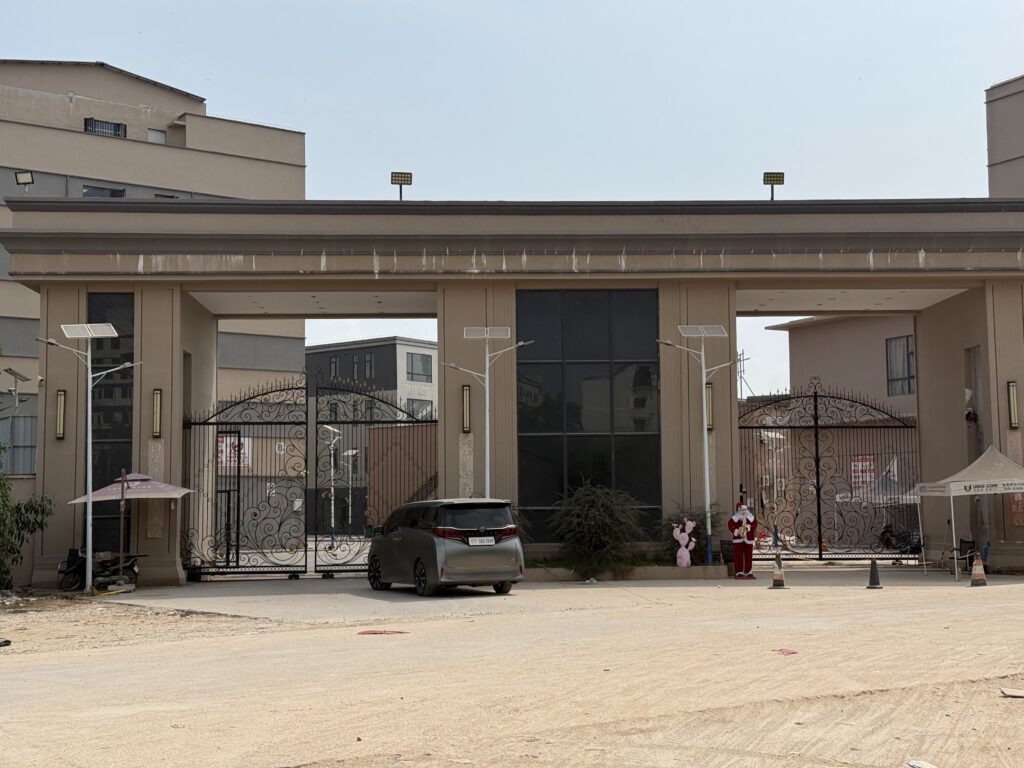
OP Science and Technology Industry Park
Huge new constructions wedged between Henghe and the Vietnamese border, known as OP Science and Technology Industry Park, had two security guards at the front gate. A motorbike trailer was leaving the property carrying flowers and plants. There were still a few street stalls selling snacks at the front of the building, while immigration police officers rested in hammocks. The buildings appeared empty, though Cambodian construction workers in blue tents remained, saying they were waiting to collect wages.
Vuth, a snack vendor, said the compounds had mostly housed Chinese workers. Hundreds of police officers had come last week, and arrested many people and put them on buses, he said.
“Now there’s nothing remaining. There are only Cambodian construction workers getting ready to move their things. … Some workers have collected construction materials and dug up metal to sell to recyclers, while others cut wires to sell to get money.”
A construction worker said there used to be about 200 security guards per shift, and there were still about 50.
“Many people have not received their payment because the boss has run. Some people who fled fighting at the [Thai] border got work here for a few days, but now the work has vanished,” he said.
“This time it may not come back because all the bosses have already returned to China,” he speculated.
Bavet Yongyuan Casino & Hotel
On the north side of the main road, Mocbai casino — one of the area’s major properties, and named after the Vietnamese side of the border — has been rebranded as Bavet Yongyuan.
The area was quiet on Sunday, with only a few vans driving in and out. Thousands of foreign workers had already left in large groups of 60-100, said a tuk-tuk driver parked outside. Cambodian workers had then trickled out as there was no more work.
Most of the foreign workers had been Indonesian and Vietnamese, the driver said. He used to give around 20 rides a day, but the work had dried up.
“People have left the huge compounds,” he said. “They left day and night.”
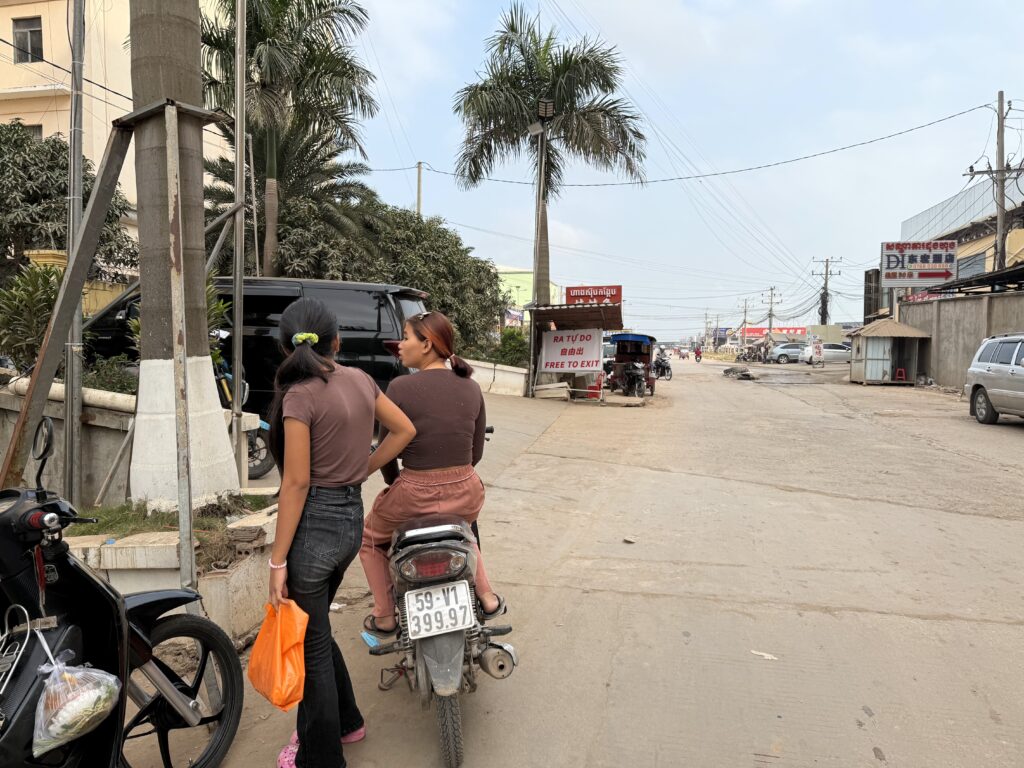
New Venetian
Leng, selling sundries in a stall outside the New Venetian casino, just behind Yongyuan, said the area had seen turmoil while the scam operations operated. Drivers were paid large fees for transporting people trying to escape, and he had heard shootings.
There had been a riot last year with gasoline thrown at guards and foreign workers using the opportunity to escape, he said. He had seen a foreign worker jump out of a building about six months ago, and knew of one case where a body was found with scars. Cambodian workers — working in construction, cleaning and other areas — had talked about the alleged conditions, he said.
“In there it was very brutal,” he said. “They beat you until unconscious and broke the bones.”
The recent exodus had been orderly by comparison, he added. “You can see everywhere has become very quiet. Each building had how many people? It could be thousands.”
Bauhinia Boutique Hotel
Near a smaller border crossing to the southwest, about 35 km away in Nhor commune, a few dozen Cambodian workers waited outside an emptied compound hoping to receive their last pay.
Entry to the property remained restricted, while trailers carrying clothes and garbage drove out. Many people, including children, searched through the loads for anything useful. The compound was flanked by green fields.
Mouen Chan, a 43-year-old Cambodian cook, was waiting to get paid, but said some had heard their employers were already in Phnom Penh.
“It’s uncertain still. It’s just speculation from people coming out of the building that they will pay,” he said. “If we do not get our pay, there will be an issue to occur soon.”
At Bauhinia, the departures of foreign workers had been in a panic, he said.
“We saw some Chinese people running across the rice fields and I asked them to hide in the forest over there, but they did not listen to us.”
Cooks were trying to collect supplies from the buildings, but construction workers thought they were stealing and beat them, injuring five people, Moeun Chan alleged — though local officials disputed the account. A local news outlet published footage of the incident.
A fruit vendor agreed that it had been chaos. “There were so many people. I sat here and watched them, rushing out of the building in fear in all directions — anywhere they could walk.”
Nhor commune chief Chhou Yorn said no one had been armed, and denied there were fights. However, he acknowledged there had been some injuries.
“I don’t know how it happened,” Chhou Yorn said. “Three people were injured, two of them with minor injuries and another with serious injuries.”
This article is published as Creative Commons.