
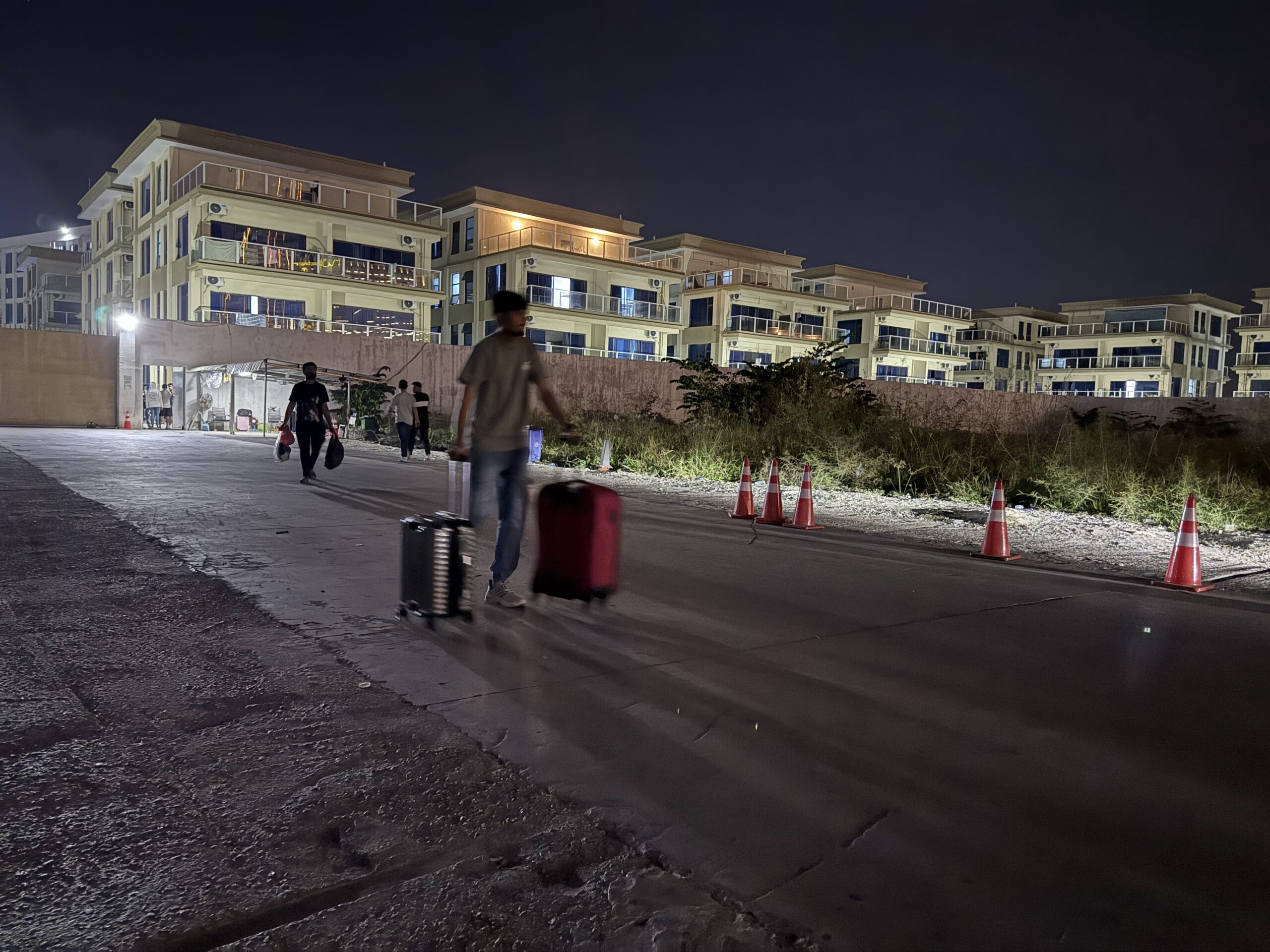
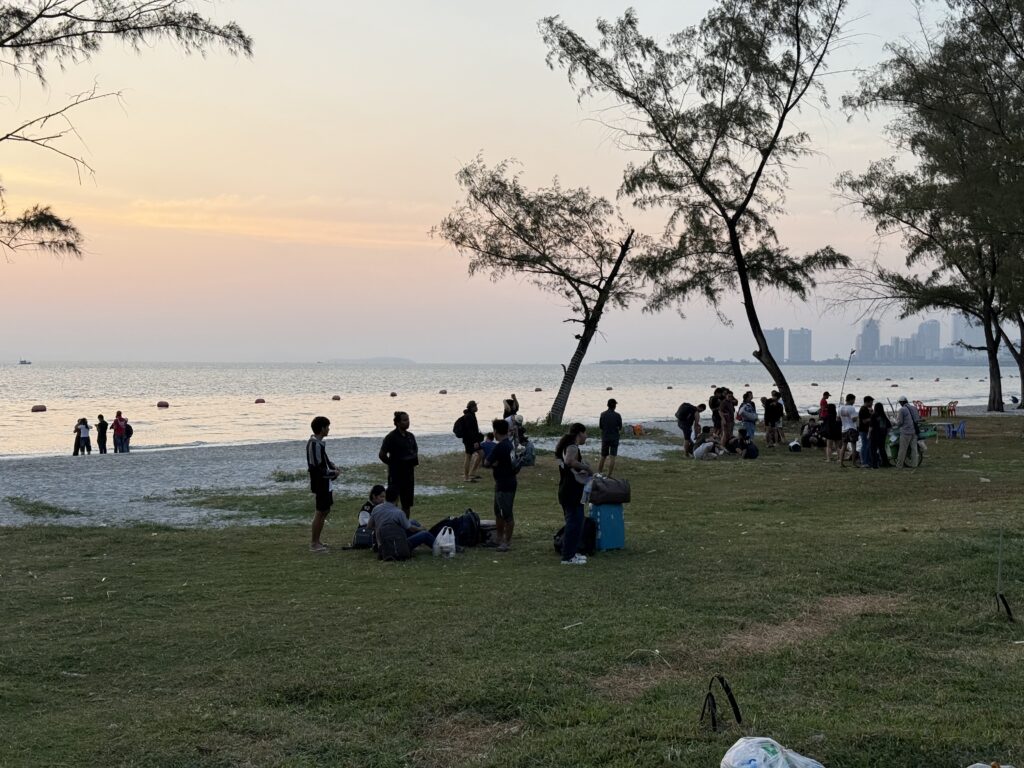
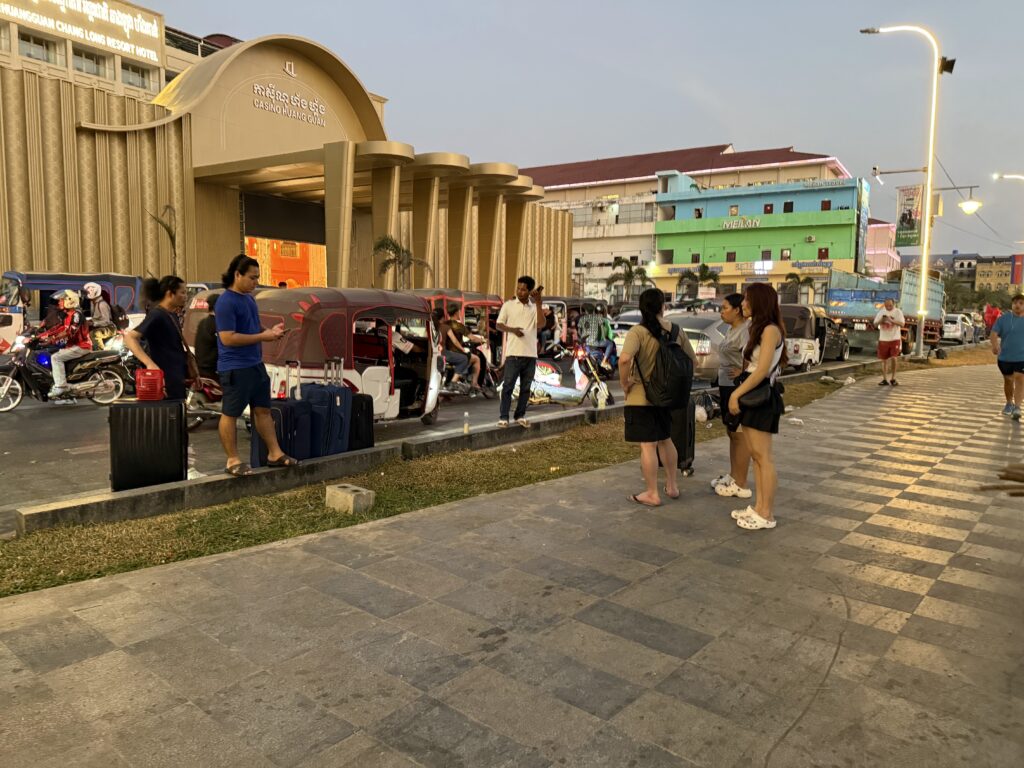
Dozens of people were loitering outside a beachside casino property when a reporter arrived before sundown on January 14. They strolled along the beach, but they didn’t seem to come just to take in the sunset at Occheuteal Beach: They were lugging rolling suitcases across the sand, or pulling pushcarts with boxes, furniture and even one washing machine.
A security guard outside the casino compound told Mekong Independent that the mass exit from Casino Huang Guan was “in full swing” for more than two hours. He believed they were warned of an impending raid or other law enforcement actions, but they had time to escape leisurely.
“If the police had come, they would not stand and wait like this,” he said. “We cannot hold them back because it has been chaotic.”
People kept coming out of the casino with their belongings even after 10 p.m. that night. When a reporter returned to the casino the next morning, it was mostly quiet, aside from a few straggling foreigners and some moving trucks loading furniture out of Casino Huang Guan.
Foreign workers in reported online scam and gambling businesses have been fleeing across Cambodia’s coastal city of Sihanoukville, local residents said last week. They had seen foreigners leave in large groups and reportedly overbook buses. And shortly after the workers’ departures, they saw police entering at least three of the now-emptied scam buildings.
Facing international pressure, particularly from South Korea and the U.S., Cambodia has taken a series of highly publicized law enforcement actions.
On January 5, the Cambodian Interior Ministry passed a sub-decree holding property owners accountable for tenants conducting illegal activities in multi-resident properties. The following day, authorities arrested and deported Prince Group chairman Chen Zhi, alleged to be one of the major figures behind the country’s scam industry.
Phnom Penh Municipal Court on Friday ordered pre-trial detention for Ly Kuong, a business owner connected to casino properties tied to the online scam industry, on charges of human trafficking, money laundering, and fraud with other aggravating circumstances under the criminal code.
Interior Minister Sar Sokha met China’s deputy minister of public security also on Friday, with the Cambodian ministry saying on social media that the Chinese official had said recent law enforcement actions “clearly demonstrated to the international community Cambodia’s unwavering commitment to strengthening law enforcement and suppressing all forms of crime.” Chinese Ambassador Wang Wenbin has further called on Cambodia to protect Chinese nationals from going missing or crimes, after a rise in suspicious deaths, like individuals dropping from skyscrapers or bodies found in suitcases.
It remains to be seen, however, whether Cambodia’s latest actions will be more lasting than its previous crackdowns on booming scam operations.
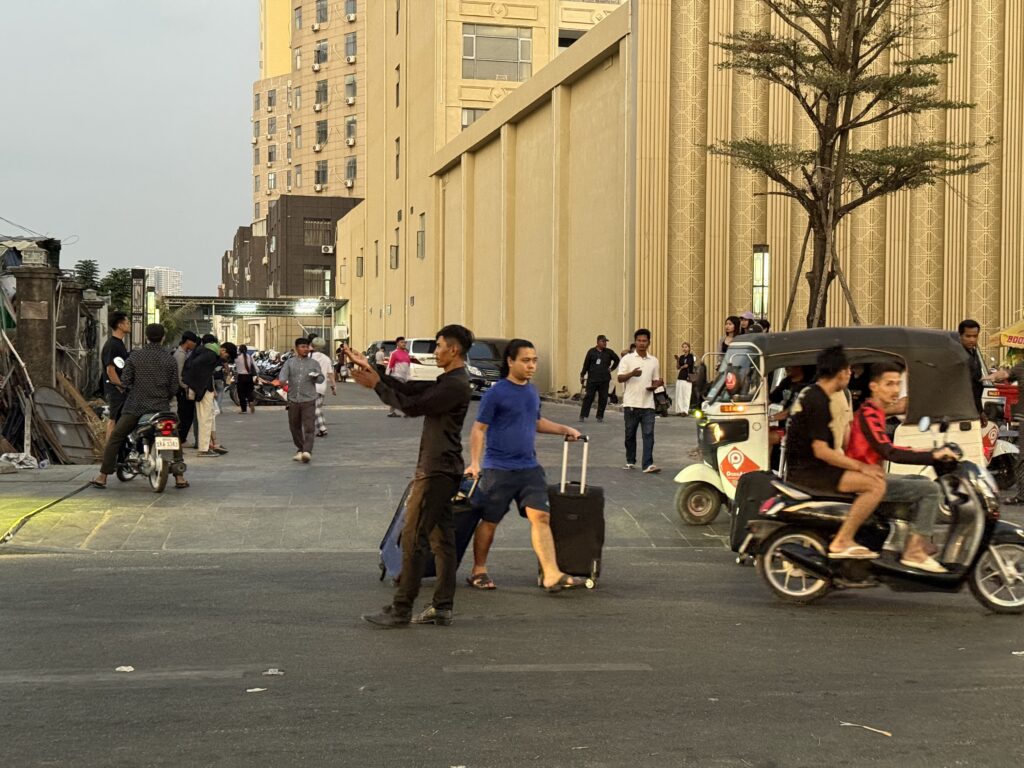
Exodus
A reporter for Mekong Independent saw workers scattering across Sihanoukville, corroborated by residents who wonder what is the future of their employment.
Noeur, a tuk-tuk driver who stationed himself near a strip of high-rises near Otres 2 beach called “Chinatown,” said he had seen people leaving different known compounds throughout the night.
“Last night I stayed up until 3 a.m. I saw five or six buses come to pick [workers] up,” he said.
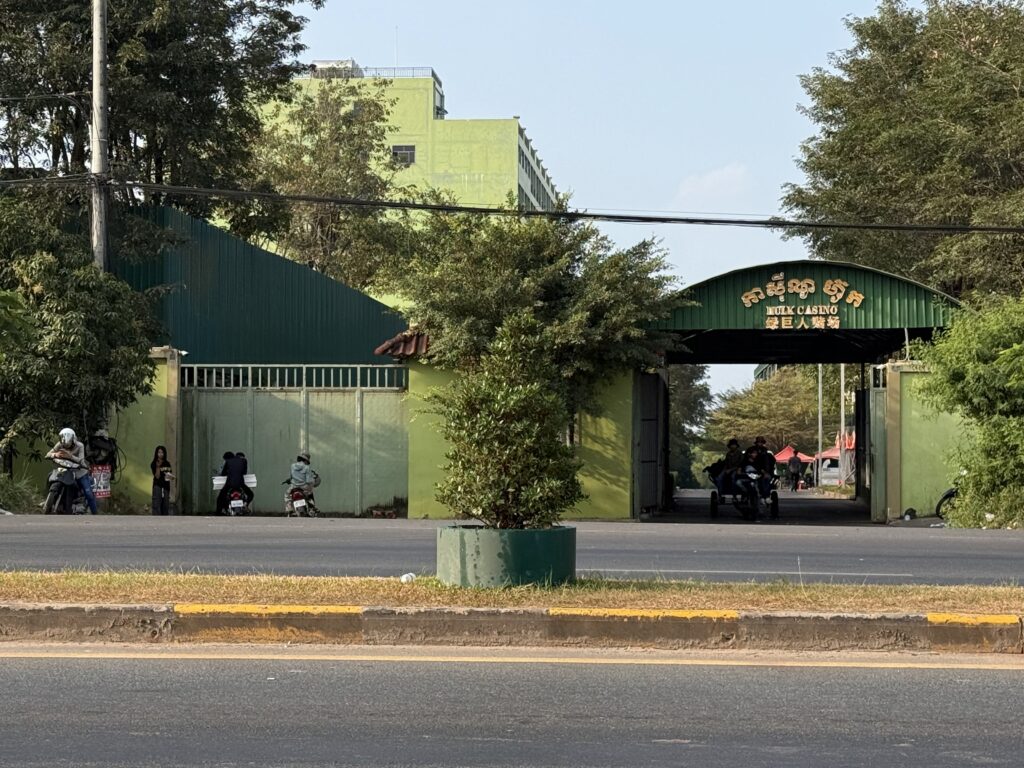
Noeur said he had seen the “Jinshui” compound mostly emptied by 10 p.m. on Wednesday, save for a few storefronts, while others also started fleeing K.B. Casino or “Kaibo,” as it is called on social media, and the “Twin Buildings,” another heavily-populated compound behind the behemoth Golden Sun & Sky Compound, known for its X-shaped print in satellite imagery.
The latest mass escape he saw — requiring five or six buses — was from the Twin Buildings, Noeur said.
“When both Chinese and Vietnamese [workers] come out, they buy masks for $1 to $2.50 per mask,” he said, which is generally higher than the 500 riel (US$0.12) a single face mask costs in a street shop. “I think I can buy a lot of masks to sell them during the flights and stop doing taxi service, because they are afraid that they would be in the news.”
The driver said rumors were circulating that a raid would occur in the coming days, and therefore workers had fled the area.
“Some people flee from Jinshui and run into Chinatown,” he said, referring to a block of buildings connected to the K.B. Casino and Hotel. “Now they have to flee again.”
“We have to return home temporarily and chill out sometimes,” he continued, referring to his lack of work.
Noeur added that there were a large number of Chinese, Vietnamese and Pakistani workers in the compounds, but no longer any South Koreans after a group of more than 50 South Koreans were busted in Sihanoukville in December.
South Korean law enforcement reportedly worked with Cambodian counterparts in a raid on December 9 arresting 50 suspects at the Xin Du Hai casino in Sihanoukville, and similarly busted a group of 32 South Korean nationals working in scams in a Phnom Penh gated residential community on January 5.
“When [company owners] find out there are Korean [workers], they will kick them out because there has been a lot of pressure from the [South] Korean government on our Cambodian country. They do not want to keep them,” he said.
A 17-year-old Cambodian who worked in the Nanhai Casino said that he had to leave his job — working in “online” business, as fraud and online gambling is commonly described by locals — as a result of expected raids. Shortly after he and other workers left the casino, police had raided the empty workplace, he said.
“I am watching people running to escape all over the roads,” he said, adding that he thinks the raids stem back to the arrest of Chen Zhi, a former tycoon and powerful business owner who was targeted by U.S., U.K., South Korean and other countries’ law enforcement before being deported to China on January 5.
“It is awesome to see it because the police [can raid] my working place at Nanhai. It has very strong connections, [but] it still has to be shut down.”
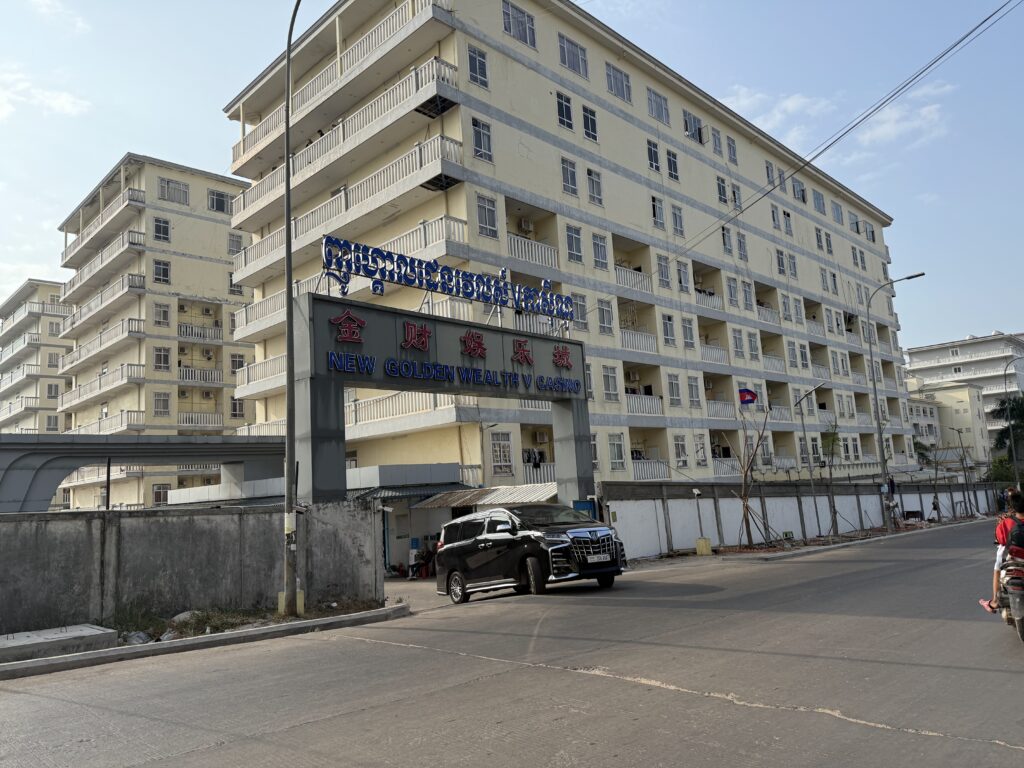
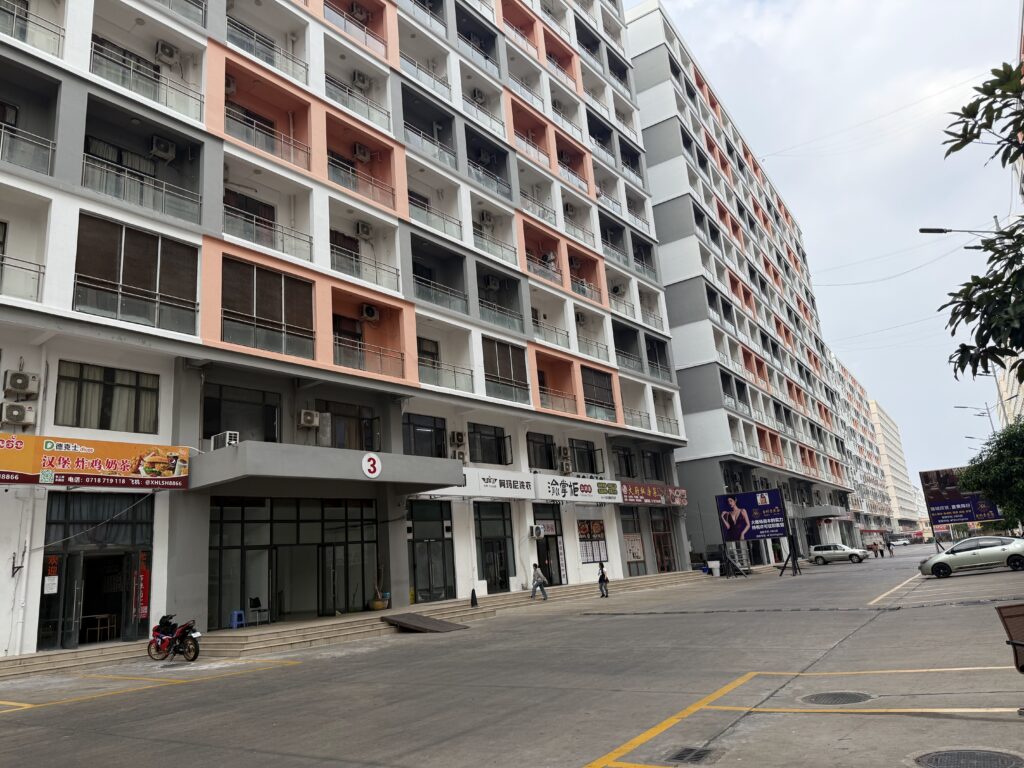
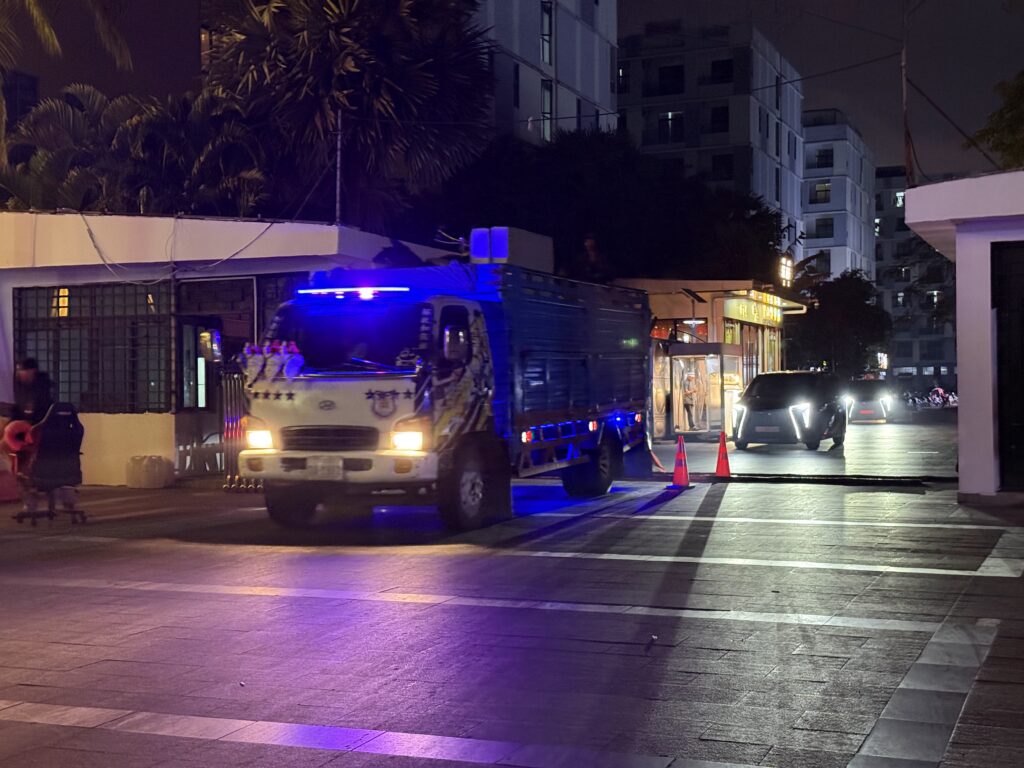
On January 14, a reporter saw a police van enter the gates of Jin Bei 6 in the afternoon. Officers entered a building that appeared empty, without even security guards out front, though there were still clothes left hanging from the building’s small balconies.
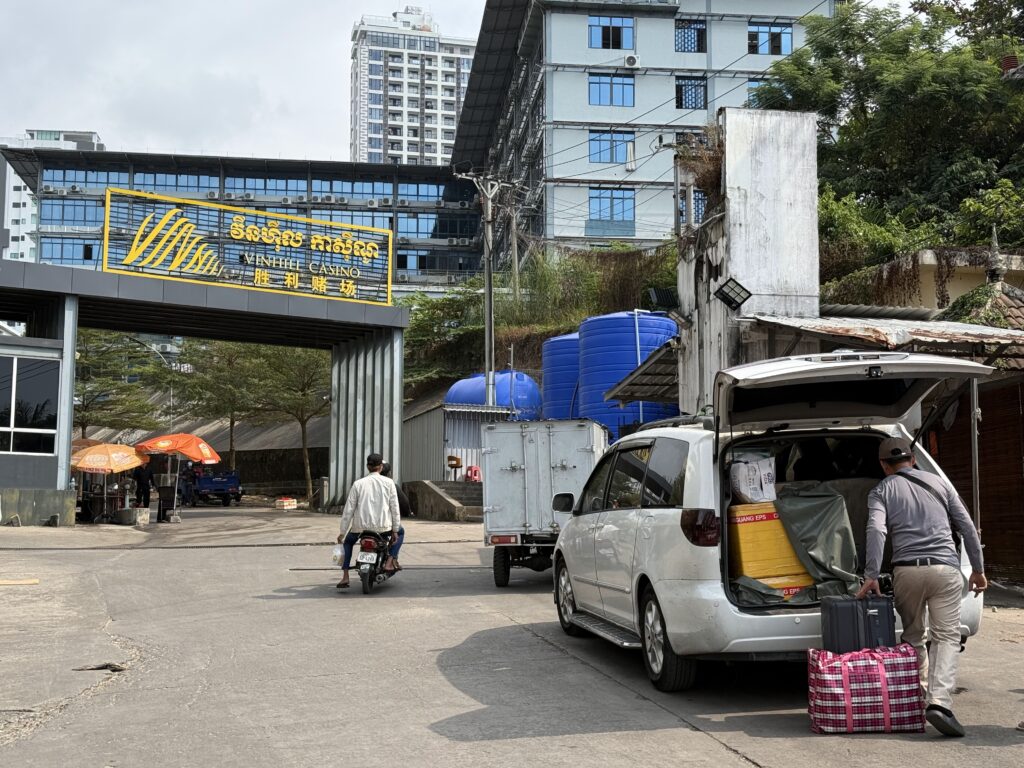
A tuk-tuk driver who regularly parks outside the GTI Casino said he had also seen a recent police raid there after most workers had already left en masse.
“It was like a dam collapsing,” he said of the workers’ departures.
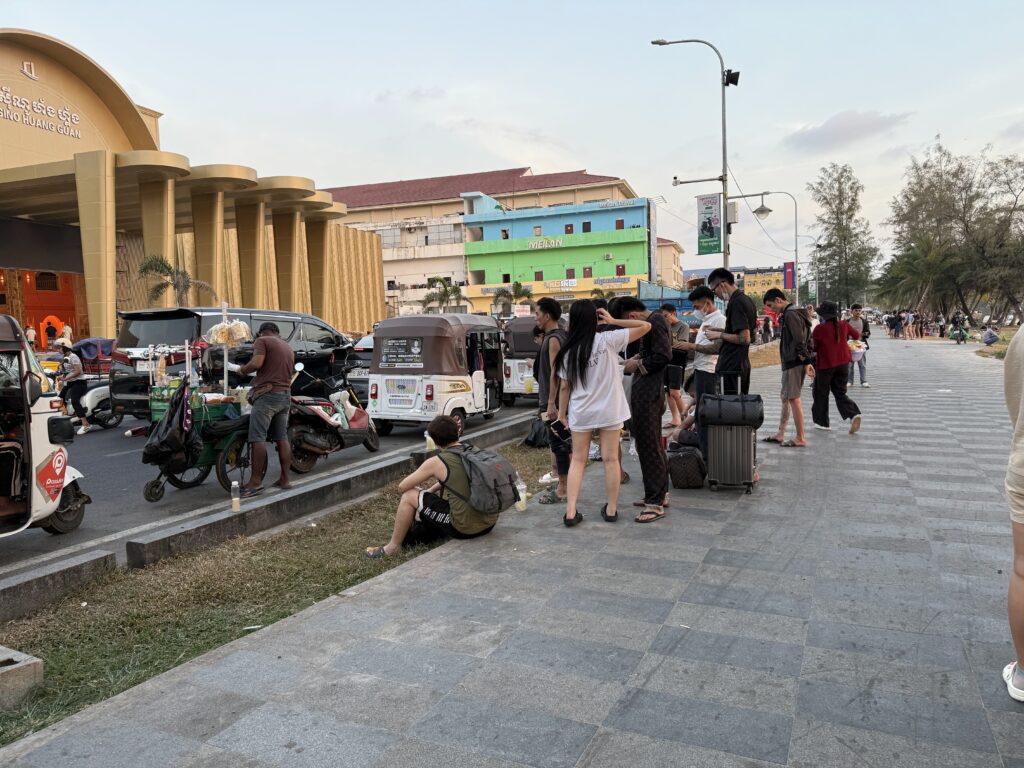
Downturn
“Our business is drying up,” the tuk-tuk driver added. “Today I got 50,000 [riel, about $12.5], but I wonder what will happen tomorrow and where I can get my clients, because they have gone and I think they will return to their homeland.”
The driver expressed frustration with the situation, saying that he barely earns income after all the fees he had to pay to do business in Sihanoukville. He said he already has to pay fees to the ride-hailing company, PassApp Technologies, as well as the high costs of food and accommodations in the coastal boom town.
He said he felt that government officials in Sihanoukville would not struggle in the same way he would when the foreign workers left.
“Recently this year, when I went inside the [Sihanoukville] city hall, the parking lot inside was full of cars belonging to officers … while the poor drive old motorbikes there to process their paperwork. Some of [officials’] salaries are only $400 to $500, so where is their money from? You see them driving Ford cars.”
“We live in peace but not in real freedom,” the driver said.
Throughout Sihanoukville’s streets, police maintained a small roadblock on 28 Mithona Road, which leads towards the sea, checking cars and sometimes asking apparent foreign workers to open their luggage for inspection.
A scavenger who searches trash for aluminum cans and copper wire told a reporter that the Majestic 2 Casino, which has been associated with Ly Kuong, had been emptied several days before.
“Our scavenger business is also bad,” he said. “Most of the security guards quit. A few remain, but [many] returned to their homes because there is no work to do.”
A tuk-tuk driver in his 30s said that the Jin Bei 3 casino had been shut down after the Cambodian Commercial Gambling Regulator’s October directive to suspend its casino license, but there were still some online businesses operating from inside the building.
The driver said he had seen some of the foreigners leaving Jin Bei 3 with their computers packed into plastic bags, but others left many valuable goods like air conditioning units.
“They are in the rush so they do not have time to pack up their things,” he said.
A reporter found workers leaving Royal Yongli Casino amid traffic congestion. Jin Bei 5, another suspended casino, was empty, with a heavy padlock still holding the glass doors closed.
Noeur, the driver based in the Otres 2 area, said that he was frustrated with the system in Sihanoukville, but he saw no avenue for change because he is focused on earning money to survive.
“We do not speak out or take pictures or videos, because we are doing business in front of these buildings,” he said. “When the clips leak out, our work and business also shuts down.”
Sidebar: Food delivery driver recalls scam-compound riot
A 21-year-old food delivery driver said he was taking Chinese food to the KB Hotel compound in Sihanoukville on October 5 when more than 200 workers burst out of two buildings around midnight.
“It was vicious. They were smashing computers and other things,” he recalled. The workers’ employers had supposedly not paid them for a couple months.
A few dozen security guards were overwhelmed by the workers.
“For those two buildings inside there, it is like a prison — they can only stay inside their rooms and get food deliveries to their rooms and they cannot come down,” he said.
“They tried a few times to bust out of the building, but they were not united with each other. When 20 to 30 people protested, the security guards could handle it and clamp down, but when there are too many of them, they cannot handle it.”
During the October riot, the delivery driver was stuck inside the compound as first dozens of armed military police officers, then police, arrived.
He noted that the compound had mostly emptied out since then.
About six years ago, he had also worked for a scam operation at Nanhai Casino in the city. It was “brutal” work of 12 to 14 hour days, he said.
“When I returned home, my family could not recognize me because I was very thin. When I left my home for work, I was fat.”
He earned about $500 a month, and sometimes up to $700 if they got a lot of “clients.”
“We defraud the ones who are greedy, and we just cheat them like this and like that, they start to participate in the conversation with us, we hand it to the top and then we start to cheat another person. … We do it again and again.”
They used half a dozen iPhones each, creating a stream of fake accounts to contact people through Telegram, WeChat and other apps using Google Translate. He was in charge of starting conversations. There were people above him who then took the scam further. The operation was creating as many as 1,000 fake accounts a day, he said.
“We scroll down to see their outside appearance and looks, [if] we believe that person is greedy we throw them a chat.”
Foreign workers were trapped in the work, he said, though he claimed Cambodian workers were also attacked. Those that signed contracts for higher salaries seemed to be under more pressure.
“I saw them beat up Chinese people — they dragged him into a room and beat him up and shocked him, and when he returned to work, he looked mentally ill — he could not even type.”
“The crying sound filled the room and you could hear — it is no different from the videos you have seen, holding them while kneeing and kicking viciously and brutally beating them up.”
“After having seen them brutally hurt [people] like this, I finished up and never returned again.”
This article is published as Creative Commons.