
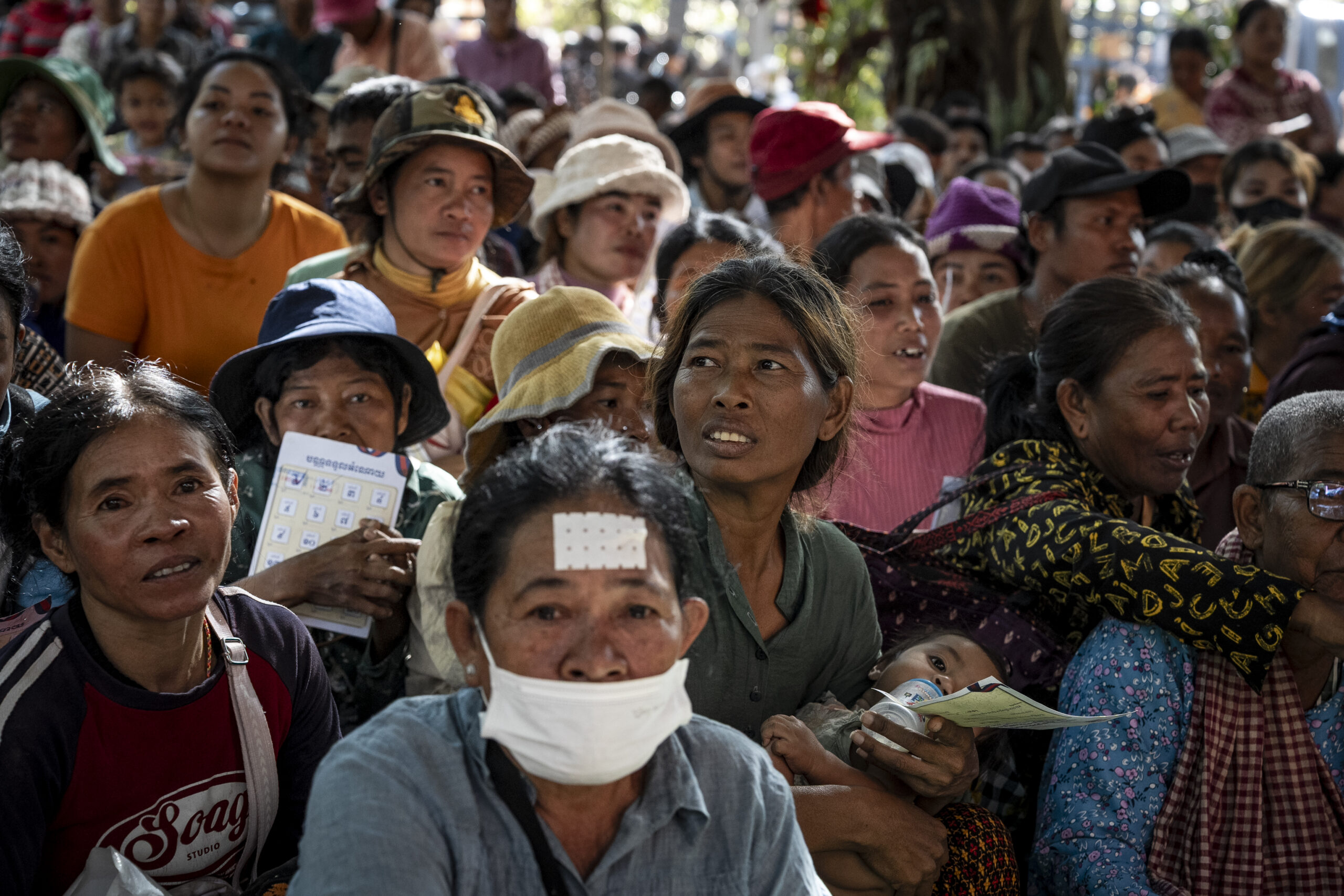
When Menn Tay heard artillery fire around her home on the border in Samraong city, she didn’t have time to run.
“We were watching from our house and there were planes everywhere in the sky,” she said. They had run twice before this, but the weapons were so close that she feared getting shot this time if the group of women and children fled at once.
The 42-year-old mother said she brought her children and sister into the mango plantation where she works as a hired farmer, and they slept there for two nights in a row.
“The farm’s owner said you have to leave, you can’t keep hiding here,” she told Mekong Independent on December 14, as she held her child to sit on a broken bench in front of a pagoda’s steps. “They [Thailand] might think there are military here, so they will drop [bombs] so that’s why we had to leave.”
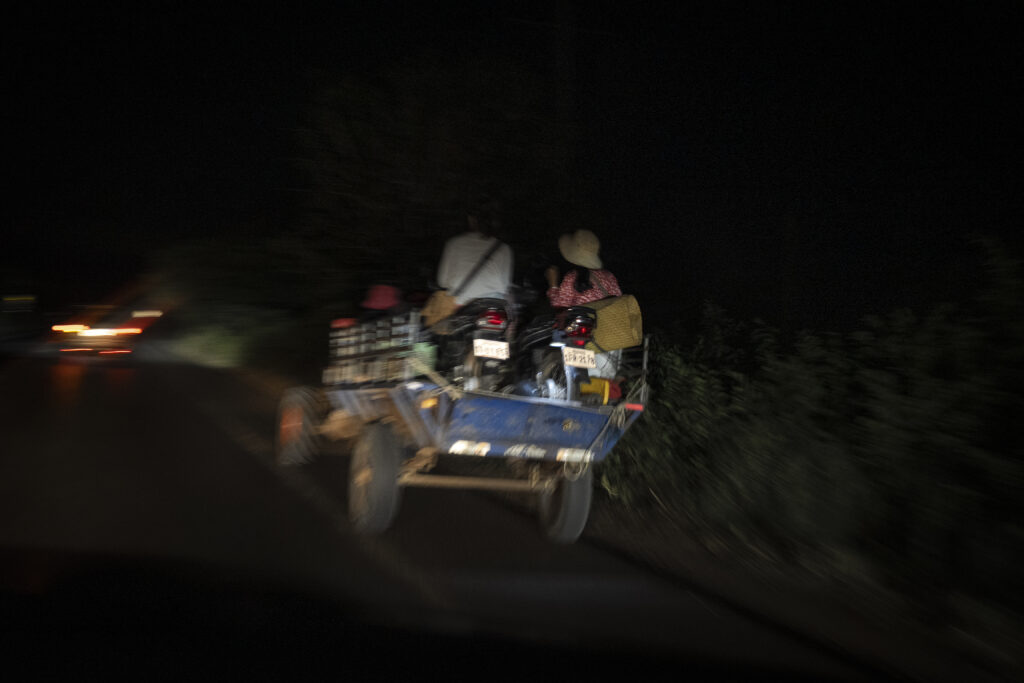
Tay and her family finally arrived in Siem Reap province on December 13, after camping on the road for an extra day while they traveled. But she said her kids were starting to get sick from the mosquitos that bit them as they laid next to the mango plantation’s irrigation canals.
“They’re all pretty sick now,” she said, gesturing to the toddlers and kids sitting around her under a tree inside Char Chhuk pagoda in Angkor Chum district.
The mass displacement of civilians at Cambodia’s borders has upended the lives of more than 525,000 people as of Monday morning, sending them from their homes to tarp tents and mats pushed into the shade of buildings and trees. Most say this is the second or third time they’ve had to camp out, and they’re wondering when they can go home, or whether they will have to flee again.
Mekong Independent visited internally displaced persons (IDP) camps across Siem Reap and Banteay Meanchey provinces on December 13, 14 and 15, as more civilians trickled in daily. Other families changed location out of fear, as bombings were reported on the border with Siem Reap province, a distance of 70 kilometers inside Cambodia’s borders. Some camps, like Char Chhuk pagoda, host a few hundred families, while thousands linger in larger camps at Siem Reap’s Chroy Neang Ngourn pagoda and Banteay Meanchey’s Borey Chey 2 area.
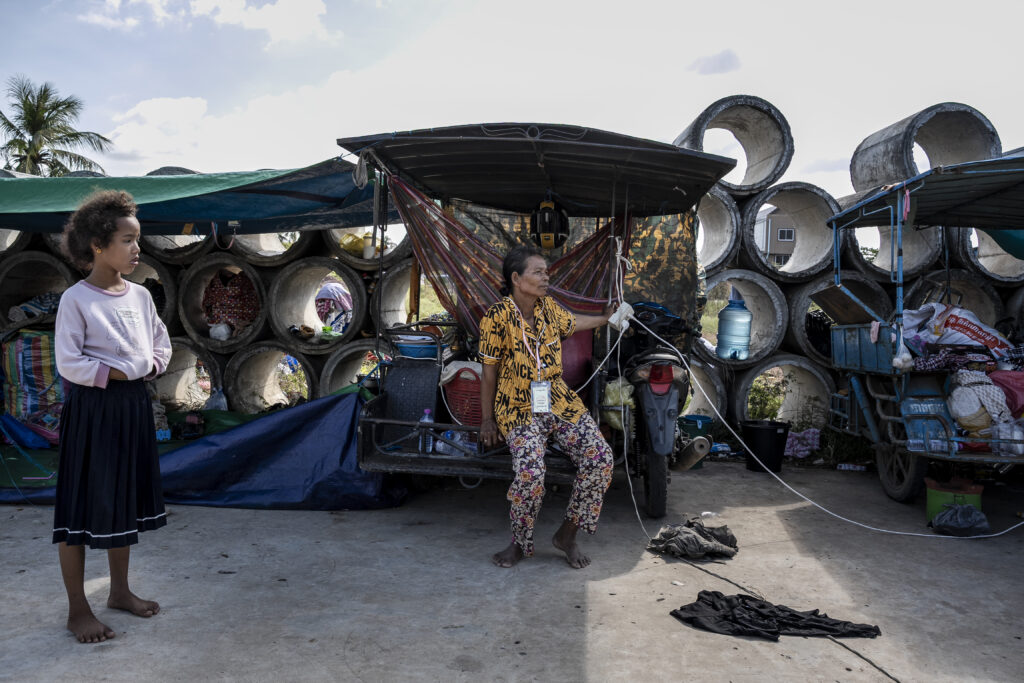
An ancient warrior stands guard in front of a clothesline, holding patterned polyester shirts and pants left out to dry. The fierce mythical beasts carrying a rope around an elderly bodhi tree are the playmates of a toddler, laughing as he caresses the monsters’ faces. The vibrant statues like these that depict Buddhist stories at Chroy Neang Ngourn pagoda are just background characters to the more than 2,000 families who camp at the pagoda grounds on December 13, waiting for the conflict to end.
The camp residents largely focused on earthly matters while on the Buddhist grounds: vendors sell snacks and groceries to those who can afford it buy, and others wait to hear the number their family is assigned in the queue. When a local official calls out their number over a scratchy microphone, they can get a portion of the donations coming in.
Som Sreymom, 34, said this is her third time fleeing her home in O’Smach town in Oddar Meanchey province, and the migration interrupts her attempts to harvest cassava this season.
“Some [farmers] already cut the cassava, but they need to do the right processing to turn it into flour,” she said. “But with this current situation going on, it’s so disturbing for us, we could not finish.”
When she and her mother Hoeun Nguon, 58, sat and talked at their camp near the pagoda’s pond, they expressed worries about whether they will continue to have enough food and money to sustain themselves. But they rather stay on the pagoda grounds than return home, which they believe is still under siege.
“We are scared to go home and this keeps us running,” Nguon said. “We don’t know what to do.”
Sreymom also worries for her cousin, who is serving in the army. She heard the data reception was bad at the border, but she hasn’t heard from him since the conflict restarted this month.
“I think it’s 50/50,” she said. “I just wish that he’s still alive, but the other half [of it], I don’t believe.”
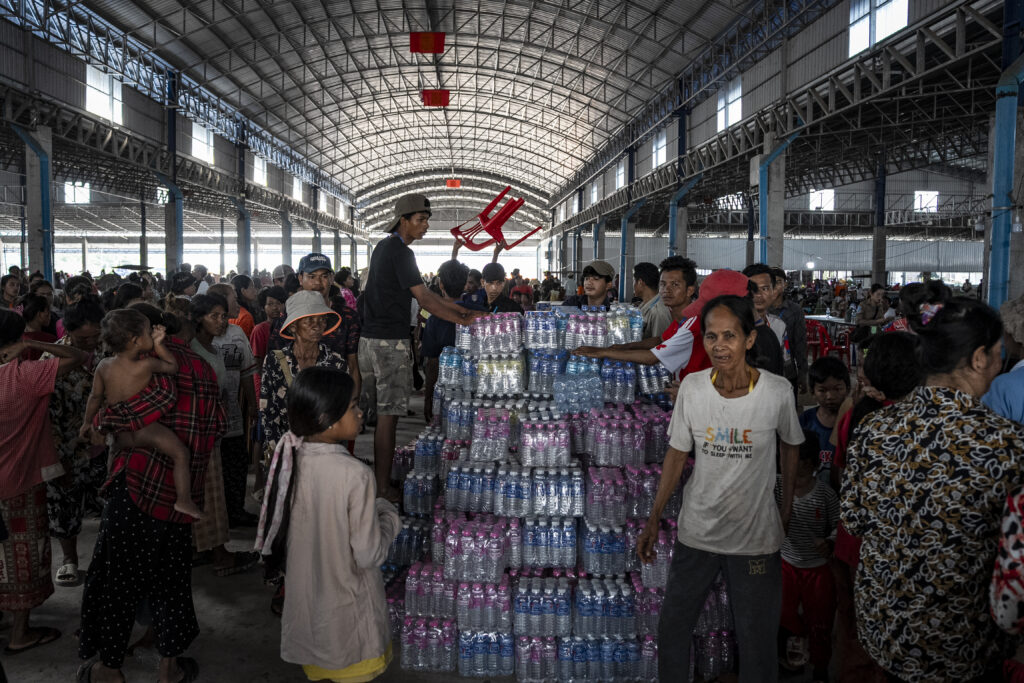
The Borey Chey 2 gated community is half-finished. Some buyers had been given the certificates to their houses, and an arcade and bubble tea shop opened in the market, but the property was largely empty before fighting across the Thai-Cambodia began again on December 8.
Now it’s brimming with life.
When reporters arrived in the mid-afternoon, a man called through a staticky megaphone, asking children to come to the center of the market square. He introduced the rules of a game to play, something to keep the kids occupied. One of the new, temporary residents said there were more than 1,000 families, so thousands of residents total.
Om Ut, 46, and Yun Mom, 42, laid across a mat, lazily talking and scrolling phones inside the echoey market hall in Banteay Meanchey’s Mongkol Borey town. Mom said they had nothing to do, and Ut added that she was just thinking about her house, if it was still standing.
“[The videos] were in exactly my village, and this morning there were some bombs dropped by the plane as well,” Ut said.
The pair of friends are from Chouk Chey village at Banteay Meanchey’s border with Thailand’s Sa Kaeo province, which has become one of the key fronts of the border conflict, since Cambodia residents confronted Thai soldiers in the village. Thailand’s government claims that village and nearby Prey Chan village as its people’s land, temporarily loaned to Cambodian residents who moved to the border to flee the Khmer Rouge regime in the 1970s.
Ut said she had joined civilians efforts to confront Thai soldiers who entered their village, but she did not want the war to continue on.
“Cambodia has gone through this type of war, and we don’t want to experience it again,” she said.
Cambodia and Thailand once again tried to start discussing a ceasefire on Monday, during the last Asean Foreign Ministers meeting of the year in Kuala Lumpur. However, the neighbor countries did not yet reach a true end to arms, with Malaysia saying in a statement that talks would continue on Wednesday.
Even if the countries reach an agreement on Wednesday, residents say they are not sure when it will be safe to return – nor whether they would need to leave again, as they did after the five days of fighting in July.
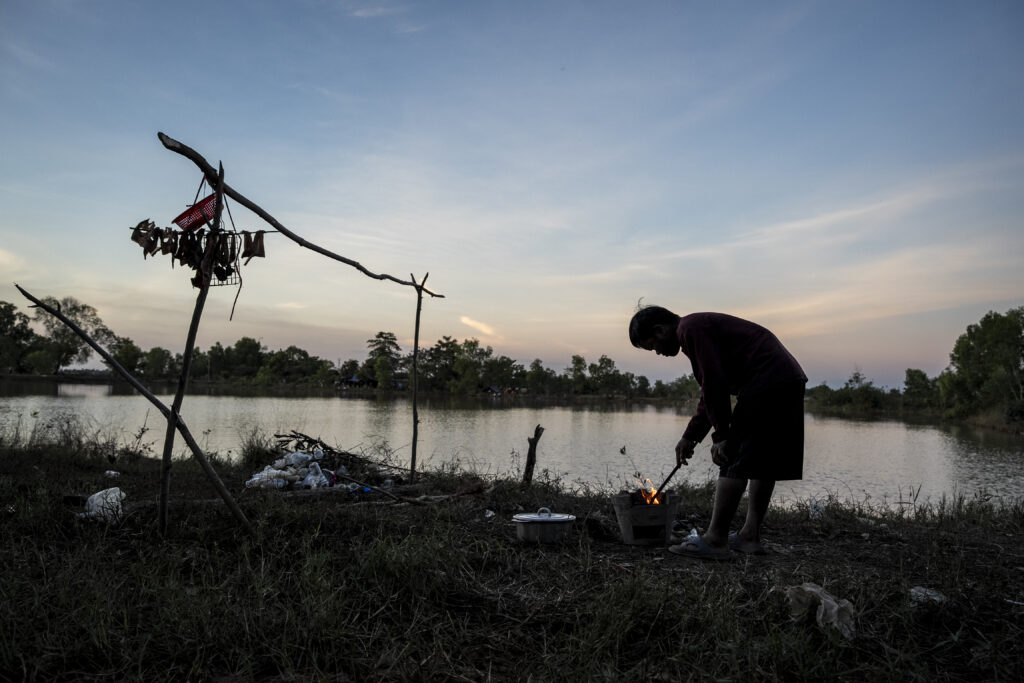
Pich Sotheb, 45, smiles at passing reporters as she squats next to a hot plate, stirring a soup, under the shade of the Borey Chey market, which was almost abandoned until a week ago.
She says she’s “disturbed” by the fact that her four school-aged kids have been out of the classroom for so long, and she wants to get back to her normal life.
“I have been busy running, so I can’t keep working,” she said, adding that everyone at the camp is bored and looking for something to take their mind off the situation. “And the kids keep asking for money but I can’t buy stuff.
Sotheb lifts up her left pant leg to show a replacement limb. She lost her leg as a child, in 1994, stepping on a land mine in Poipet, where she usually still lives.
She says she remembers a childhood of running, trying to escape civil war conflicts with the ousted Khmer Rouge regime, which still kept a stronghold on the western side of Cambodia near Poipet.
“I don’t want things to keep happening like this,” she said.
“During my mom’s generation, and when she had me, she was always running from war, and I started running too. Now it happens like this with my own children. I don’t want this to keep happening.”
This article is published as Creative Commons.