
Money changers and business owners were shaken by a National Bank announcement liquidating Huione Pay — a payment services app that was particularly popular among Chinese-speaking users — because of its illegal use of cryptocurrency.
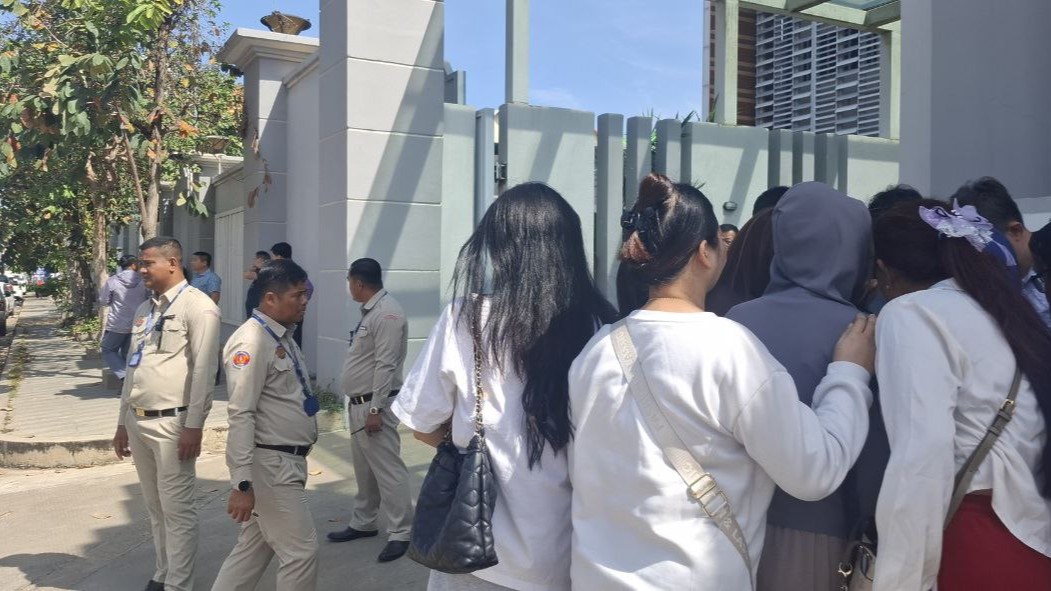
Business owners who gathered outside the bank on Monday morning told reporters they had tens of thousands of dollars in accounts with Huione, and some were worried their investments were lost forever.
The National Bank said in the statement December 4 that it had found Huione in violation of two prakas in 2018 and 2024 that prohibit financial service institutions from doing business with crypto assets.
Huione Pay, a locally registered company with Chinese and Cambodian directors — formerly including Hun To, the cousin of Prime Minister Hun Manet — held a payment service institution license in Cambodia from 2018 until last year, when it was not renewed. Huione Pay Plc. is no longer listed in the Commerce Ministry’s business registry, but the corporation is still listed in OpenCorporates, an international database listing corporate registration data.
Payment service institutions offer more limited transactions than banks, and for “basic” customers require only telephone number registration as a “know your customer” (KYC) requirement for lower value transactions. Huione Pay operated a payment application that allowed QR-based transactions predating the National Bank’s Bakong system linking local financial institutions.
By mid-morning, there were around 20 people waiting outside the National Bank headquarters in Phnom Penh, but one police officer guarding the gate told Mekong Independent that there were more than 500 people there earlier Monday morning.
Last week, a security guard at Huione’s headquarters in central Phnom Penh, estimated that some thousands more showed up at the five Huione branches in Phnom Penh, following the National Bank’s statement on December 3.
“Twenty percent are Cambodian while 80 percent are Chinese,” he said of the users gathered at Huione Pay branches last week. “The crowds lined up continuously from morning until afternoon.”
The people waiting outside the central bank asked to speak under pseudonyms to share their experiences freely.
One woman, “Sothy,” told Mekong Independent that she had $30,000 in an account with Huione Pay, saying that as a money changer she had often moved large sums of money for clients.
Prior to last week’s announcement, she didn’t see it as any different from a registered bank.
“It is like our bank, it is easy to transfer money with our client because nowadays, many people, especially in Sihanoukville, use this one,” she said. “If we do not have it, we cannot get the money from them so we must have it and so far there had been no problems.”
After waiting two hours, Sothy said she was able to meet briefly with a National Bank official, who took her story and told her to follow the bank’s Facebook page for updates about Huione Pay.
“Because there are still many people complaining about this, they asked us to come as a survey to see who and how many people were involved with this bank to find a solution for us,” she said.
One elderly woman said that her son held more than $100,000 in a Huione account. “I thought they would pay us back the money, but still they still cannot give money!”
When a Huione account holder walked out of his meeting with National Bank employees, others in the queue surrounded him, asking what documents they’d need to make their case and what questions they might be asked.
The man told the group that he had to show when he opened the account, and he was asked if he knew that doing business with USDT — or Tether, a U.S. dollar-backed stablecoin — was illegal. He claimed he didn’t know, and the rest of the crowd murmured their agreement.
As the business owner exited the crowd, he told Mekong Independent that he thought it was “50-50” whether he and others could get their money back from their accounts. Based on his meeting with the bank, he said it sounded like they were winding up Huione Pay, and it wasn’t clear to him if the National Bank was too far along in the liquidation process to help clients like him.
“We did not know that they have cleared their list [of assets] and they have already paid their debts. This is the last call … because there have been many people commenting [to complain] on their Facebook.”
A National Bank employee waiting with civilians at the gate similarly told the crowd they would analyze the number of customers impacted and then file a report to bank management before they could decide how to handle the matter. He added that there would be at least two weeks for Huione customers to file complaints, echoing a second National Bank statement from Friday.
“Lina,” a massage shop owner, said she had opened a Huione Pay account about one year ago, as Chinese clients preferred to use the payment app.
“When we used to offer the ABA [QR code], they did not transfer to it, so we set up Huione for them,” she said. Lina found out the company was liquidated via news on TikTok. They also owed staff members money, as she was planning to pay them with the funds in the business’s now-frozen Huione account. Lina said she planned to line up at the National Bank in the early morning on Tuesday so she could make a claim to try to recuperate her funds.
“We believed that as long as the money was in the account, we were not going to lose it,” she said.
The U.S. Treasury Department in October severed Huione Group from the U.S. financial system, primarily for its reported association with laundering proceeds of online investment scams. The rule bans financial institutions from opening or maintaining accounts for Huione Group or any entity operating on its behalf, like a shell company. The U.S. news outlet Bloomberg reported in August that Huione reportedly used shell companies to open bank accounts and facilitate money laundering, connecting the Cambodia-based firm to investment scam victims in the U.S.
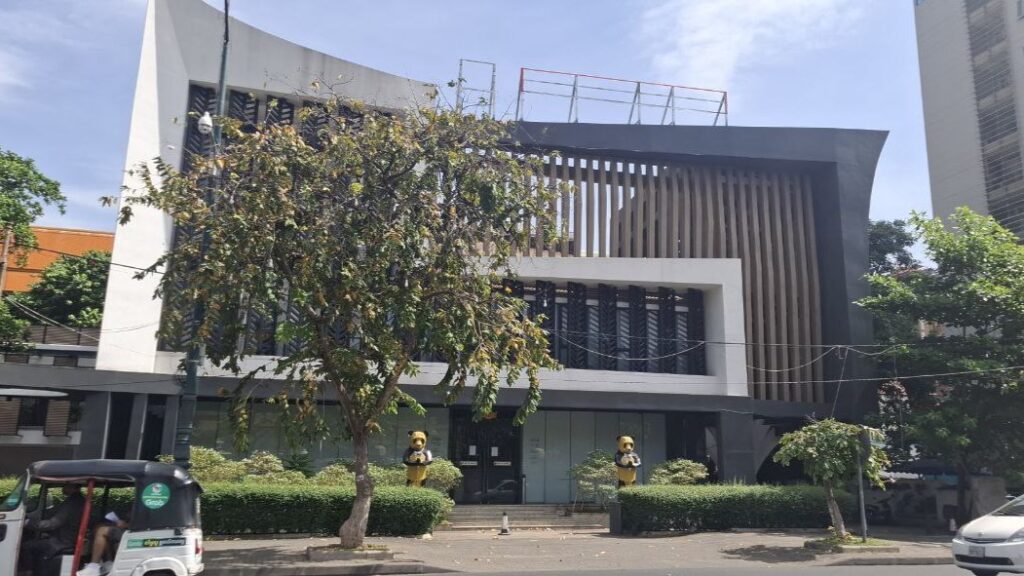
Another major financial institution, Prince Bank, came under fire in October, after the U.S. sanctioned what it calls the “Prince Group Transnational Criminal Organization,” which includes the Cambodia-licensed Prince Bank. The U.S. also filed an indictment against group chairman Chen Zhi, a naturalized Cambodian citizen, and filed a civil forfeiture to freeze a total $15 billion worth of bitcoin, reportedly held by the conglomerate.
Following the NBC statement, ABA Bank posted on its WeChat account in Chinese, reminding users that Cambodia prohibits cryptocurrency transactions with banks and financial institutions.
Money-changing stalls, particularly those advertising to the Chinese-speaking population in Phnom Penh and Sihanoukville, have been known to advertise offramping Tether into ABA accounts.
Am Sam Ath, operations director of Licadho, said that the National Bank should take this as an opportunity both to investigate the extent of Huione’s potential violations, while reviewing other banks for misconduct.
“From what we have seen, [Huione] has violated the law. Beside enforcing the revocation of the [license], they should investigate other issues thoroughly if there are crimes. If they are involved with other crimes, they must take action in accordance with the law.”
This article is published as Creative Commons.