
Senior officials acknowledged the death of foreign workers, hit to Cambodia’s reputation, rising recruitment of local workers and continued challenge of policing transnational crime as they presented the country’s new law against online scams on Friday.
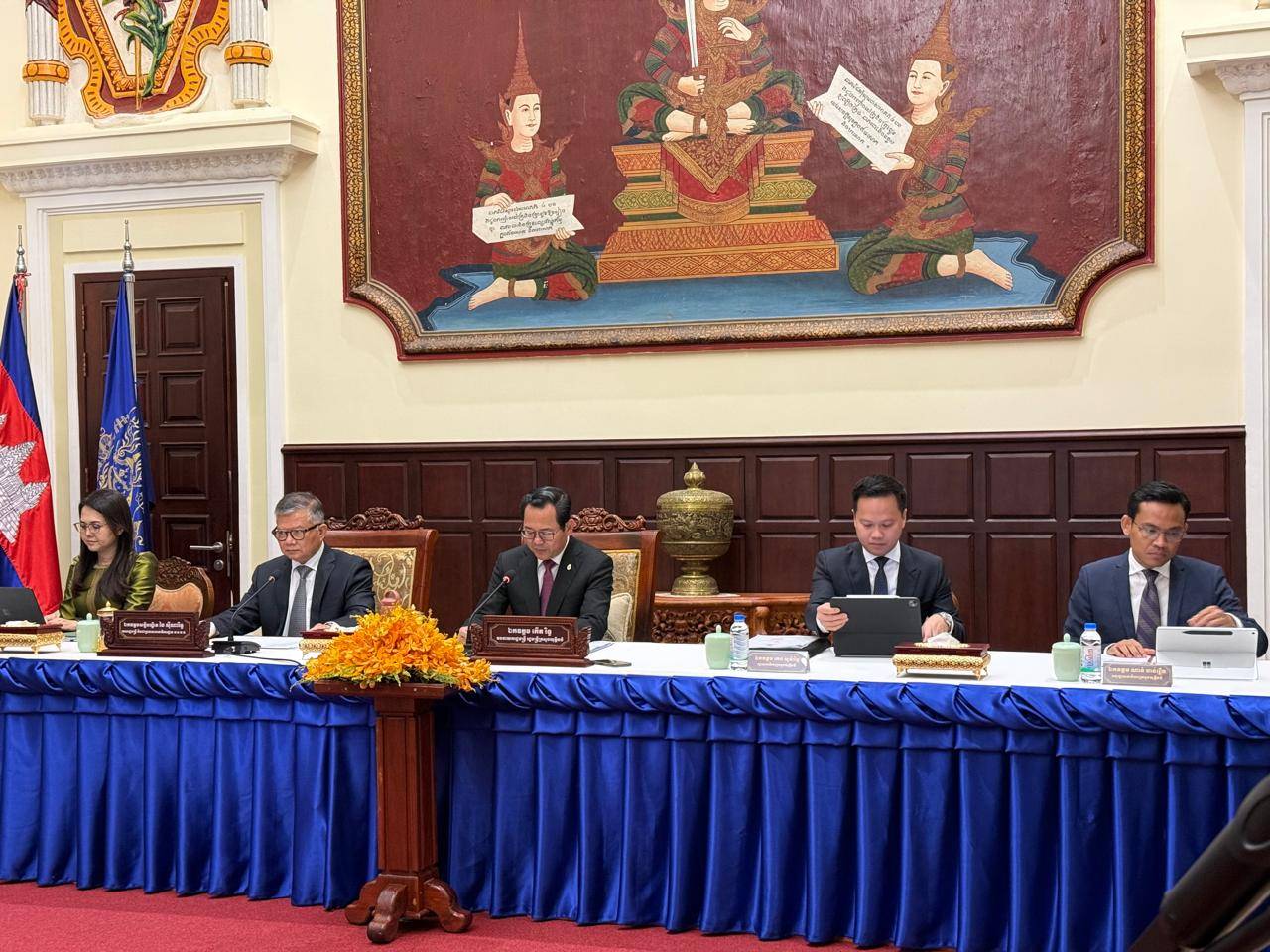
The “Law on Combating Online Scams,” which has already been passed by the country’s National Assembly and Senate, and only remains to be signed by the king, was presented at a press conference on Friday, April 3, at the Justice Ministry.
An English-language version of the text was shared with reporters on the condition that it would only be quoted in part, and not reprinted in full. However, the Khmer version of the text was already posted online by various accounts by the afternoon.
Justice Minister Keut Rith said the law was being passed urgently so it could be implemented immediately.
Though online scams weren’t new, the fraud had quickly evolved amid changes in technology and turned into a global challenge, he said.
“The eyes of the world are on online scams, and it has become a new shared concern for Cambodia, the region and the world — because mostly online fraud is committed across borders by organized crime networks. Criminals located in any country can defraud victims in other countries.”
The law contains five chapters and 24 articles, and stipulates four new offenses alongside provisions around the liabilities of legal entities and seizures of assets.
The four offenses, in summary, are:
- Online scams: Acts of deception using technology with the aim of obtaining transfers of funds, property, services or contracts. The punishment is two to five years in jail and a fine of 200 million to 500 million riel (about $50,000 to $125,000), or five to 10 years in jail and 500 million to 1 billion riel ($125,000 to $250,000) when committed by organized crime or against multiple victims.
- Organizing or directing an online scam center: Punishable by five to 10 years in jail and 500 million to 1 billion riel in fines, or 10 to 20 years and 1 billion to 2 billion ($250,000 to $500,000) where there is violence, torture, confinement, coercion or human trafficking. Organizing or directing an online scam center that results in a death is punishable by 15 to 30 years or life imprisonment.
- Recruiting or training others to commit online scams: Two to five years in jail and 200 million to 500 million riel, or five to 10 years and 500 million to 1 billion riel if there is violence, capture, confinement, death or migrant smuggling.
- Collecting identification documents or personal information documents of others with malicious intent: Collecting bank accounts or social media accounts in order to commit online scams is punishable by one to three years in jail and a fine of 100 million to 300 million riel ($25,000 to $75,000), or three to five years and 300 million to 500 million ($75,000 to $125,000) if committed by organized crime.
Money laundering is punishable under existing laws, and attempts are punishable as committed misdemeanors, the text says.
Keut Rith said international cooperation was needed, including sharing information about frauds being committed in individual countries and the money people have lost.
“No country can fight this issue alone,” he said. “This is a form of transnational crime.”
“Cambodia is among many other countries in the region that have suffered from criminals using [them] to commit transnational online scams. … These crimes have heavily impacted Cambodian security and public order, tourism and investment and the economy, as well as reputation, honor, image and dignity of Cambodia on the international stage.”
He singled out the case of a South Korean student who was killed in a scam operation in Kampot province.
“The number of Korean tourists dropped quickly, flight tickets were canceled, hotel rooms were canceled. … It created a fear that when they come to Cambodia, it is dangerous.”
He added that the country had been “attacked” since scams arrived, but there needed to be international cooperation. He also raised the difficulty of stamping out the industry.
“When the scam issue arrived, they started to attack us and started to report badly about us,” he said.
“We saw previously in Preah Sihanouk province that we conducted a crackdown, but scams returned even bigger than before. … So the government must think about the strategy and plan to make sure this time after cleaning up scams, it will not return.”
He said Cambodia’s border conflict with Thailand since last July had diverted some attention. But since a second ceasefire at the end of December, “you can see the crackdown on online scams is in full swing.”
“It has not finished yet, and the campaign will end when the big scams are over too.”
He emphasized the difficulty of tackling transnational crimes.
“The perpetrator might be in Cambodia but the victim is not,” he said. “Victims don’t know who they’ve been defrauded by, and they don’t know where the scammers are.”
“Anywhere there is internet, they can do this work,” Keut Rith said, noting how authorities had confiscated hundreds of thousands of foreign SIM cards from Cambodian compounds.
Cambodian authorities rarely received complaints from overseas scam victims, but “when they file complaints about this issue, we take action quickly,” he said.
“We are securing our legal net. At this time [the mesh in] our legal net is smaller than before and they can’t slip through it,” he said. The new law was part of constricting the space for scammers, he said.
“Just seeing the law against online criminal scams, they don’t dare to come. When there is no law or our law has loopholes, criminals see this as [an opportunity].”
Authorities have found cases of confinement, torture and killings when raiding scam centers. Those cases could now be punished with decades in jail or a life sentence for the center operators.
He also acknowledged the emergence of local recruitment for scam work.
“Now they are recruiting our Cambodian people to be trained to scam, and some of our Cambodian people are in a phase where they do not know that they are being pushed into online scam networks. … Once this law comes out, these recruiters will be punished.”
“It has been happening gradually with this place with a few people and that place with a few people and in there. They have scripts on how to scam.”
He also asked that people be wary about being asked for ID cards and personal information, as they could be used by scammers.
Keut Rith said his own picture had been used for an investment scheme he was uninvolved in.
“Recently, a former teacher of mine told me that teachers had joined a Telegram [group] and saw Rith in there, and I told them I have nothing to do with it. They must be careful and this is completely a fraud. … Unless we join together to combat it — it is complicated because it is involved with technology.”
“They have techniques to get people into these [Telegram] groups, and this is very dangerous. … We cannot investigate to find out who created this and we do not have the means to do so.”
He clarified that landlords whose properties were used for scams would not have the properties confiscated as long as they were not involved in the scam.
Chhay Sinarith, senior minister in charge of special missions and head of the Secretariat of the Commission for Combating Online Scams, spoke at the press conference that authorities had cracked down on 250 online scam locations, including 92 casinos. More than 800 suspects had been charged and placed in pretrial detention, and there were a further 700 arrest warrants against foreign suspects.
An investigating judge had visited the notorious Park 8 in Prey Veng province on Friday. The location was specifically named in U.K. sanctions last week.
“Once the draft law becomes effective, we will have many grounds for enforcement. We took control of the location previously, and today we sealed it off and cut off the internet system and electricity.”
“In the past we have cracked down but not taken legal action … We just extradited them. But we [will] take strict legal action to clean it up and take legal action against the masterminds.”
Regarding Chen Zhi and Li Xiong — the extradited chairmen of Prince Group and Huione, respectively — the cases against them were still being implemented, he said.
“We have found many locations where the company committed [alleged crimes], in Preah Sihanouk, Kandal, Svay Rieng, Takeo, Kampong Speu, and now it is Prey Veng. We are working on this.”
Authorities had found a new scam location related to the Prince Group in Phnom Penh this week, he added. The investigations against the two men were ongoing.
“[There is] evidence of committing scams in some locations and compounds and in casinos,” he said. “There are organized crime groups, and there are people involved in committing crimes and money laundering — we are investigating.”
The law was passed by the national assembly on Monday, and then approved by the senate on Friday. The law now awaits signature from the King or acting head of state.
As senators voted on April 3, senator Ouk Malis warned her peers about the importance of preventing loopholes in the law from emerging, and also urged all national government members to inform subnational government officials about the law’s points.
Ahead of the national assembly vote, parliamentarian Lok Kheng described online scams as worse than drug addiction, nuclear weapons or Covid-19, in a video from the March 30 session.
”I am more afraid of this than nuclear weapons because when [a nuclear weapon] drops location, it only destroys the location,” she said [Though when used, nuclear weapons are found to cause extremely high death tolls, severe environmental impacts and multigenerational health issues].
“It is even worse than Covid because when people are infected with Covid, it claim people’s lives but scams not only take people, first they take their wealth and defraud them…they take their wealth and then they suffered and committed suicide and jump off the building. I watched the movie from the country that produced this [type of] scam. I could not sleep.”