
This article was originally published on Prachatai.
The Election Commission of Thailand (ECT) faces legal challenges in three courts over the integrity of the 8 February elections after major irregularities were reported.
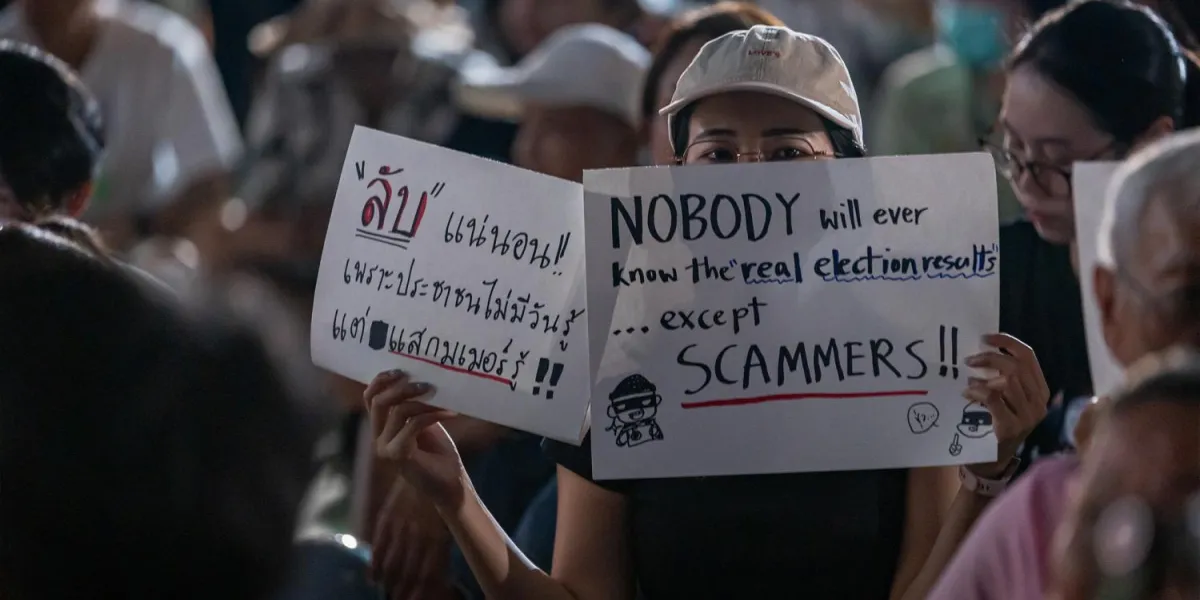
Following the 2026 general elections on 8 February, concerns have been raised over vote transparency. According to Vote62, an independent election watchdog, over 5,000 irregularities have been reported, ranging from missing candidate and voter information to valid votes being counted as invalid.
All eyes have been on the ECT, which was allocated over 7.8 billion of taxpayers’ money to stage the election, yet the outcome has been widely criticised.
In several areas, the number of recorded votes significantly outnumbered that of eligible voters who turned out. In addition, huge discrepancies between constituency MPs and party list MPs’ ballot papers were detected across the country, despite the fact that all voters were given the two ballot papers simultaneously before entering the polling booths.
The most serious concern was raised by the discovery of unique barcodes and QR codes on ballot papers and the corresponding counterfoils, potentially revealing how each voter cast their vote; this could lead to voiding the elections.
All of these irregularities have prompted a series of complaints against the ECT by the general public, independent organisations, and political figures.
The Administrative Court
The first petition was filed on 13 February by a lawyer, Thanu Rungrotreungchai, with the Central Administrative Court. He requested the Court to temporarily suspend the announcement of the election results and to declare the election on 8 February void. The Court has already accepted the case.
The Court was also asked to order the destruction of all ballot papers to safeguard the people’s privacy and to order a new election using ballot papers without traceable codes.
On 15 February, a reserve senator, Akarawat Phongthanachalitkuun, filed a petition against the ECT for alleged misconduct in managing the elections. He accused the ECT of violating ballot secrecy through its use of barcodes and QR codes.
Akarawat also requested the Court to temporarily suspend the certification of the election results until a verdict is reached. He further asked the Court to order the ECT, the Election Commissioners, and its Secretary-General to compensate the expense of a new election and to impose criminal penalties
On 16 February, student representatives from nine universities filed a petition over the controversial barcodes and QR codes, requesting the Court to rule on whether the ECT’s design of the ballot papers was unlawful, as the ballot papers were allegedly traceable and could reveal how individuals voted. If the Court rules that the design was unlawful, the election would also be deemed illegitimate.
The petition also requested the Court to suspend the announcement of the election results.
Prasit Puttamapadungsak and Weerapat Kantha, two People’s Party MP candidates , also filed a petition with the Administrative Court over the barcodes. Prasit raised concerns that it would be detrimental if voting data embedded in the barcodes were leaked to a political party, and that it could serve as a valuable asset for the party in future elections.
The Constitutional Court
According to the Constitution, the elections must be carried out by direct suffrage and secret ballot. Most of the complainants based their petitions on the controversial barcodes, which they argued could make ballots traceable and compromise ballot secrecy. Such cases must first be submitted to the Ombudsman before being forwarded to the Constitutional Court.
On 11 February, lawyer Phattarapong Supaksorn requested that the Constitutional Court declare the 8 February elections void over the use of barcodes, arguing that it violated the Constitutional principle of a secret ballot. He also described the 2026 general elections as the most corrupt elections in Thailand’s history.
On 16 February, Mongkolkit Suksintharanon, the New Alternative Party Secretary General, also requested the Court to rule on the legality of the barcodes. He reiterated that a secret ballot means no one, not even the ECT, should be able to trace and identify voters.
The Criminal Court for Corruption and Misconduct Cases
On 10 February, Wiroj Lakkhanaadisorn, Deputy Leader of the People’s Party, filed a complaint for wrongful exercise of duties against the seven Election Commissioners and the Chonburi Provincial Director of the Election Commission over a case where the public protested to seek a recount.
On 12 February, a group of protesters who demanded a vote recount in Chonburi filed criminal charges against the Provincial Director of the Election Commission for allegedly making a false statement after the Director filed a series of criminal charges against them for trespassing and interfering with officials in the execution of their duty. The protesters insisted that they had CCTV footage proving that they did not commit the alleged offences.
On 13 February, the People’s Party filed a complaint against the ECT for wrongful exercise of duty over the controversial barcodes. The party also demanded clarification regarding the significant discrepancies in number between constituency ballots and party-list ballots, and urged the ECT to disclose vote-count reports from all 400 constituencies.