
This article was originally published on Prachatai.
Amid the intensifying tensions between Thailand and Cambodia, online nationalist sentiment in both countries has been growing stronger. Although netizens on both sides of the border are demanding tit-for-tat retaliation, many still reject the war.
Recent clashes between Thailand and Cambodia not only included military operations but also online propaganda, stirring nationalist sentiment and wartime hostility in both countries.
Online commentary is predominantly negative, with strong support for taking retaliatory measures against the other side. In Thailand, the sentiment is so intense that anyone who voices opposition to the war is likely to face backlash.
Not surprisingly, it is easy to lose sight of the fact that many are still calling for a peaceful resolution of the conflict.
In both countries, anti-war movements still prevail, however.
Thailand
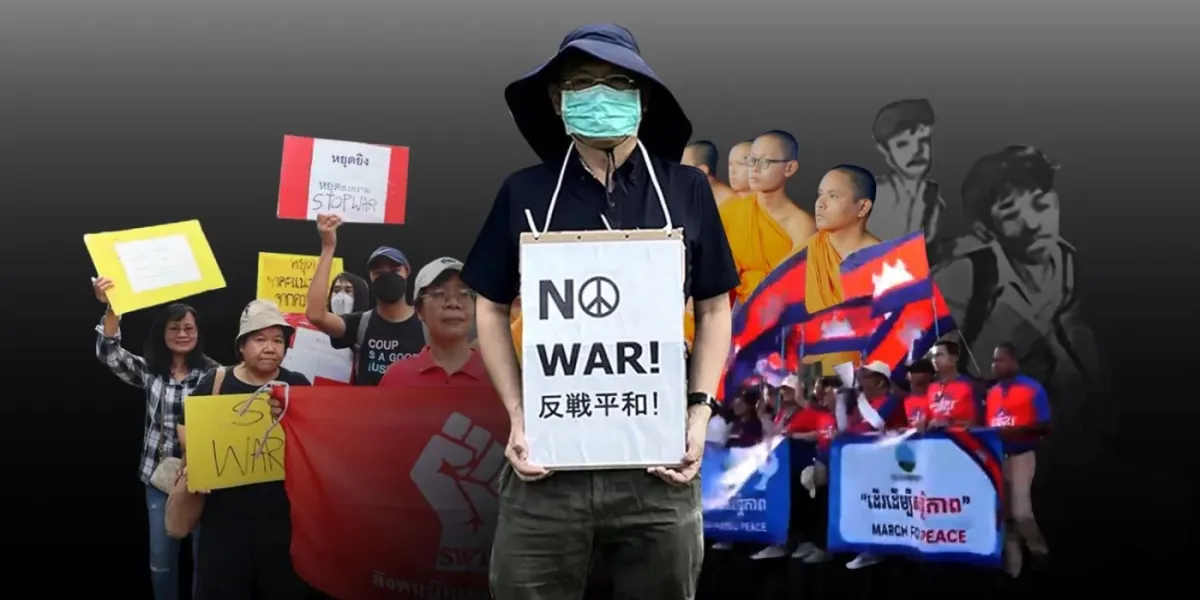
On 13 December, the Socialist Worker group gathered at the Bangkok Art and Culture Centre (BACC) to demand an immediate ceasefire and peace along the Thai-Cambodian border.
In their statement, the group noted that the war has done nothing for the Thais and Cambodians who have lived together for generations along the 800 km border, only benefiting their respective military establishments. The group also called on Thailand’s caretaker government to bring border issues to the negotiating table.
Others have been equally outspoken. On 17 December, well-known human rights lawyer and political prisoner Anon Nampa posted on Facebook that he does not agree with the war and stands instead for peace, a view he acknowledged was likely to anger some.
Two days later, a music for peace event was held at the BACC and another Arts for Peace campaign on 25 December at the same venue to promote peace through music performances, poetry readings, and art installations.
On 24 December, Chiang Mai students and residents staged a protest in front of Chiang Mai University calling for an end to armed clashes along the Thailand-Cambodia border. One protester said that many of their co-workers are Cambodians, and that people are all the same.
Thais and Cambodians both want a good life and an education for their children, they said, and there is no reason to kill each other. They said that they don’t have much, but are joining the protest to do what they can to take a stand against the killing.
The protesters said they don’t want people at the border to have to celebrate the New Year in shelters or for children to have to stay in shelters for Children’s Day, which they said is the only day the government dedicates to children. They are also concerned that people would lose property or livelihoods because of people on social media who incite war for their own satisfaction and online engagement.
In Khon Kaen, on 15 December, people gathered in front of Khon Kaen University to stage the first in a series of “Stand to Stop War” events – despite being approached by hostile audience members who were not satisfied with their activity. In a Facebook post on 17 December, the group expressed concern about the prevailing mood of the country, where calling for peace was perceived as wrongdoing, and asserted that their activities are being staged for those suffering the war’s consequences – border residents and low ranking soldiers, on whose behalf the war should be stopped immediately.
Meanwhile, in Phitsanulok, Professor Dr. Katsuyuki Takahashi, a Naresuan University ASEAN Community Studies Center lecturer who previously spoke out when a colleague, Paul Chambers, was hit with royal defamation charges, has been conducting symbolic anti-war protests since 14 December. His actions includes holding protest signs and wearing placards, even while eating. Others periodically join him.
And in Chiang Mai, the “Stand Against Tyranny” group recently held its 151st weekly gathering at the Tha Pae Gate. While their primary demand is for political detainee bail rights, participants have also joined together to oppose the Thai-Cambodian conflict. Protesters held banners with messages like “No War,” “Bring it to the negotiating table and resolve problems peacefully,” “Ceasefire,” and “War is not entertainment.”
Cambodia
On 13 December, Venerable Yon Seng Yeath, a senior Cambodian monk, called on Thai monks to appeal to the Thai government and military to uphold the peace agreement so that people in both countries can coexist peacefully.
On 18 December, a “March for Peace” event was also held in Phnom Penh. Participants included monks, civil servants, community leaders, and members the general public. The event was organized by the Union of Youth Federations of Cambodia, a group close to Cambodia’s leaders and government. The president of the organisation, Hun Many, is the youngest son of former Cambodian Prime Minister Hun Sen.
In Siem Reap, an Arts for Peace project was also held at the Preah Ang Chek – Preah Ang Chom Garden. Over 50 artists from different provinces reportedly worked together to create a large mural.