
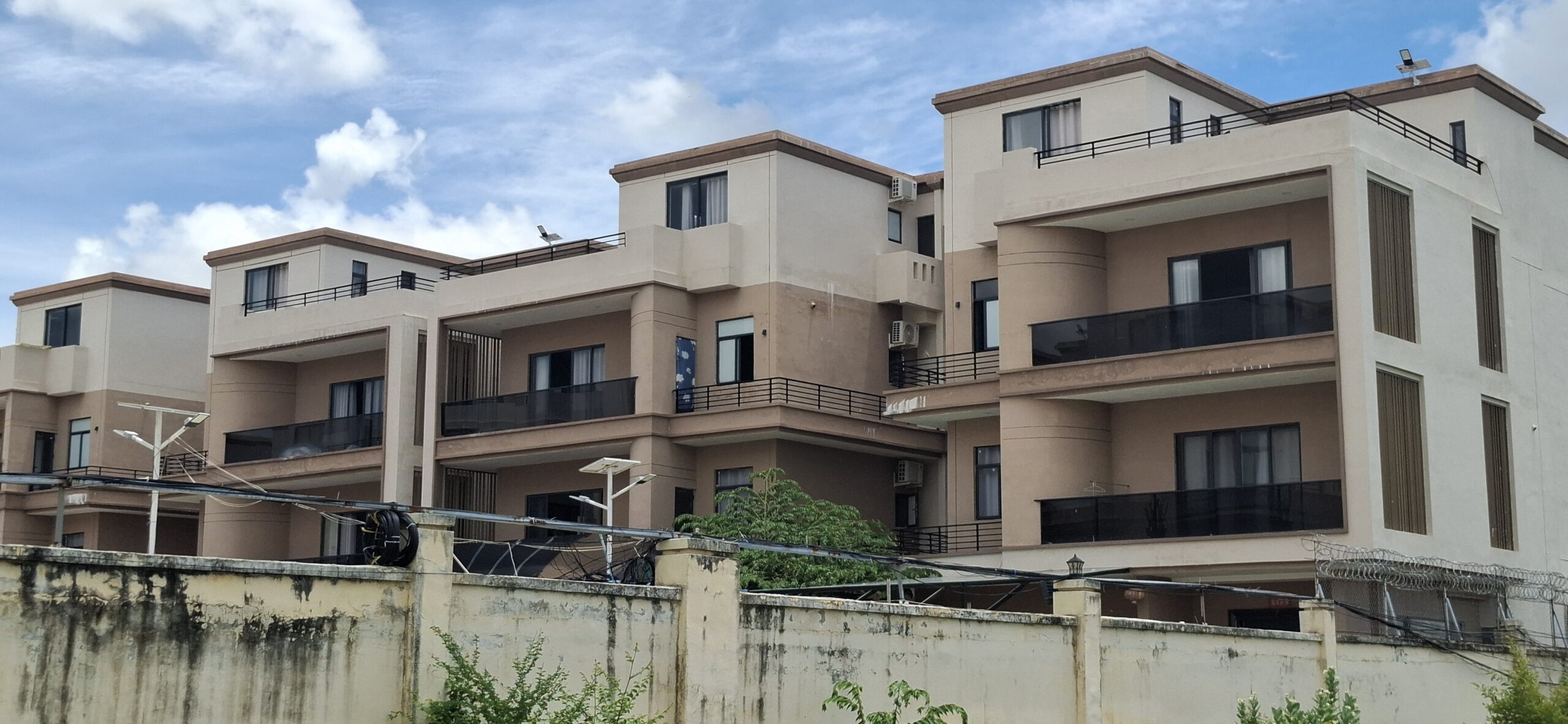
Authorities in Phnom Penh and surrounding areas led crackdowns on online scams and gambling from the second half of last year through this month. But local residents say they saw many workers leave before authorities arrived, and some scam centers remained in operation or in limbo.
Cambodia made one of its most significant arrests to date by cooperating with China on the deportation of Chen Zhi, the tycoon, former government adviser and chairman of the Prince Group, on January 6. Chen Zhi had been sanctioned by the U.S. and U.K. governments in October, with various governments confiscating assets as the network was exposed.
Following Chen Zhi’s arrest, observers on Chinese social media say that Prince-linked compounds in the Chrey Thom area started relocating workers.
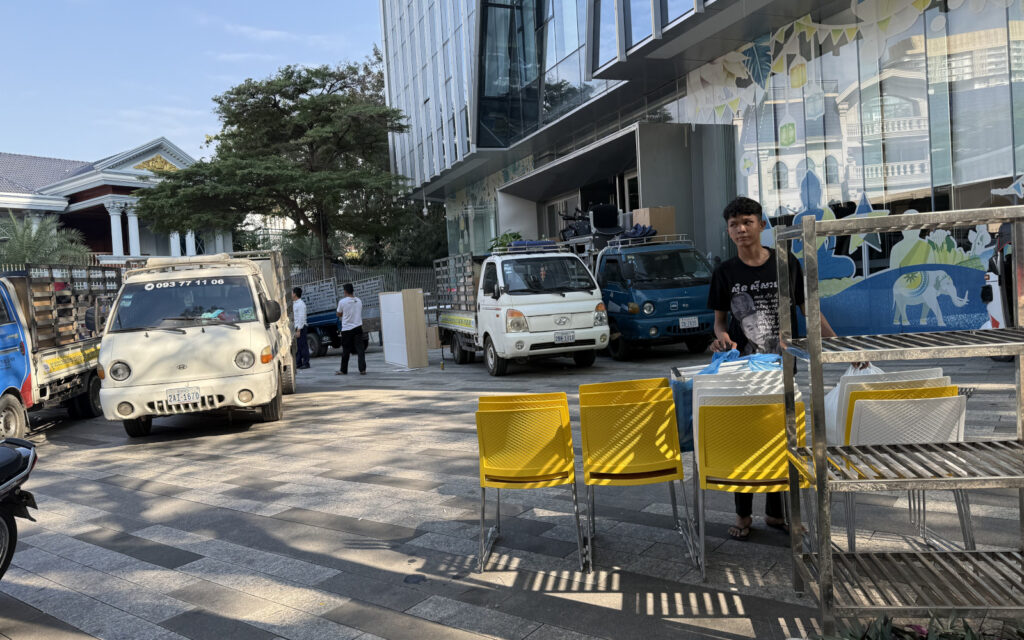
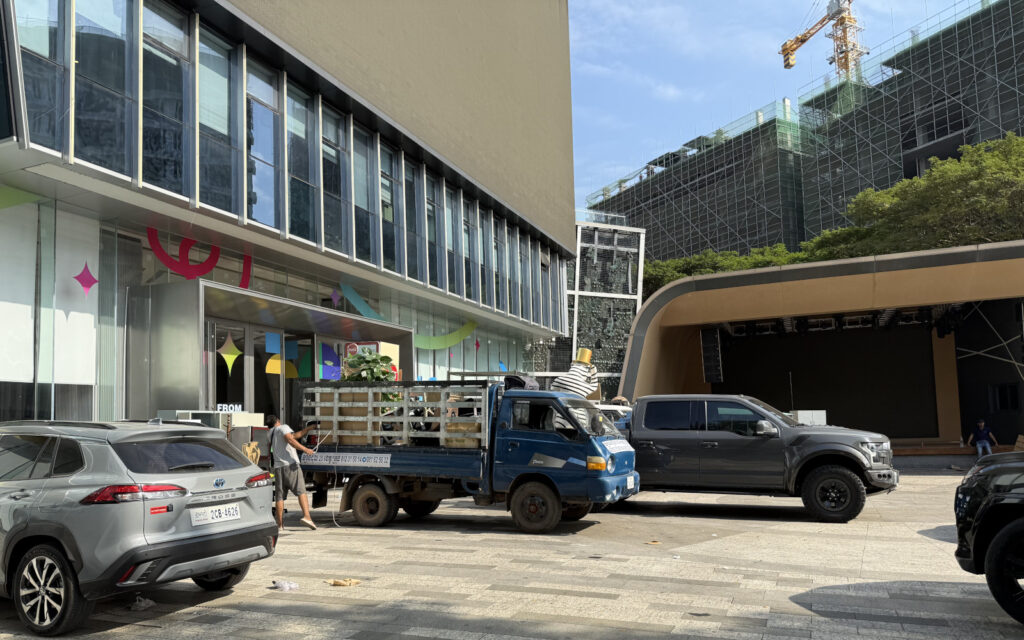
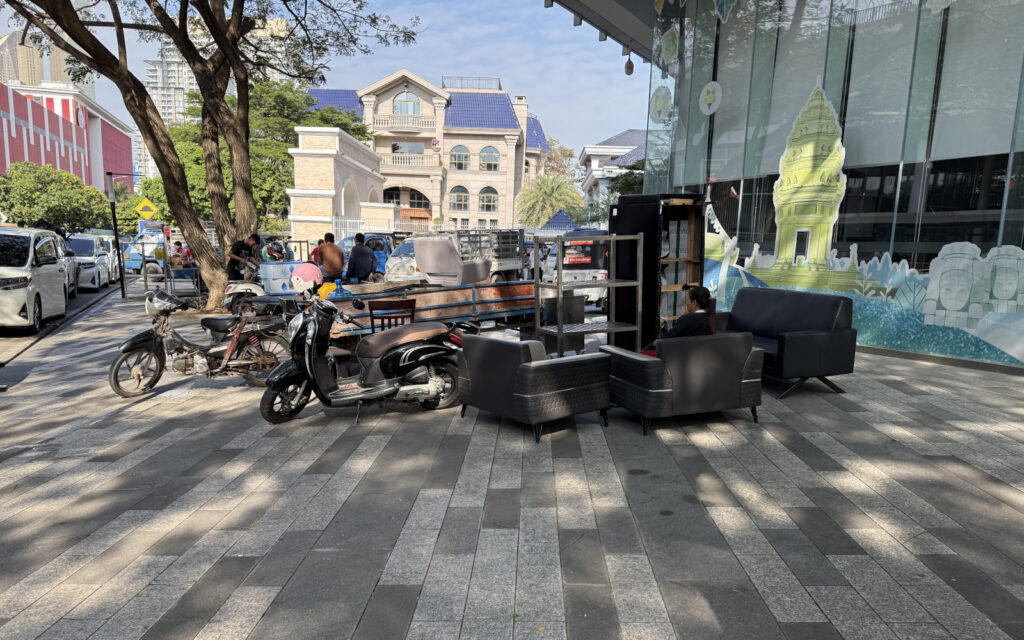
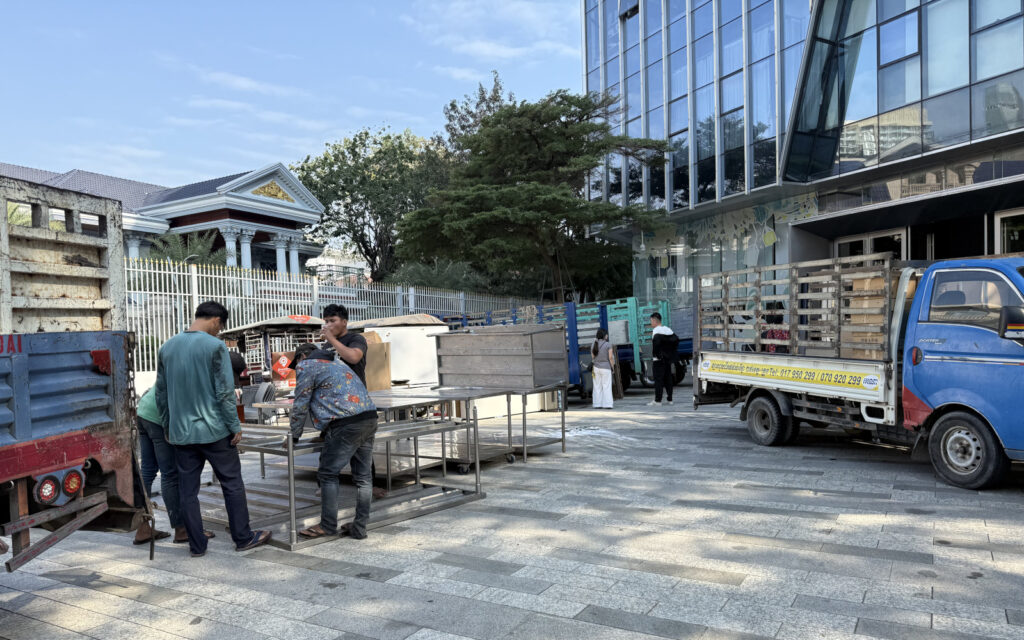
On Tuesday, workers could be seen removing furniture and other equipment from the Prince Group’s headquarters on Koh Pich island in Phnom Penh.
On Monday, the Real Estate Business and Pawnshop Regulator issued a statement suspending the sale of units at five Prince real estate developments: Prince Happiness Plaza, The Pinnacle Residence, Prince Golden Bay, Prince Huan Yu and Prince One Tropica.
Prince Bank’s liquidator, Morisonkak MKA CPA Audit-Accounting, also gave depositors and creditors 30 days to submit claims.
The Interior Ministry simultaneously held a meeting on January 6 about its progress and plans for other crackdowns on the cyberscam industry, but no details were revealed about the plan in ministry announcements. Phnom Penh governor Khuong Sreng later that day met with authorities in the capital’s 14 districts to work on this issue. Raids followed across Phnom Penh.
The country’s Immigration Department announced this week it deported more than 13,500 foreigners in 2025, up 57 percent from the previous year, in large part due to investigations and raids on reported online scam compounds.
Cambodia has also been raiding alleged scam businesses, in cooperation with the South Korean government. On the same day of Chen Zhi’s arrest, National Police also raided four properties inside the Borey Peng Huoth gated residences in Chbar Ampov district to arrest 32 South Korean nationals accused of conducting a police impersonation scam.
One of the villas where the South Koreans lived and worked was empty on Saturday, with leaves and other debris swept into a neat pile in front of the villa. A borey resident who spoke to reporters anonymously said the property was raided this week, with around 20 police coming to the property on January 5.
Before that day, he knew people lived in that property but had rarely seen people coming in and out of the villa. Even on the day they were arrested, police went inside the compound to manage the arrests, so he heard they were Korean but didn’t see very much of them.
Reporters obtained internal documents reportedly related to the raid of the Korean-language scam operation in the Borey Peng Huoth villas. The Korean documents appeared to depict a “client” information sheet collecting personal background information like family relationships as well as clients’ income and existing loans — this seemed to corroborate local news reports that workers were impersonating government officials to collect information and convince them to send money.
Crackdowns in 2025
Cambodian Prime Minister Hun Manet announced plans to root out the cyberscam industry in Cambodia last July, and several major operations followed. Within a day of that government directive, law enforcement detained more than 1,000 foreign workers from several different nationalities, according to CamboJA News. The crackdown was further spurred by the death of a South Korean college student, who was reportedly tortured and killed by a scam business operator in Cambodia in August — leading South Korea to place travel restrictions for its citizens.
There were raids across the country following the July directive, including in Sihanoukville, Poipet, and Kratie province’s Snuol district.
In Kandal province, Kandal provincial authorities arrested roughly 500 foreigners while they were inspecting the roads in Takmao city, Kandal Steung and Sampov Loun districts, on July 18. The authority said there were 491 foreigners involved with online fraud including Chinese, Vietnamese, Indonesian, Philippine, Pakistani, Indian, Bangladeshi and Myanmar. They also seized two trucks and 26 vans, one big bus and electronic equipment including 78 monitors, 10 desktop computers and 177 mobile phones.
But observers noted that there were still evident scam businesses operating across Cambodia, including some connected to powerful elites. When reporters visited some of the raid sites in August, civilians told them that some workers were seemingly able to escape during the chaos of a raid. Locals working and living around the Jin Bei casinos in Sihanoukville similarly reported that some kind of business seemed to continue operating out of the casino properties after the gambling operator revoked their licenses.
A Prince-linked complex, often called Mango Park for its previous life as the Cam MJ Agricultural Park mango processing factory, has been inactive since a mass evacuation from the multi-building complex on the evening of July 17.
Videos circulating on social media in July showed hundreds of foreigners running beside and across National Road 3 in Kampong Speu. Reporters couldn’t find any announcement of the raid from authorities, but observers say there were police on the ground at one point during the mass escape.
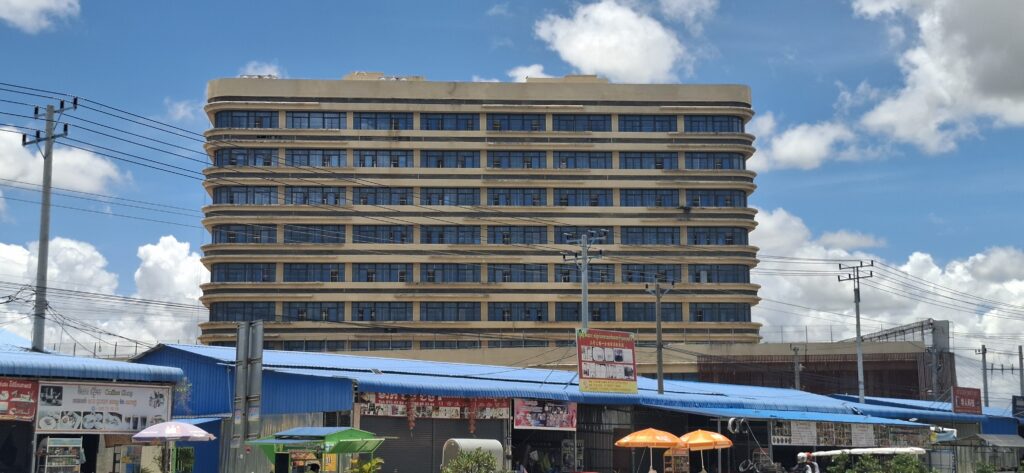
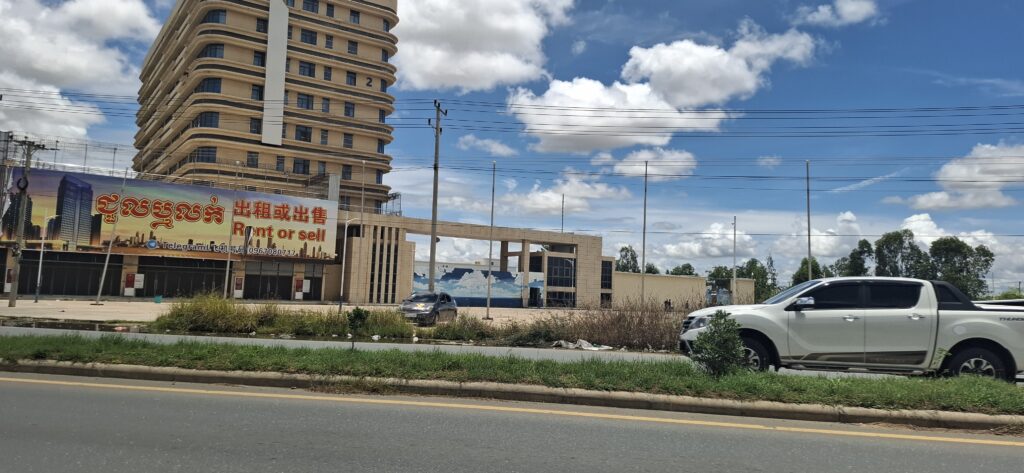
Pen Heng, the Angk Popel commune chief in Kampong Speu’s Kong Pisey district, said that he had not been in the Mango Park since it changed from a mango processing plant into something else. Commune authorities, including himself and police, could not go in, but national authorities were able to enter. He added that the July event was the second mass escape, following a raid in October 2024.
“We were seeing police come here, but we did not see any arrests,” he said.
One tuk-tuk driver who parks near Mango Park, who wanted to speak anonymously, said it was chaotic, as thousands of foreigners emptied out of the multi-building complex. He said he saw mostly Chinese workers, but also Vietnamese, Thai, Indonesian, Indian and Pakistani people among others.
They stormed out at about 8 p.m. that night, the driver recalled when he spoke to reporters in August, pulling suitcases and carrying their cash. A Chinese man paid him $30 to drive that night to Phnom Penh, he said, but other drivers got up to $100 for one ride. By the time he got back, most of the crowd was gone, but he saw stragglers on the street until the next morning, or hiding in local businesses like guest houses or a massage shop.
“It is possible that they needed to shut down [the compound] because there had been a number of cases like this. … As you know they [workers] have been sold from one place to another,” he said.
Before the raid, the tuk-tuk driver said he had seen a lot of people coming out of the compound beaten or in distress. He saw bosses sell groups of people, often Chinese or Vietnamese, when they are deemed useless to their businesses. Others would be shocked with tasers, as a form of punishment.
“Some of them struggle to escape,” he said. “Some of them would fall down from the [compound] wall, break their legs and get recaptured, so they installed the barbed wire.”
The driver added this wasn’t the first time Mango Park was raided, referencing a raid that detained more than 1,000 workers in October 2024, after South Korean news outlet KBS News published an investigation on workers being kidnapped and forced to work in the compound.
“When we saw these people [coming out], we thought that there must be a raid,” he said. “They learned their lesson from the past raid so they became chaotic when they learned police would come. … They were almost stamping on each other [to escape] at that time.”
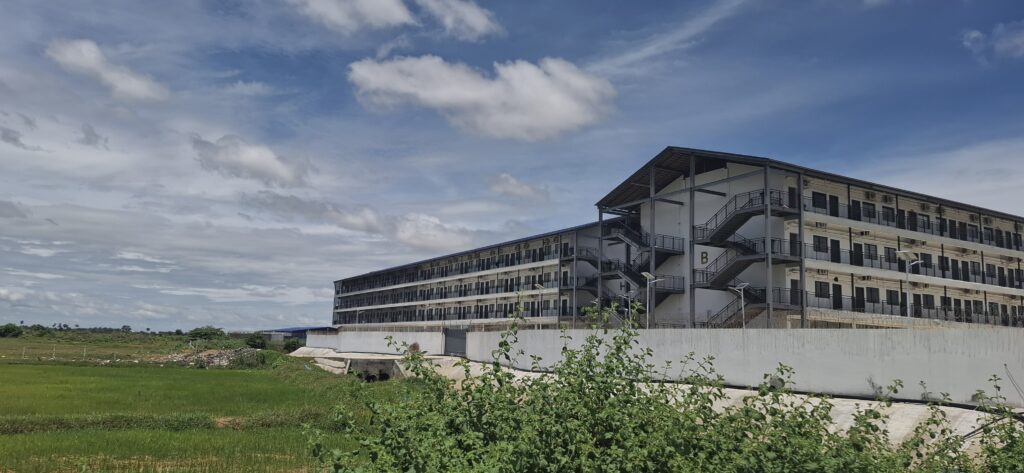
At the same time as the raid on Mango Park in July, workers ran out of a compound called Mango 2, less than 10 km away in Takeo province. It’s not clear if the Mango 2 Park is related to the Prince Group-linked Mango Park.
A Cambodian vendor who sold staples like instant noodles, soap packets and drinks in a small hut near Mango 2 said that the multi-building complex was empty, when she spoke to reporters in August. The only people remaining were some security guards and vendors like her outside the compound. A few construction workers still carried materials around a guesthouse construction site nearby.
The vendor said her business hadn’t been good to start with because the many foreign workers mostly stayed inside.
“I am lucky that I did not expand my business because we earn very little while others wanted to expand their businesses,” she said.
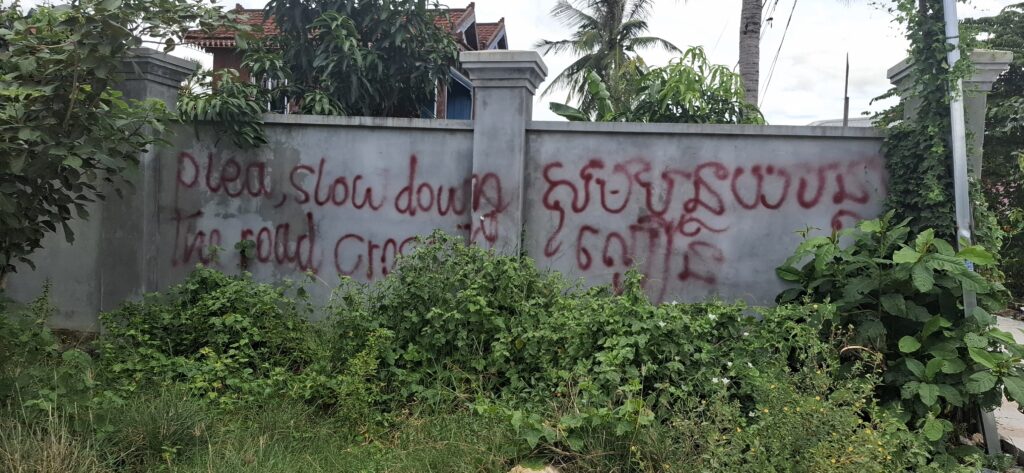
Around a nearby Takeo pagoda, residents started posting signs in Khmer and English asking drivers to slow down. A traveling sugar cane seller named Long Mao said that luxury vans used to speed along what was otherwise a typical provincial neighborhood road to Mango 2, which Mao described as a casino. That traffic stopped after police raided the property, he said.
Mao said he witnessed the raid in person and in videos shared online. He said he didn’t get too close because there were six police officers blocking off the road, and more at the compound.
“I was afraid to go there, I could be arrested too.”
Mao said from the videos he had seen, people were desperate to escape.
“Some people ran barefoot,” he said. “They even left behind their phones … [so] security guards collected the phones and sold them.”
Mao heard from Cambodian security guards who used to work there that police got “30-40 percent” of the people who were staying there, but a majority ran away, despite the remote location in a farming community, away from the national roads. He added that most of the Cambodian security guards went to their home provinces because they no longer had any work.
The Lumpong commune chief, Chhe Soy, said this week that he wasn’t informed by national authorities about the July raid. Even days after the mass escape, he said he wasn’t allowed to inspect further. Instead, some provincial forces were left at the Mango 2 compound to guard the block of buildings.
“We, the [local] authority, could only watch from the road and cannot go inside,” he said.
The area, which is also called Taizi compound, was still abandoned when a reporter for the Korean news outlet Hankook Ilbo visited in October. The news outlet found belongings left inside dorm rooms inside the complex, suggesting the people working and living inside escaped in a hurry.
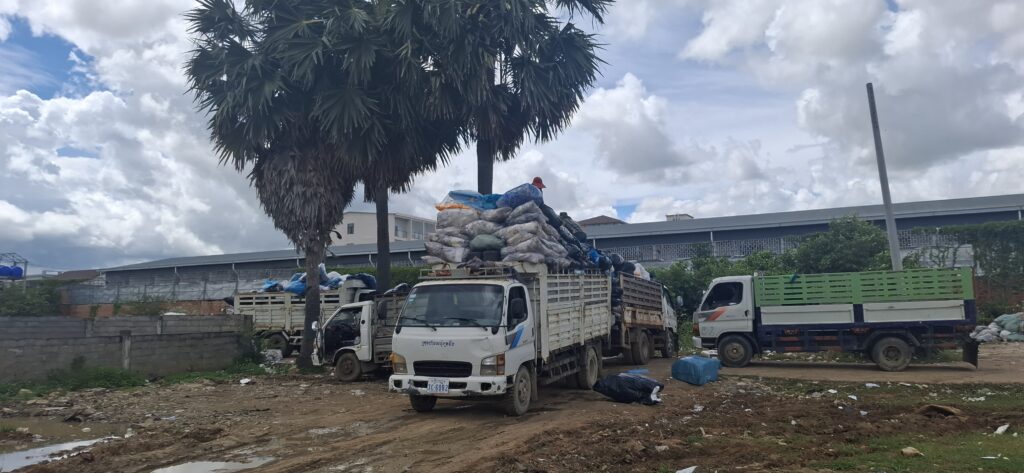
Authorities raided another compound on July 16 on Cambodia’s National Road 41. The building didn’t have a distinct name, according to residents and the scam analysis organization Cyberscam Monitor, but an image on Google Streetview from 2023 showed a sign saying BPA Asia.
Kampong Speu authorities announced on the night of July 16 that they raided an online scam site inside a former cigarette factory with nine buildings in Kong Pisey district’s Roka Koh commune. They added that they arrested 63 foreigners, the majority Chinese, and confiscated computers, phones, and other devices used in online fraud.
A coffee and tea seller near the compound said she saw people pour onto National Road 41 in large groups starting from 4 p.m., hurrying before police arrived about an hour later.
She witnessed one foreign man fall and hit his face on the ground in the rush. “Some ran through the rice fields in order to escape,” she said. “They were scared and we heard that police had arrested more than 60 people and sent them [away].”
“Some people later picked up iPhones [the workers] dropped,” she said in August. “I do not know anything, I just learned that it was an online site that had been raided.”
During the raid, officials posted a court document on the wall of the compound near the door, which reporters saw on August 13. The document, signed by Kampong Speu’s deputy provincial prosecutor, said it was forcing the complex, which it named as Soriya Guesthouse, to shut down temporarily during an investigation for online scams, and calling owners in for a court questioning on July 31.
A trash collector who piled refuse on the bed of an overfilled truck said in August that he believed business was still running. He said his private trash-collecting firm showed up at the compound everyday, sometimes needing multiple trucks each day to haul trash from the compound. One truck carries 10 tons of trash, he added.
Ros Keom, the commune chief for Roka Koh, said this week that the building’s doors remained closed since the mass escape in July.
Similar to the coffee vendor, he recalled seeing phones left behind by workers as they tried to flee: “On that evening, they scattered everywhere … and all the while a long line of cars waited along the road to pick them up.”
Before becoming an alleged scam compound, Keom said the building was a cigarette manufacturer, but now the framing as a “guesthouse” was just to disguise its business as an online scam center.
The building remained quiet after authorities checked, he said. “We do not see people and [we] see its doors have been closed, both the small and big gates.”
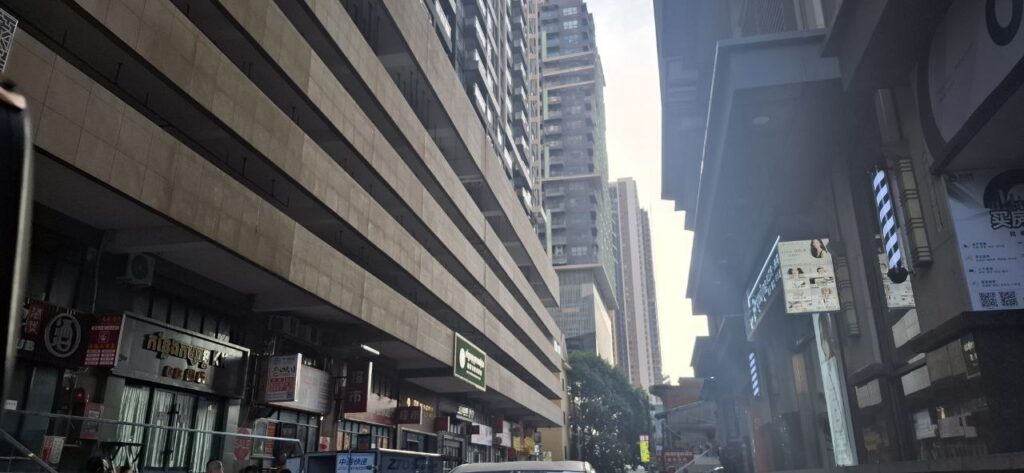
Months later, a joint force of national police and other authorities raided a building complex on Norodom Boulevard in Phnom Penh’s Tonle Bassac neighborhood on the morning of November 14. Officials reported seizing 168 desktop computers, six computer towers, 35 monitors, and a total of 600 phones, adding that they would look for operational leaders of the scam.
A 45-year-old tuk-tuk driver named Sea, said he saw dozens of police and military police walking between two sky scrapers: The Prince Modern Plaza and Yuetai Business Center.
“They inspected [the buildings] room by room; one day they inspected this building, another day they inspected that building because there are many rooms,” he said.
He added that the residents in Prince’s complex, who lived among the buildings behind the Yuetai storefront, had thinned out in the last seven months. But he estimated it was in relation to the conflict with Thailand in July, rather than acting ahead of authorities’ November raid.
“Now we are starving because there have been no clients,” he said. “Each day we get one client but before we could earn 50,000 to 60,000 riel [US$12.5-$15 per day]. It is very bad and a hard situation for everyone.”
Chinese and Indonesian restaurants used to run for 24 hours to serve the many people in the compound, but Sea now said the residents have disappeared, so no one can pay rent anymore.
“Some shops shut down because there are no people coming to eat, so the boss does not have money to pay their staff. … Cambodian people have jobs [here] but now it is over,” he said, referring to the boom in business in this complex. “Everyone is starving.”
This article was updated at January 13, 5 p.m. with photos from the Prince Group headquarters in Phnom Penh. It was updated again at 5:30 p.m. with information about the suspension of real estate sales and liquidation proceedings.
This article is published as Creative Commons.