
Chen Zhi — the notorious chair of the conglomerate Prince Group, a naturalized Cambodian citizen and tycoon — has been arrested in Cambodia and deported to China.
The National Bank of Cambodia also announced the liquidation of the group’s Prince Bank.
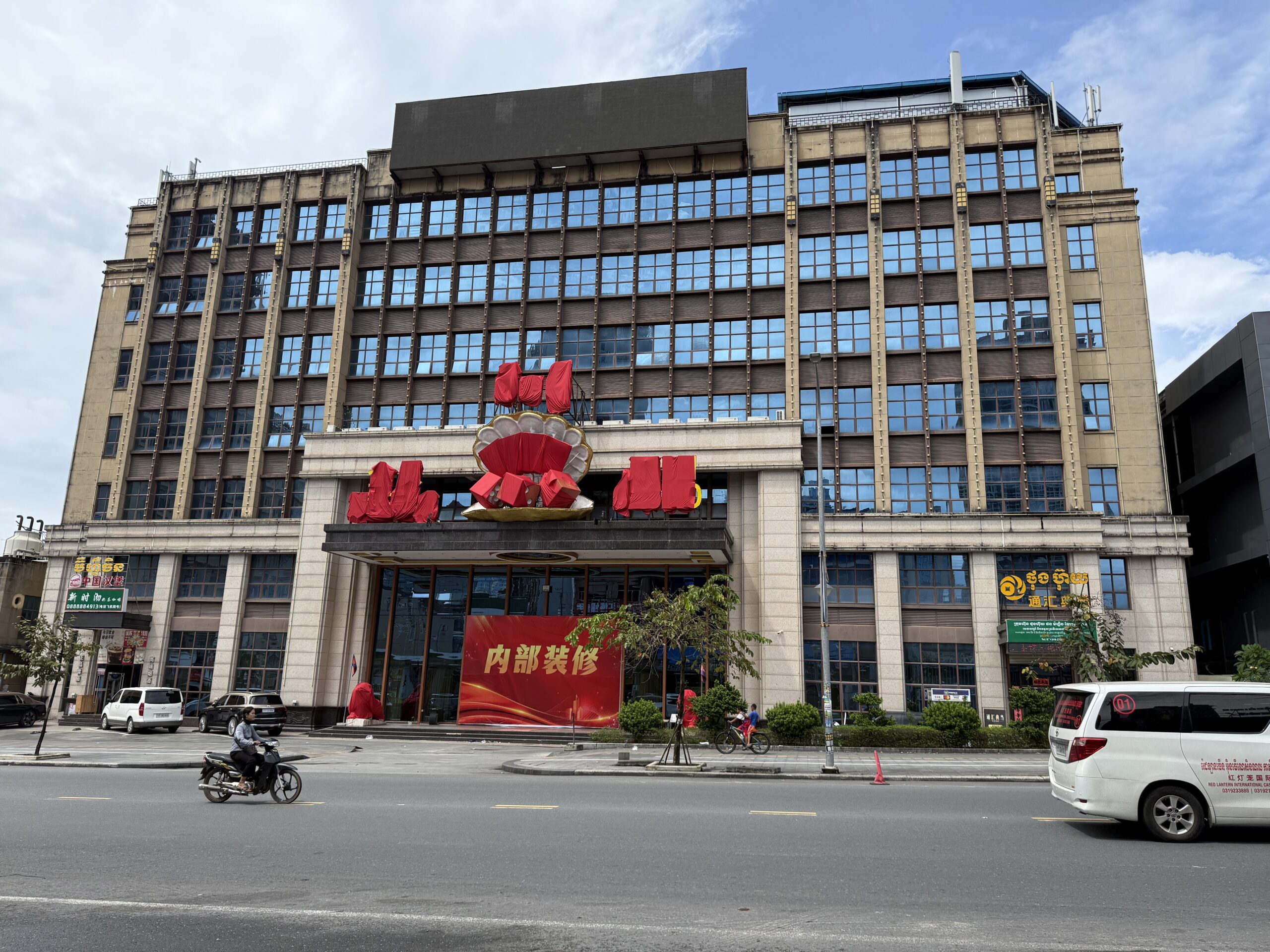
The actions came amid sharpened U.S. pressure and related measures taken across Asia in recent months. Prince offices in Phnom Penh were quiet on Thursday, while in Sihanoukville, where the conglomerate has been linked to at least six casino and scam compounds, local-level officials said they had “no right” to know what happened in the buildings.
Cambodia’s Interior Ministry announced Wednesday night that it had worked with Chinese authorities to arrest and deport Chen Zhi on January 6. The ministry also said two additional people, Xu Ji Liang and Shao Ji Hui, were deported, but Mekong Independent could not verify details about these individuals.
Earlier in the day, the ministry met to discuss their progress on scam crackdowns nationwide as well as in Phnom Penh’s 14 districts, according to its Facebook page.
The network around Chen Zhi came under fire in October, when the U.S. and U.K. announced joint sanctions against the businessman, 17 associates and more than 120 connected companies in the British Virgin Islands, Cayman Islands, Cambodia, Hong Kong, Palau, Singapore and Taiwan. The U.S. simultaneously indicted Chen Zhi and froze $15 billion worth of crypto assets — although the Chinese government later labeled that confiscation, which appeared to occur in 2020, as a state-backed hack.
Taiwanese prosecutors detained 25 suspects in alleged connection with the Prince Group in November, and seized assets totaling about $145 million U.S. (NT$4.5 billion). Their haul included 11 luxury properties, 48 parking spaces, 60 bank accounts, and various luxury vehicles including Rolls-Royce, Ferrari and Lamborghini models. Singapore arrested one of its citizens in December who reportedly drove Chen’s superyacht, the Nonni II, and operated a Prince-linked freezone warehouse, where businesses can store alcohol and tobacco products without paying taxes. Singaporean police have also seized more than $110 million (SG$150 million) of assets since the October sanctions, including 15 bank accounts.
Two days before Chen’s arrest, Hong Kong authorities froze about $350 million (HK$2.75 billion) in cash, stocks and funds that were allegedly connected to the scam and money laundering network. Various business people resigned from two Hong Kong-listed firms that were named on the sanctions list throughout October and November.
In Cambodia, the Commerce Ministry’s commercial gambling authority in November revoked the gambling licenses of Jin Bei casinos in Sihanoukville and the Golden Fortune complex in Kandal province’s Sampov Poun city. The Interior Ministry further revoked Chen Zhi’s citizenship in December, according to the ministry’s January 7 press release. He also had the honorary tycoon’s title of neak oknha and a role as adviser to Prime Minister Hun Manet and his father Hun Sen.
The National Bank of Cambodia announced on Thursday that it would liquidate Prince Bank, a licensed financial institution with 36 branches across 22 of Cambodia’s 25 provinces.
Prince Bank appeared to have hidden or deleted its Facebook page as of Thursday, which had more than 1.2 million followers according to Google search indexing. After the sanctions were announced in October, the bank claimed in a statement to shareholders that it followed NBC requirements and its bank statements were independently audited and compliant with anti-money laundering procedures.
A security guard outside the Phnom Penh Tower on Monivong Boulevard, home of the Prince Bank headquarters and former office of the Prince-owned airline Cambodia Airways, said that only about four or five people had arrived by mid-afternoon to withdraw funds. An armored cash-transport truck was on site as reporters visited. Prince Bank staff told reporters that they could not talk to the press.
At Prince Group’s headquarters on Koh Pich, a front desk staff member told reporters that many of the staff had quit.
At the same time as the crackdown, the Interior Ministry released a sub-decree that would put new onus on landlords to monitor foreigners who reside in their premises for suspicious activities. The new decree, effective from January 5, requires landlords who host a foreign resident to report their presence within 24 hours of arrival, and to maintain both CCTV and registration booklets. It would also put a fine of up to about $1,000 (4 million riels) on any property owner who intentionally tries to conceal a foreigner who is residing illegally in Cambodia.
Foreigners who claim they are illegally trafficked into Cambodia and detained for alleged scam work are often reported as overstaying or violating immigration laws, according to anti-trafficking experts. However, this sub-decree could additionally place punishment on property owners deemed negligent or involved in such cases.
Casinos in limbo
Local authorities near Sihanoukville’s multiple “Jin Bei”-branded casinos on Thursday deferred when asked about their current state, with some noting that they cannot enter or know little about the compounds’ operations.
The fraud information organization Cyberscam Monitor lists six different casinos in the coastal city Sihanoukville under the “Jin Bei” brand, all in the city’s Buon commune. Jin Bei casinos had been owned by different Cambodia-listed companies — Cambodia Heng Xin Real Estate Co. Ltd., G.C. Media Co. Ltd., Jin Bei Group Co. Ltd. — according to the casino regulator’s data.
Puth Savann, chief of Muoy village in Buon commune, said that he didn’t know anything about Jin Bei Artisan — which is referred to as Jin Bei 3 in the Cyberscam Monitor database, but sometimes called Jin Bei 2 by residents including Savann.
“I am not the manager of the hotel and security, so you have to go ask them.”
Sam Prak, Buon commune police chief, told Mekong Independent he had not gone inside Jin Bei 4 to check its operations. “The building has people who stay inside but I do not know what they do in there.”
Heng Bunly, chief of Buon commune’s Buon village, said that a Chinese company owned the land where Jin Bei 4 stands, but he didn’t have many details about the compound and wasn’t allowed access.
“Even when the land already has the land title or certification that has been sold, we do not know [when it happens] because they do not allow us to know. Only the commune [authorities] know about it,” he said.
“When it’s online [business] or a casino building, we have no right to go close to them, frankly speaking,” Bunly added.
Ouk Phanarath, police chief for Bei commune, and Baek Sarin, a Buon commune council member, both declined to give comment.
Cambodian officials instigated a crackdown on improperly-operating casinos, including properties linked to the Prince Group, since the U.S. sanctioned businesses in October, but by November it was unclear whether they had fully shuttered.
A security guard standing in front of Jin Bei 2, also known as Jin Bei Palace Hotel, told Mekong Independent on November 8 that the company was still operating, but it had changed its name to Kuoy Chou.
When a reporter visited this property, they observed that a logo above the door had the new name, but the old logo and the partial “Jin Bei” name was still visible at the building’s skyline view.
“The cars’ logos have been removed and it changed its name … [but] the [company] uniform has not changed yet,” he said.
He said he was earning $360 per month, but he believed members of the military who already have a gun could earn much more working security there — up to $1,000 a month with benefits.
“The army’s bodyguard unit has earned a lot of money, and they can work there through their connections,” he said.
A tuk-tuk driver waiting at a stoplight near the Jin Bei Artisan property in November said that the public casino had shut down and a lot of people left, but there appeared to be some still inside. He said there was a public facing casino and a private building behind it where online scam and casino workers operated. He said he wasn’t sure if this property was still operating online businesses.
“They do not dare to make advertisements to recruit people because they operate online and they can only work in a secret way,” he said. “[Workers] need to have a network to get those jobs.”
Before the November crackdown, the driver estimated that there were thousands of workers in the building — he saw a lot of Cambodians, Indonesians and Indians working there. People also tried to escape, he said, but the compound often tried to suppress news about escapes when they could.
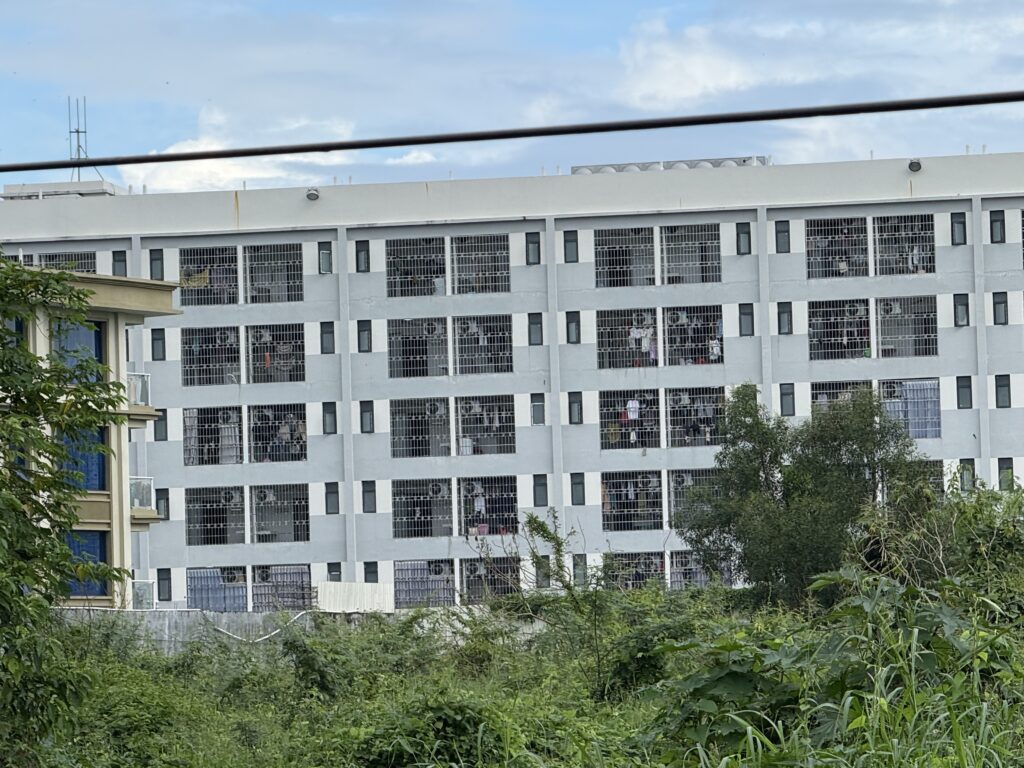
“They jump because [the fence] is a little low, at about 5 to 6 meters high,” he said. “There is barbed wire. … I see one worker was captured while another was carried away. They keep [the escapes] secret and some people go missing.”
Complaints about different Jin Bei properties date back to at least 2022, when the now-defunct VOD English reported that a Cambodian woman allegedly pleaded for help to escape forced labor. Authorities also investigated Jin Bei 3 in 2023 after a Chinese national asked for help on then-Interior Minister Sar Kheng’s Facebook page.
A woman who lived near Jin Bei 4, an expansive property in Sihanoukville’s Buon commune, said that there had been a number of mysterious deaths in the area. She said that the management installed corrugated plastic sheeting along the sides of the property, but before then, people would regularly fall from high floors. She recalled one night around March, when two people fell out of the Jin Bei 4 property in one night.
“While I was sitting working on [collecting] plastic, I heard a thud and glanced in that direction, around 8 or 9 p.m., and the first Chinese person fell,” she said. “The second Chinese person fell at 11 p.m. or 12 a.m.”
“I do not know” what happened to them, she added. “They were taken inside. … They could not stand up.”
This article is published as Creative Commons.